Should I Cut Back My Roses in Midsummer?
The short answer: mostly deadhead, don't hard-prune. What to actually do with hybrid teas, climbers and once-flowering roses in midsummer, the correct technique, and the mistake that costs you your next flush of blooms.
Why the confusion
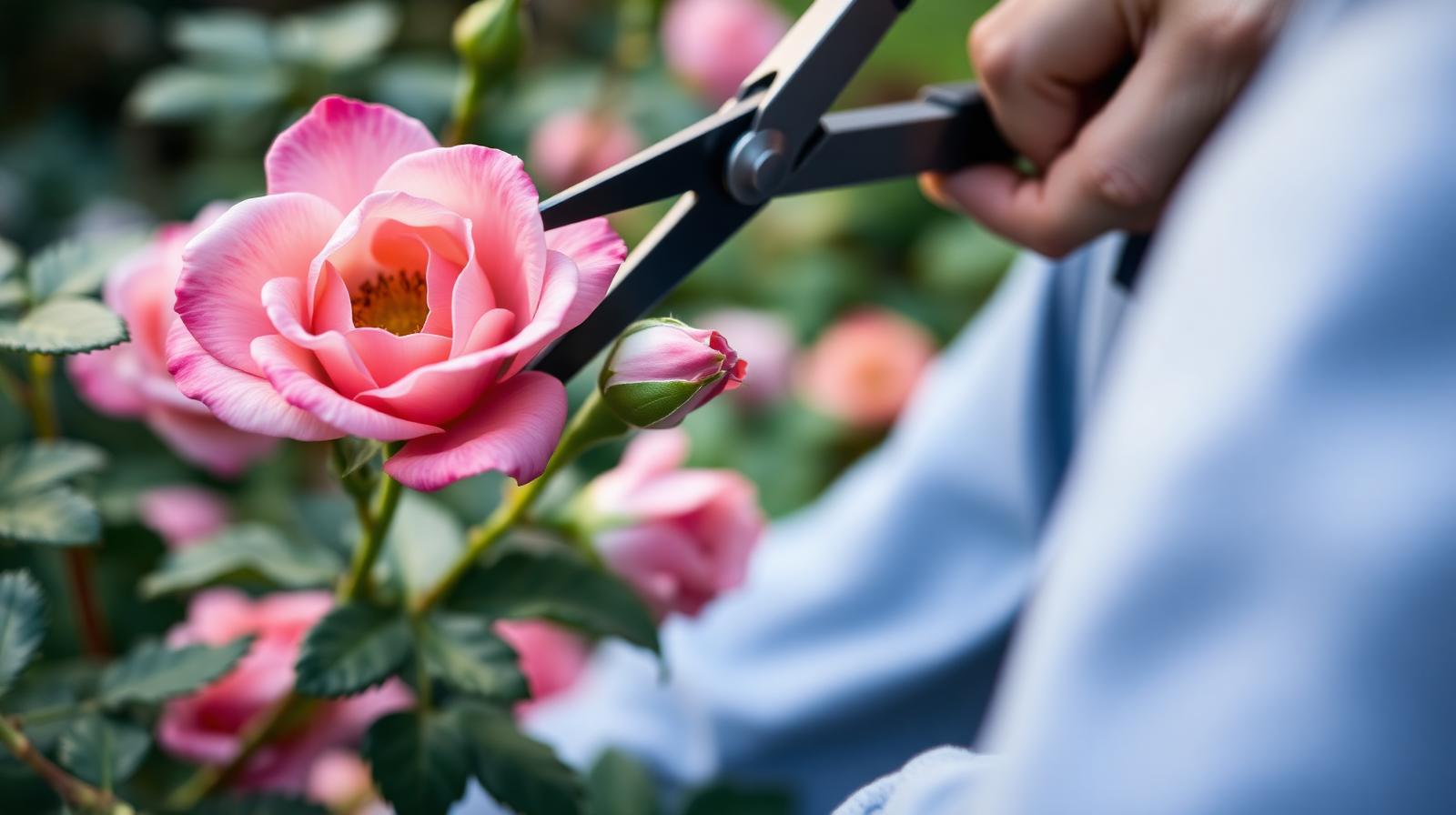
"Pruning" and "deadheading" get used interchangeably, and that's where most of the worry comes from. They're not the same job. Deadheading — snipping off faded flowers — is a light, ongoing summer task that most repeat-flowering roses want throughout the season. Proper pruning — cutting stems back hard to reshape the plant — is a different job entirely, and midsummer is generally the wrong time for it.
So if you're standing in front of a rose covered in spent blooms wondering whether to reach for the secateurs: yes, but gently, and mostly just the dead flowers. What "gently" means depends a little on which type of rose you're actually growing.
What to do, by rose type
Most repeat-flowering roses — hybrid teas, floribundas, modern shrub roses — get the same treatment: deadhead through summer, no structural cuts until winter. Deadhead a hybrid tea flower by flower. On a floribunda, which flowers in clusters, wait until most blooms in a truss have faded and remove the whole spent cluster at once, rather than picking off individual flowers — it encourages the next cluster to form together rather than staggering awkwardly.
Climbing roses are trained onto a permanent framework of main canes that you barely touch in summer. The midsummer job is trimming the shorter flowered side-shoots coming off that framework back to two or three buds once they've finished flowering — leave the main canes alone, since they've taken years to establish and do the structural work. Ramblers are usually once-flowering, with one big early-to-midsummer show, and most varieties are pruned once that flowering is properly over, which for many falls later in summer rather than in the middle of it — worth checking your specific variety rather than assuming.
Once-flowering shrub roses and old garden roses are the genuine exception to "just deadhead": they flower on the previous year's growth, so the right moment to prune them is right after their single flush finishes, typically mid to late June. Even then, keep it light — shape rather than cut hard.
If you're not sure what you've got, the flowering pattern is the fastest clue. One big flush and done for the year means once-flowering. Flowers arriving in repeated waves through summer means repeat-flowering, and that's the group that wants ongoing deadheading rather than a single prune.
The correct deadheading technique
Technique matters more than people think — a sloppy cut heals poorly and can let disease in.
Use clean, sharp bypass secateurs, and wipe the blades between plants if any of them have shown disease, so you don't spread it. Follow the stem of the faded flower down to the first proper leaf with five leaflets on strong growth (or a leaf with three leaflets lower down, on a weaker stem). Find the growth bud sitting just above that leaf — it should be facing outward, away from the centre of the plant. Make a clean cut about 5mm above the bud, angled downward and away from it, so rain runs off rather than pooling on the cut.
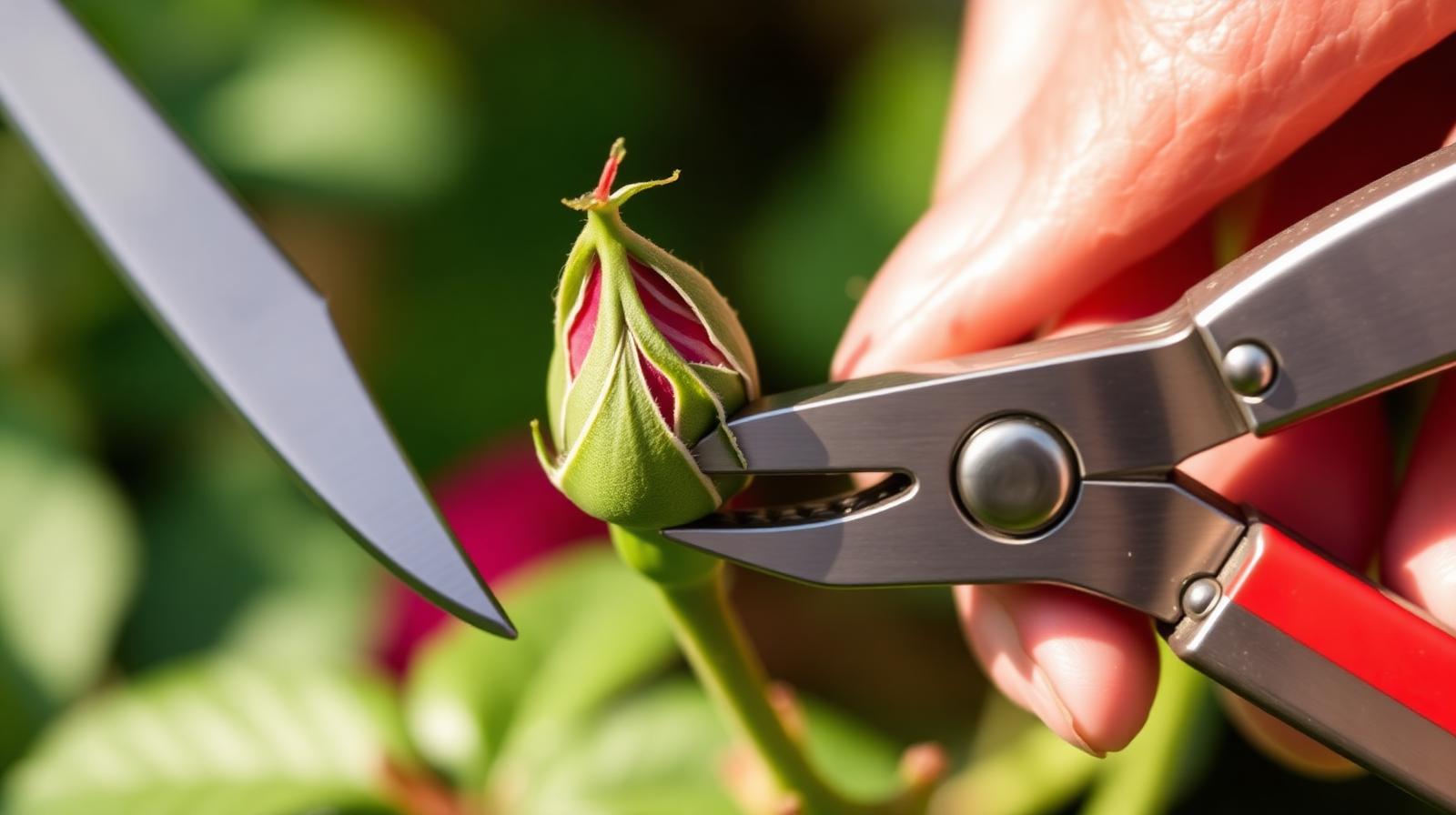
Cutting to an outward-facing bud keeps the centre of the bush open, which improves airflow and cuts disease risk — a genuinely useful side effect of doing this properly rather than hacking off dead heads at random heights. Go easy on how much you take, too. Each cut removes some of the leaf area the plant uses to make food, so on a smaller or weaker rose, removing just the flower and its immediate stem is usually enough.
Why hard pruning now is a bad idea
Heavy structural pruning — cutting stems back hard to reshape the bush — puts real stress on a plant, and in summer that stress lands on top of heat stress that's already there. A rose pushed to put out vigorous new growth in the middle of a hot spell is more vulnerable, not less. That kind of proper cutback is a job for late winter or early spring, when the plant is dormant and can shrug off the disruption.
There's a cost to getting either end of this wrong. Hard-prune now and you stress the plant; skip deadheading and it stalls on producing new buds. So if you're eyeing an overgrown or lopsided rose and thinking "I'll sort it out now" — don't. Note it, and come back to it in the dormant season.
Disease and damage: the anytime exception
Health-driven cuts are the other exception to "leave it alone in summer" — remove problems as you see them, whatever the calendar says. Snip off any dead, damaged or diseased canes as soon as you spot them, and lightly trim any crossed stems that are rubbing together, since the wound they create is an infection point.
The three problems worth knowing on sight: black spot shows as black or purple-black patches on leaves with yellowing around them; powdery mildew is a white-grey powdery coating on leaves and buds; rust shows as orange-brown pustules on the underside of leaves. For a few affected leaves, just pick them off. If whole stems are smothered rather than a handful of leaves, cut back further than routine deadheading, taking the growth back into clean wood, and clear the debris away afterwards rather than leaving it under the plant — fallen leaves and trimmings are exactly where fungal spores overwinter and reinfect next year's growth.
Feed after you cut
Any pruning, even light deadheading done regularly, asks the plant to put energy into new growth — so it's worth feeding at the same time. A proper rose feed worked into the soil around the base, or a watering can of tomato feed, replaces what the plant used up producing its first flush and supports the next one. Water the feed in well, especially in dry weather, so it actually reaches the roots rather than sitting on the surface.
Roses in containers
Container-grown roses need slightly more attention through summer than those in open ground, for the same reason any container plant does: a limited volume of compost holds a limited store of water and nutrients. Deadhead just as regularly as you would in a border — the technique doesn't change. Feed more often, every two to three weeks through summer, since nutrients wash through and get used up faster in a pot than in open soil. And watch the watering closely, especially in a heatwave; a rose in a pot can dry out and wilt within a single hot day. See the guide on watering plants in a heatwave if you're dealing with one right now.
Don't hard-prune a container rose in summer for exactly the same reasons as one in the ground — arguably the stress risk is even higher, since a potted plant has less root reserve to draw on if you push it.
The mistakes worth avoiding
A flat cut straight across the stem, rather than an angled one above a bud, heals poorly and can let in disease. Cutting too far above the bud leaves a stub that dies back and can spread rot toward the healthy wood below. Hard-pruning an overgrown rose "while you're out there" is the single most common midsummer mistake, and the one this whole piece exists to head off. Forgetting to feed after a heavy flowering flush leaves the plant pushing new growth on empty reserves. And treating a once-flowering rose like a repeat bloomer — either hard-pruning it at the wrong time, or never pruning it at all — is an easy trap if you're not sure which type you've got.
FAQ
Is it okay to prune roses in July?
Light deadheading, yes — that's exactly what July is for on a repeat-flowering rose. Hard structural pruning, no — save that for late winter or early spring, unless you're dealing with disease or damage that needs removing straight away.
What happens if I don't deadhead my roses?
The plant will generally slow down on producing new flowers, since old, fading blooms signal that flowering is "done" for now. You'll still get some further flowering on most repeat varieties, but noticeably less than with regular deadheading.
Can I cut back an overgrown rose in summer?
It's better not to. A proper reshaping cutback stresses the plant, and that on top of summer heat is a poor combination. Note where it needs work and do the real pruning in the dormant season instead — deadhead and remove dead or diseased wood in the meantime.
How do I know if my rose flowers once or repeatedly?
Watch the pattern: a single big flush and nothing more for the year means it's once-flowering. Flowers arriving in waves through summer, with gaps between, means it's a repeat-flowering type — and that's the one that wants ongoing deadheading rather than a single after-flowering prune.
Do climbing roses get pruned the same way as bush roses in summer?
No. Leave the main framework canes alone and just trim the shorter flowered side-shoots back to two or three buds after each flush. The permanent structure takes years to build, so it isn't touched in a routine summer tidy.
Should I feed my roses after deadheading?
Yes. Producing flowers and pushing new growth uses up the plant's stored nutrients, so a rose feed or a tomato feed worked in after deadheading helps it recover and supports the next round of blooms.
Is it too late to prune roses if I missed the winter window?
For repeat-flowering roses, no — just deadhead through summer as normal and do the proper structural prune this coming winter. For once-flowering types, the after-flowering window has usually passed by high summer, so it's best to wait for the same point next year rather than pruning out of season.
RELATED POSTS
Robin is a small-space grower writing for everyone working with a courtyard, balcony, window box, patio or sunny sill. Edible and leafy, both kept alive in the kind of light real small spaces actually get.
✦ Free with the newsletter — the small-space starter sheet
Grow Anywhere — a free weekly email.
The Potted Club newsletter. A short note from Robin — what to sow, one plant problem solved, and the best new guide.
FREE WEEKLY EMAIL · NO SPAM · UNSUBSCRIBE ANYTIME