Yarrow Is a Brilliant Garden Plant. So Why Is It Taking Over Your Lawn?
Yarrow stays green through drought, flowers for wildlife and is deliberately grown in meadows. In a fine lawn, it can spread relentlessly. Here's how to decide whether to keep it or remove it.
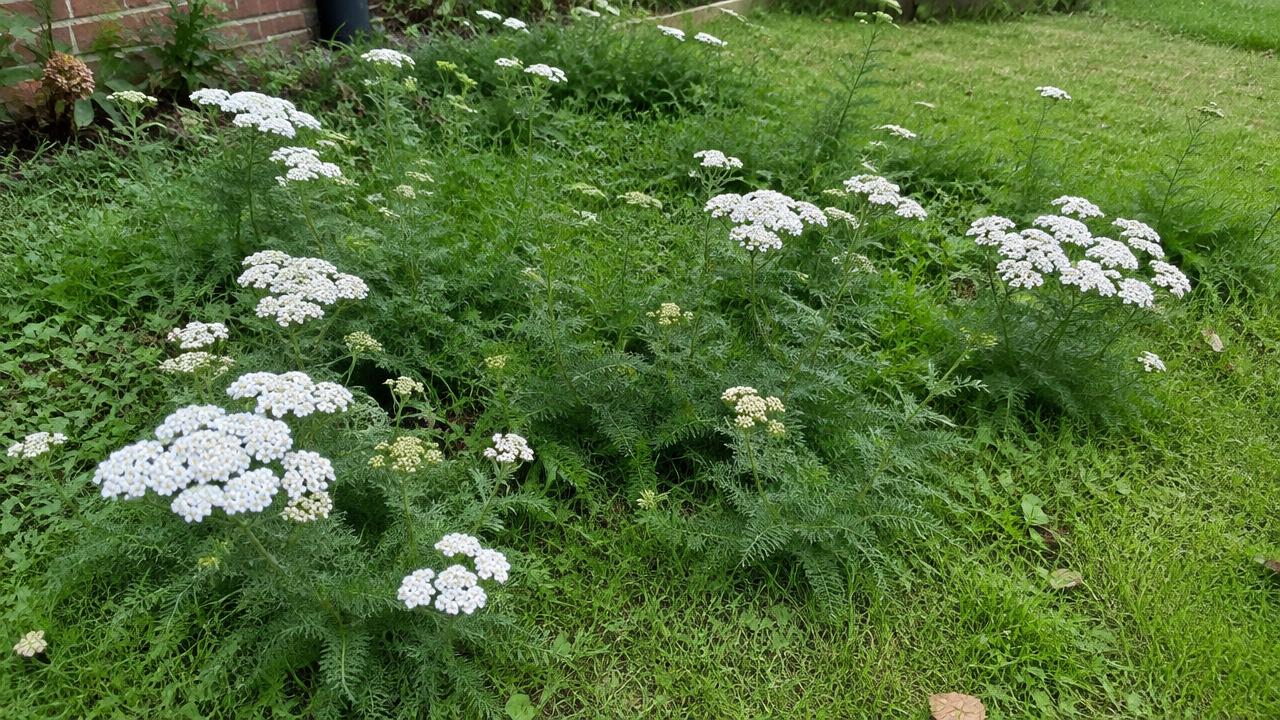
It survives mowing, stays green when grass turns brown and spreads underground where you can't see it. Yarrow is also a British native that supports an extraordinary range of insects. Before you try to get rid of it, decide which version of a lawn you actually want.
You may have noticed it this summer
At first it doesn't look particularly threatening. A few soft, feathery leaves appear among the grass, sitting low enough that the mower passes over them. Then another patch appears a little further across the lawn. Leave it long enough and stems rise above the grass carrying flat heads of tiny white flowers.
That's common yarrow, Achillea millefolium. And after a summer like this one, it can look remarkably pleased with itself.
While conventional lawn grasses have spent prolonged dry periods slowing down, turning brown or becoming sparse, yarrow is built for considerably tougher conditions. The RHS describes yarrow as a native wildflower found among short grass on banks, verges and wasteland, especially on dry, gravelly and chalky soils. It can remain green through the hottest part of summer when much of the surrounding lawn doesn't.
That creates a slightly perverse gardening problem. The characteristic that makes yarrow increasingly interesting as a drought-resilient garden plant is exactly the characteristic that can make it infuriating in a conventional lawn.
First, make sure it is yarrow
The leaves are the giveaway. Common yarrow has narrow leaves divided repeatedly into tiny segments, producing a soft, almost fern-like appearance. One of its old common names, milfoil, effectively means thousand-leaf, which gives you a good idea of the effect.
When it flowers, usually from summer onwards, taller stems carry broad, flattened clusters made from many tiny flowerheads. Wild yarrow is commonly white, sometimes with a pinkish cast. Crush the foliage and it is aromatic.
In a lawn, however, you may rarely see those flowers. Regular mowing removes the upright flowering stems while leaving the low foliage underneath, which can result in extensive mats of yarrow hiding almost unnoticed among the grass until you look closely. And once you recognise those leaves, you may discover there's considerably more of it than you thought.
Why does it spread so well through a lawn?
The important part isn't above ground. It's underneath.
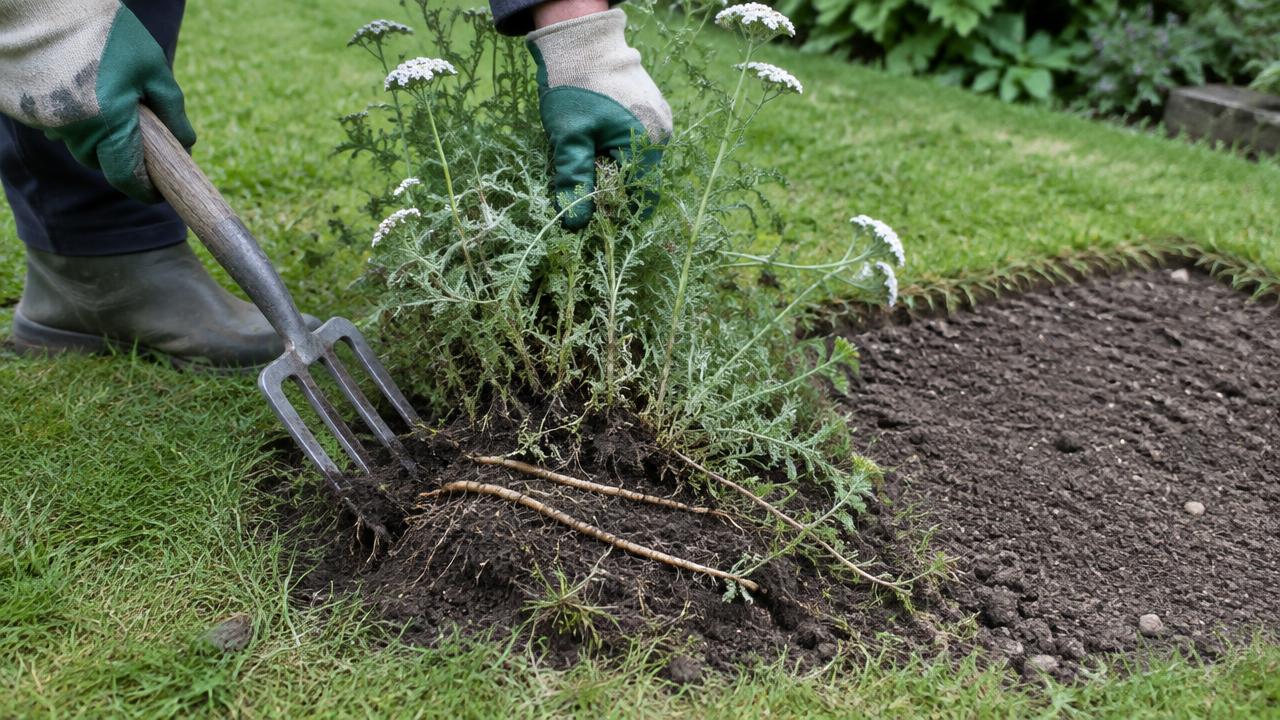
Yarrow is a perennial and, in lawns, spreads predominantly through creeping rhizomes: underground stems that travel sideways and produce new shoots as they go. What appears to be a collection of separate little yarrow plants can therefore be parts of an interconnected spreading patch.
This is why simply pulling off the foliage is so ineffective. The plant you can see isn't the whole plant. Leave sections of viable rhizome behind and new shoots can emerge, and an established patch can gradually move into adjacent turf even if you never allow it to flower.
Yarrow can also reproduce by seed if the flowers are allowed to mature, but in a regularly mown lawn the creeping rhizomes are the bigger problem. Or advantage, depending on your point of view.
Why mowing doesn't get rid of it
Lawns are difficult places for many plants. Anything that depends on keeping a tall growing point or large upright leaves is repeatedly decapitated. Yarrow has adapted rather well to that arrangement.
Its foliage can sit low within the turf, below a normal mowing height, so cutting the lawn removes taller growth and flowering stems but leaves enough green leaf for the plant to continue photosynthesising. The RHS describes yarrow as tolerant of both close mowing and foot traffic.
That means mowing alone isn't an eradication strategy. Regular mowing can still help suppress it: the RHS recommends raking patches first to lift the low foliage, then mowing, which removes more leaf and reduces the plant's ability to photosynthesise while also preventing flowering and seed production.
Strengthening the surrounding grass helps too, because yarrow competes less successfully with dense, vigorous turf. That doesn't mean reaching automatically for fertiliser. Feed only where the lawn genuinely needs it, and don't treat the presence of yarrow as evidence of a nutrient deficiency, since it thrives perfectly well in poor conditions regardless.
But if your aim is to remove an established patch completely, eventually you're going to have to deal with what's underground.
The drought has tilted things in its favour
This is where 2026 becomes relevant.
As covered in our guide to repairing a lawn after drought, established lawn grass is remarkably good at surviving drought. It can turn completely brown above ground while the roots and growing points remain alive, then begin producing fresh leaves when rain returns. But severe or prolonged drought can weaken already poor turf, and where grass becomes sparse, plants capable of tolerating dry conditions face less competition.
Yarrow is one of them, and it's well equipped for the job. It's a perennial adapted to dry, free-draining sites, with a tough, persistent root system that reaches moisture shallow-rooted lawn grasses can't, and foliage that copes with conditions which leave turf struggling. The RHS specifically identifies it as a plant that thrives where lawn grasses are weakened, and notes that yarrow foliage can help lawns remain green during dry weather.
So a lawn in which yarrow suddenly seems dominant hasn't necessarily been invaded this summer. The balance may simply have changed. The grass retreated. The yarrow didn't. Now autumn rain is bringing the lawn back to life, the contrast is obvious.
Is yarrow actually bad for your lawn?
No. This is where calling it a weed becomes unhelpful.
Common yarrow is native to Britain and Ireland, occurring naturally in short grass, banks, verges and other open habitats, particularly where conditions are relatively dry. It is also extremely valuable to wildlife: the RHS notes that it supports a variety of insects, including numerous beetles, flies, true bugs, butterflies and moths. Its flowers attract a broad range of insects, and unlike a lawn composed entirely of conventional grasses, it provides both nectar and habitat value.
Yarrow is consequently something gardeners deliberately buy. Achillea cultivars are grown in borders for their flattened summer flowerheads, common yarrow is recommended for wildflower meadows and flower-rich lawns, and its drought tolerance is increasingly useful rather than incidental.
So there is nothing horticulturally wrong with a lawn containing yarrow. The question is aesthetic.
Keep it if you want a tougher, more diverse lawn
If your priority is a green, resilient surface rather than a perfectly uniform grass sward, keeping some yarrow makes a great deal of sense. It tolerates drought, mowing and being walked on. Its foliage remains relatively compact in regularly cut turf, and if you allow some areas to grow longer, you get the flowers too.
Alongside clover, daisies and the other plants covered in our guide to autumn lawn weeds, it can become part of a more species-rich lawn that requires less intervention than immaculate turf.
You can also compromise. Keep the main lawn mown but leave an edge, strip or small island longer so the yarrow can flower, and mow paths through longer areas if you still need access. That turns what looked like a lawn weed into something you're deliberately managing.
But not everybody wants that lawn. And if you want clean grass, yarrow is one of the more persistent plants you're likely to meet.
If you want it gone, start while the patches are small
One isolated plant is much easier than a square metre of interconnected rhizomes.
For small plants, use a hand fork and loosen the soil around them rather than pulling at the leaves. You're trying to lift the underground structure with the plant. For an established patch, a spade or border fork is more realistic: work around and underneath the patch, lifting the turf and following the pale creeping rhizomes through the soil, removing as much of that network as you reasonably can.
Don't expect perfection on the first attempt. Small fragments can remain behind, so check the area for new shoots and remove them while they're small. The RHS specifically recommends this approach for unwanted yarrow and advises taking out as much of the root and rhizome system as possible.
Don't put the roots, rhizomes or seedheads on your home compost heap, where they may survive and spread; put that material in your council green-waste collection or take it to a recycling site instead. Ordinary foliage without roots or mature seedheads can be composted.
There's another detail worth knowing: the RHS advises wearing gloves when handling yarrow, because contact with the foliage can aggravate skin allergies in susceptible people.
Don't leave the hole empty
This is the part that matters just as much as removing the yarrow.
Once you've dug out an established patch, you've created exactly what lawn weeds like: bare ground. Our guide to starting and repairing a lawn covers preparing and reseeding damaged areas in detail. Leaving it exposed simply gives yarrow fragments, other weeds or newly germinating seedlings somewhere with very little competition.
In early autumn, repair the patch immediately. Lightly prepare the surface, sow an appropriate lawn seed and make sure the seed has good contact with the soil. Keep the newly sown area from drying out while it establishes, subject to any local water-use restrictions. For a larger patch, cutting the affected turf out completely and replacing it with new turf is another option.
Whichever method you choose, the objective isn't simply to remove yarrow. It's to replace it with dense grass.
What about weedkiller?
This is one weed where the chemical shortcut isn't especially attractive. The RHS says yarrow is resistant to many selective lawn weedkillers and recommends non-chemical control instead.
That's significant because a selective lawn herbicide has to achieve something rather specific: kill the broad-leaved plant while leaving the grass around it unharmed. Yarrow isn't particularly cooperative.
Repeated digging, removing regrowth and encouraging dense grass may sound slower than spraying, but for a small lawn it gives you much more control over what disappears and what remains.
And don't use a non-selective weedkiller on yarrow growing through grass. It will kill the grass with it.
Make the grass harder to invade
If you remove yarrow without changing the conditions that allowed it to spread, you may be doing the same job again. Yarrow competes less successfully with dense, healthy grass, which means basic turf management rather than a bag of fertiliser.
Avoid scalping the lawn, particularly during dry weather. Repair bare areas. Aerate genuinely compacted soil. Deal with significant thatch if it is interfering with healthy grass growth. Use a grass mixture appropriate to the light and conditions.
After drought damage, autumn overseeding is particularly useful because you're increasing grass density at exactly the point when space has opened up.
And if the lawn repeatedly struggles every dry summer while the yarrow sails through untouched, consider what the plants are telling you. Perhaps the answer isn't making the yarrow behave more like grass. Perhaps it's allowing the lawn to behave a little less like a golf course.
Yarrow somewhere else
There's one final option: remove it from the lawn and deliberately grow it somewhere you actually want it.
Common yarrow works in sunny, well-drained wildflower planting, gravel gardens and informal borders. Cultivated achilleas offer the same characteristic flat flowerheads in yellow, pink, red, apricot and other colours, and some are suitable for containers, particularly the more compact forms. They generally like sun and free-draining conditions and don't require rich soil. In fact, overly fertile conditions can produce taller, floppier growth.
So this is one of those peculiar gardening situations where the same genus can be an ornamental perennial in a £30 pot on one side of the path and something you're digging furiously out of the lawn on the other. Neither description is wrong.
The decision is yours
If you've found yarrow spreading across your lawn this autumn, you have three sensible options.
Keep it if you want a tougher, more diverse lawn and don't mind the appearance. Contain it by mowing the main lawn and allowing selected areas to flower. Or remove it by lifting the rhizomes, returning for regrowth and immediately repairing the resulting gaps with grass.
What doesn't work particularly well is pretending it isn't there while hoping the mower eventually wins. It probably won't. Yarrow is extremely good at being yarrow.
The only question is whether that's what you want your lawn to be good at too.
FAQ
How do I know if I have yarrow in my lawn?
Look for low patches of finely divided, feathery foliage. If allowed to flower, common yarrow produces taller stems topped by flat clusters of many tiny, usually white flowers from summer onwards.
Why is yarrow spreading through my lawn?
In lawns it spreads mainly through creeping underground rhizomes. It also tolerates drought, poor soil, close mowing and foot traffic, so it can perform particularly well where grass has become sparse or weak.
Will mowing kill yarrow?
Not usually. Its foliage can remain below mowing height. Regular mowing after raking the foliage upwards can suppress growth and prevent flowering and seed production, but established rhizomes can continue spreading.
Should I remove yarrow?
Only if you don't want it. Common yarrow is a native wildflower, valuable to insects and useful in drought-tolerant, species-rich lawns. It becomes a problem principally when the aim is a predominantly grass lawn.
How do I get yarrow out of a lawn?
Lift isolated plants with a hand fork and larger patches with a spade or border fork, removing as much of the creeping rhizome system as possible. Check for regrowth and reseed the resulting bare ground. Keep roots and rhizomes out of home compost.
Will lawn weedkiller kill yarrow?
Don't rely on it. The RHS says yarrow is resistant to many selective lawn weedkillers and recommends non-chemical control. Digging out patches, suppressing growth through appropriate mowing and maintaining dense grass are more useful approaches.
READ THE FULL GUIDE
Starting and Repairing a Lawn →
RELATED POSTS
Robin is a small-space grower writing for everyone working with a courtyard, balcony, window box, patio or sunny sill. Edible and leafy, both kept alive in the kind of light real small spaces actually get.
✦ Free with the newsletter — the small-space starter sheet
Grow Anywhere — a free weekly email.
The Potted Club newsletter. A short note from Robin — what to sow, one plant problem solved, and the best new guide.
FREE WEEKLY EMAIL · NO SPAM · UNSUBSCRIBE ANYTIME