The Leaves Are Falling. Don't Automatically Clear Them Away
Fallen leaves need clearing from some places and can stay in others. Here's where to rake, where to leave them, what to do in pots and how to make leaf mould in a bin bag.
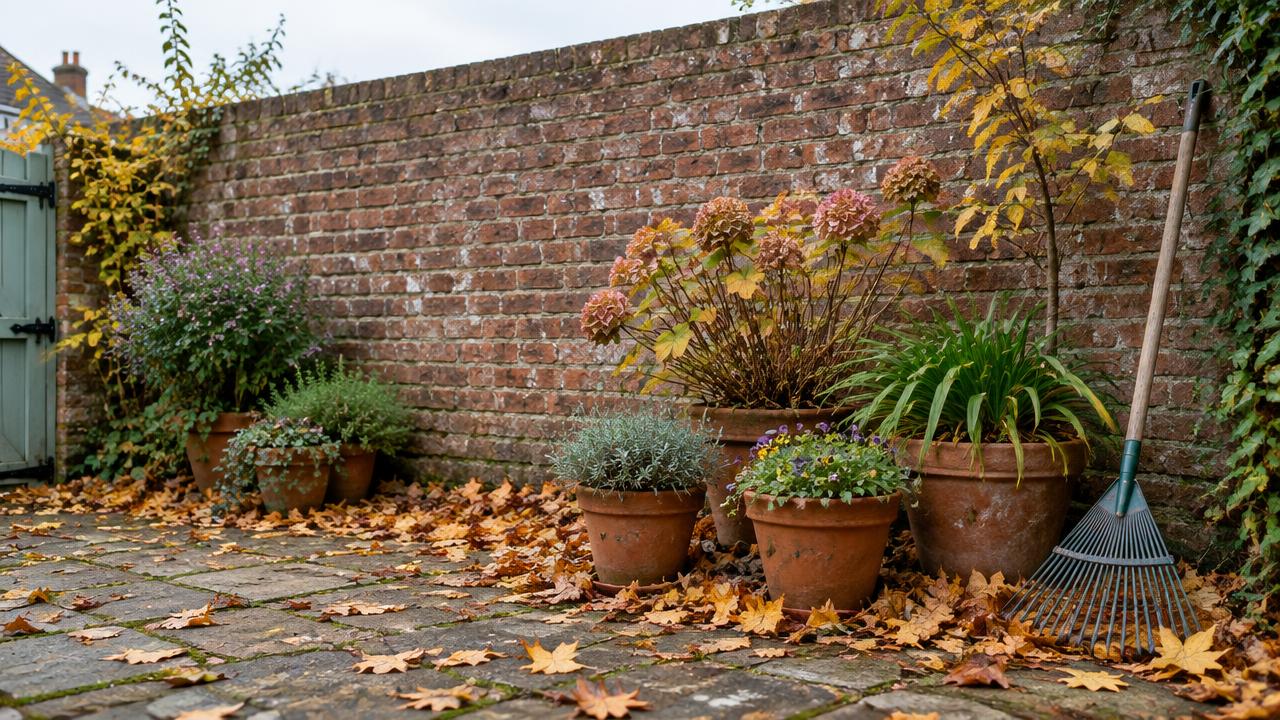
Fallen leaves are a problem in some parts of a garden and an asset in others, and the difference comes down to where they land. Clear them from the places they do harm, leave them where they do none, and bag the surplus, because even a balcony can turn a sack of leaves into something useful.
Where leaves need clearing
Lawns come first. The RHS advises removing fallen leaves from lawns so that they do not smother the grass and block out light and moisture. Raking is the straightforward option. If you mow them up instead, you get a head start on the next job as well: RHS leaf-mould guidance notes that shredding leaves speeds decomposition, while grass clippings add nitrogen that helps them rot.
Hard surfaces come next, and for a different reason. Wet leaves on paving, steps and decking are slippery, and in a small space the route to the back door or the bins usually runs straight across them. Sweep those areas regularly through the autumn instead of waiting for the trees to finish.
The other place to look is directly on top of plants. A few leaves caught between established shrubs are unlikely to matter, but a persistent wet layer sitting over low evergreen foliage or packed into a dense plant is different. Lift it away where it is smothering the foliage, and leave the rest alone.
Where they can stay
On borders, the RHS advice is unambiguous. Its October guidance for trees and shrubs says that leaves which have already fallen onto borders can be left, and that leaves collected from the lawn can be spread on borders and under plants to improve the soil and provide wildlife habitat. That is the national gardening charity telling you not to rake the beds.
It also settles the question of what bare-earth tidiness is for. Under shrubs, at the back of a border and beneath a hedge, fallen leaves cover the soil over winter and break down into it, and clearing them achieves nothing except neatness. If a corner of a small garden can be left to collect leaves, it is doing useful work.
Leaves and pots
The same reasoning works at pot scale, with a little more judgement. A loose scattering of leaves on the compost of a large container is harmless, and around a shrub or small tree with a clear stem it can simply stay.
It is worth distinguishing that loose layer from a thick mat. Andy Vernon, an RHS senior horticultural advisor, notes that wet whole leaves compact easily when they collect densely. Around a large woody plant that may be harmless enough, but over a small plant or tight against its crown it is better lifted away. If you have a surplus, turning it into leaf mould gives you a much more versatile material to bring back to the pots later.
Leaf mould in a bin bag
Leaf mould is what leaves become when fungi have slowly broken them down, and it asks for much less than a compost heap. Vernon describes it as needing only leaves and moisture, a cooler and damper place than compost, and no turning. That makes it an unusually good fit for a small space.
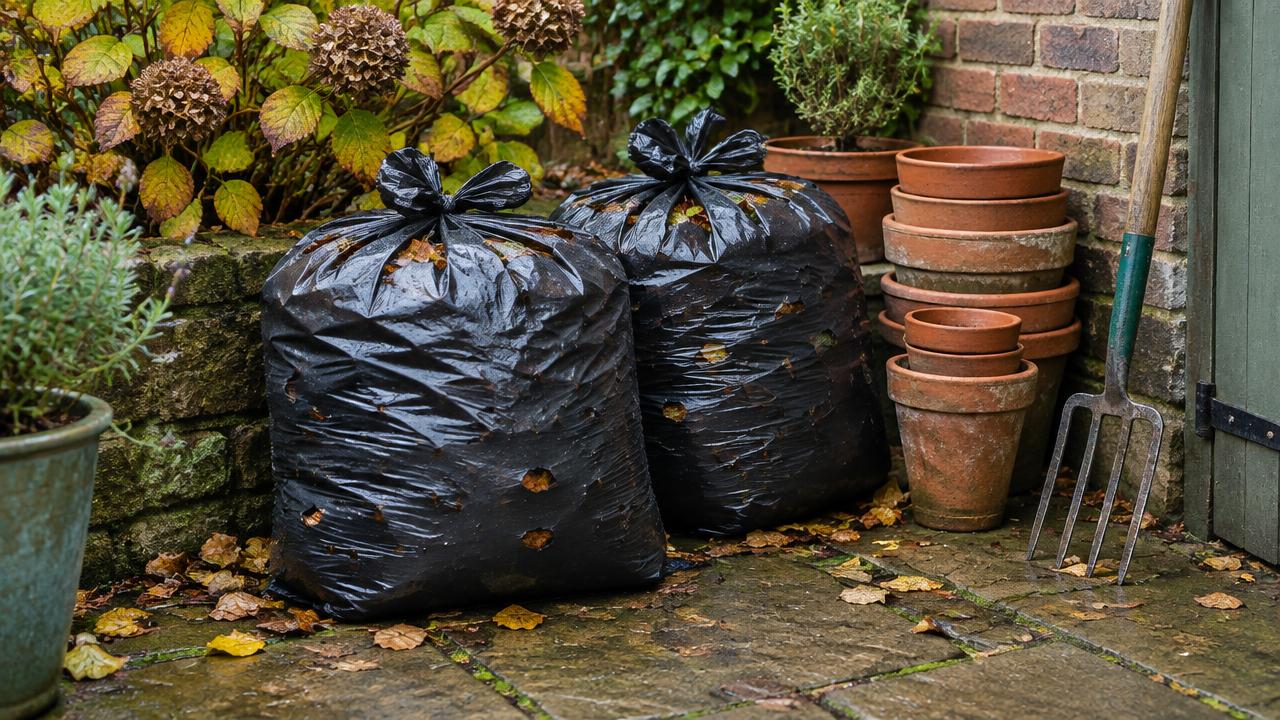
The RHS method needs nothing more than a bin liner. Fill it with leaves, moisten them if they are dry, pierce holes in the bag with a knife or garden fork and tie the top loosely. Then put it somewhere cool and out of the way where the leaves won't dry out completely. Vernon keeps his perforated bags in a shed or garage and reuses them each year, and a sheltered corner outside can work too, provided you check now and then that the contents are still damp.
The honest part is the timescale. Partly decomposed leaf mould can be useful after a year, while a finer, soil-like material generally takes two years or more. You do not have to wait for the finished article, though. Vernon opens his bags after a little over a year and uses the contents as a spring mulch, and he finds that shredded leaves often give a usable, fine-textured leaf mould within six to twelve months.
No tree? You can still make leaf mould
A courtyard or balcony may produce almost no leaves of its own, but that does not rule leaf mould out. The RHS suggests collecting fallen leaves from public places as well as from your own garden, which puts the nearest quiet pavement within reach of anyone with a bag.
It adds two sensible qualifications. Leaves gathered beside main roads may be affected by atmospheric pollution, so quieter streets and side roads are preferable. Street leaves can also be mixed with litter, so sort through what you have collected before it goes into the bag.
Which leaves are worth collecting
All leaves will rot eventually, but some do it far more readily than others. The RHS leaf mould guide names oak, beech and hornbeam as breaking down with little help and giving the best product, and Vernon adds birch, acers and hazel from his own experience. If you have a choice of what to gather, those are the ones to favour.
Thick leaves are slower. The same RHS guide lists sycamore, walnut, horse chestnut and sweet chestnut as needing to be shredded before they go in, and running a mower over them is the easy way to do that. Evergreens such as holly and cherry laurel are a different case again. The RHS says they are better shredded and added to a compost heap, where they break down faster than they would as leaf mould, so without a heap you should expect them to be slow.
Pine needles are the exception worth knowing about. The RHS suggests keeping them in a separate bag, because they produce an acidic leaf mould that suits ericaceous plants such as rhododendrons, azaleas, blueberries, camellias and pieris. If you grow any of those in pots, a small bag of needles is worth the trouble.
Which leaves to keep out
Diseased leaves need sorting, and the RHS draws a useful line between them. Its October guidance says to rake up any leaves affected by rose black spot, quince leaf blight or apple and pear scab, to reduce the chance of the disease returning next year. In the same breath it says that leaves affected by powdery mildews and rusts can be composted.
For the first group, raking up is only half the job. For rose black spot specifically, the RHS explains that the fungus spends the winter on fallen leaves, and gives two options: collect and destroy them in autumn, or bury them under a layer of mulch. Its guidance on diseased material adds that council composting facilities should reach temperatures that kill most diseases, which makes the garden waste collection a sound route if you have one; home compost bins rarely get hot enough. Either way, these leaves stay out of a bag that will end up back on your pots.
How to use it in pots
How you use leaf mould depends on its age. After a year, partly decomposed leaf mould is useful as a surface mulch, which for a container gardener means a layer over the compost in larger pots in spring. Once it has had two years or more and broken down into a finer, soil-like material, Vernon says it can also be used as a soil conditioner or as an ingredient in potting mixes.
It is not a feed. Vernon describes it as low in nutrients and says its value in a potting mix is in holding moisture. Think of it as a structural, moisture-holding ingredient and not as a substitute for fertiliser or a complete container compost, and keep feeding your plants as you normally would.
FAQ
Should I rake up all the leaves in my garden?
No. Clear them from lawns, paths, steps and decking, and lift them off small plants they are smothering. The RHS says leaves that have fallen onto borders can be left.
Can I leave fallen leaves on top of my pots?
A loose scattering, yes. Remove a thick, wet layer if it is sitting over a small plant or packed tight against the crown.
Can I make leaf mould on a balcony?
Yes. Fill a bin liner with damp leaves, pierce it with holes, tie it loosely and keep it somewhere cool where it will not dry out. Partly decomposed leaf mould can be useful after a year, while finer material takes longer.
Which leaves make the best leaf mould?
The RHS names oak, beech and hornbeam. Thick leaves such as sycamore, horse chestnut, sweet chestnut and walnut are much slower and should be shredded first.
What should I do with diseased leaves?
It depends on the disease. The RHS says to rake up leaves with rose black spot, quince leaf blight or apple and pear scab, while leaves with powdery mildew or rust can be composted.
READ THE FULL GUIDE
Container Growing Fundamentals →
RELATED POSTS
Robin is a small-space grower writing for everyone working with a courtyard, balcony, window box, patio or sunny sill. Edible and leafy, both kept alive in the kind of light real small spaces actually get.
✦ Free with the newsletter — the small-space starter sheet
Grow Anywhere — a free weekly email.
The Potted Club newsletter. A short note from Robin — what to sow, one plant problem solved, and the best new guide.
FREE WEEKLY EMAIL · NO SPAM · UNSUBSCRIBE ANYTIME