How to Get a Thicker Trunk on an Olive Tree
A thin olive trunk doesn't need harder pruning. Here's what actually makes an olive tree thicken, what slows it down and how to grow a more substantial tree in a pot.
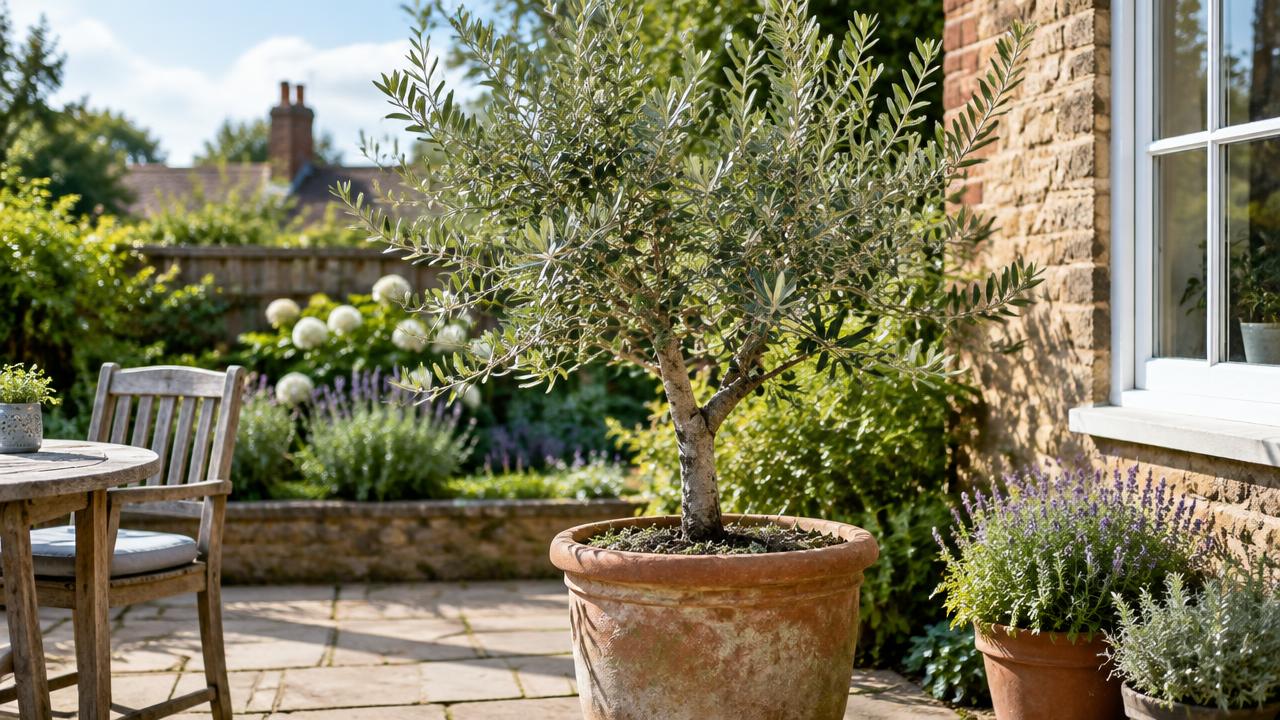
A thin olive trunk is rarely a pruning problem, and harder pruning will not fix it. Trunks thicken when the tree is allowed to grow, so the changes that help are about light, root room and leaving the shears alone for a while.
Why is my olive trunk still so thin?
There is a gap between the olive most of us picture and the one most of us buy. The first is an old Mediterranean tree, broad at the base, irregular and deeply fissured, under a loose crown of silvery leaves. The second is usually a young half-standard with a slender clear stem and a neatly clipped ball of foliage on top. There is nothing wrong with the second tree, which is simply young.
The trouble starts when a young olive is treated as though it had already reached its final size. New shoots appear, they are cut back to restore the neat outline the tree was sold with, and the trunk stays much as it was. If a heavier trunk is the aim, the tree needs the chance to become a bigger tree first.
What makes a trunk thicker
A woody plant grows in two ways. The shoot tips extend the branches, while a thin layer of dividing cells beneath the bark, the cambium, adds new wood each season and gradually increases the diameter of stems and trunk. That second kind of growth is what you are waiting for.
It is paid for by the rest of the tree. Leaves capture light and make sugars, roots supply water and nutrients, and the tree spends those resources on maintaining itself and building new tissue, wood included. The practical lesson is simpler than the physiology: if you want more trunk, you have to allow more tree. A young olive that is constantly clipped, held in a small pot or kept in a shady corner is restricted on all three counts, and it stays slight for that reason.
Stop clipping it back to the same shape
For most owners this is the change that matters. The RHS places olives in Pruning Group 1: plants that need very little pruning beyond removing dead, damaged, congested or crossing growth. Its current olive-growing advice recommends doing that work in early spring. Hard pruning is not a shortcut to a heavier trunk because it removes the healthy leaf area that supports the tree's overall growth.
There is a wider principle behind that. University of California Cooperative Extension guidance on training young landscape trees, which is general advice and not specific to olives, describes pruning as a dwarfing process. The more branches and leaves you remove while a tree is young, the more slowly it grows.
None of this means leaving an olive untouched. Dead or damaged wood should still come out, shoots from the base can be removed if you want a clear stem, and a badly placed branch is easier to deal with early. It is a question of priority. If you want a compact, tightly clipped tree that stays the size it is, keep clipping. If you want a heavier trunk, give the tree several seasons of much freer growth, accept that it will look less finished for a while, and refine the shape afterwards.
Give the roots room
The same trade-off applies below the compost. Restricting the roots is one of the ways a container keeps a tree small, which is useful on a patio or balcony and unhelpful when you are trying to encourage growth above ground.
If the rootball is congested and trunk development is the priority, move the tree up through pot sizes in stages. One size at a time is the right pace, as explained in our complete repotting guide, because an oversized volume of wet compost can create a new problem around a small rootball. Our Complete Guide to Growing Olive Trees in Pots covers pot size, compost and repotting in detail. The point here is only that maximum restriction and maximum growth are competing aims, and you have to choose where between them your tree should sit.
Give it your best light, water and feed
The RHS plant profile for Olea europaea specifies full sun in a sheltered, south-facing position. Light is what funds growth, so a mediocre spot cannot be made up for with fertiliser. If you have one really sunny place on a small patio and the olive is the priority, the olive should have it.
Olives tolerate drought and lean soil once established in the ground, which leads some owners to keep a potted tree dry and hungry in the belief that it suits the plant. Surviving and growing are different things. The RHS recommends keeping the compost moist and giving container olives a balanced liquid feed every month during the growing season. Refreshing the surface with fresh compost in spring also helps maintain a long-term container, as covered in our complete olive guide. A young tree you are trying to bulk up should be kept healthy and in active growth, not under stress.
What about sacrifice branches?
This is the point where ordinary container growing turns into deliberate tree training. A sacrifice branch is a bonsai technique and no part of standard RHS olive care. A chosen branch or leader, one that will not feature in the finished tree, is left to grow hard for a few seasons to help thicken the trunk and is then cut off.
It rests on the same principle as everything above. Bonsai Empire, a widely used bonsai reference, says the only way for a trunk to thicken is to let the tree grow freely in a large container or in the ground, without much pruning, for several years. It describes sacrifice branches and sacrifice leaders as a way of doing that in a more controlled manner.
Bonsai growers generally use a branch low on the trunk when they want to thicken the base in particular and so build taper, and a leader at the top when they want to thicken the whole trunk. Either way there is a cost. A branch grown this hard becomes thick itself and leaves a sizeable wound when it is removed, which is why bonsai guidance stresses choosing one whose scar will not show.
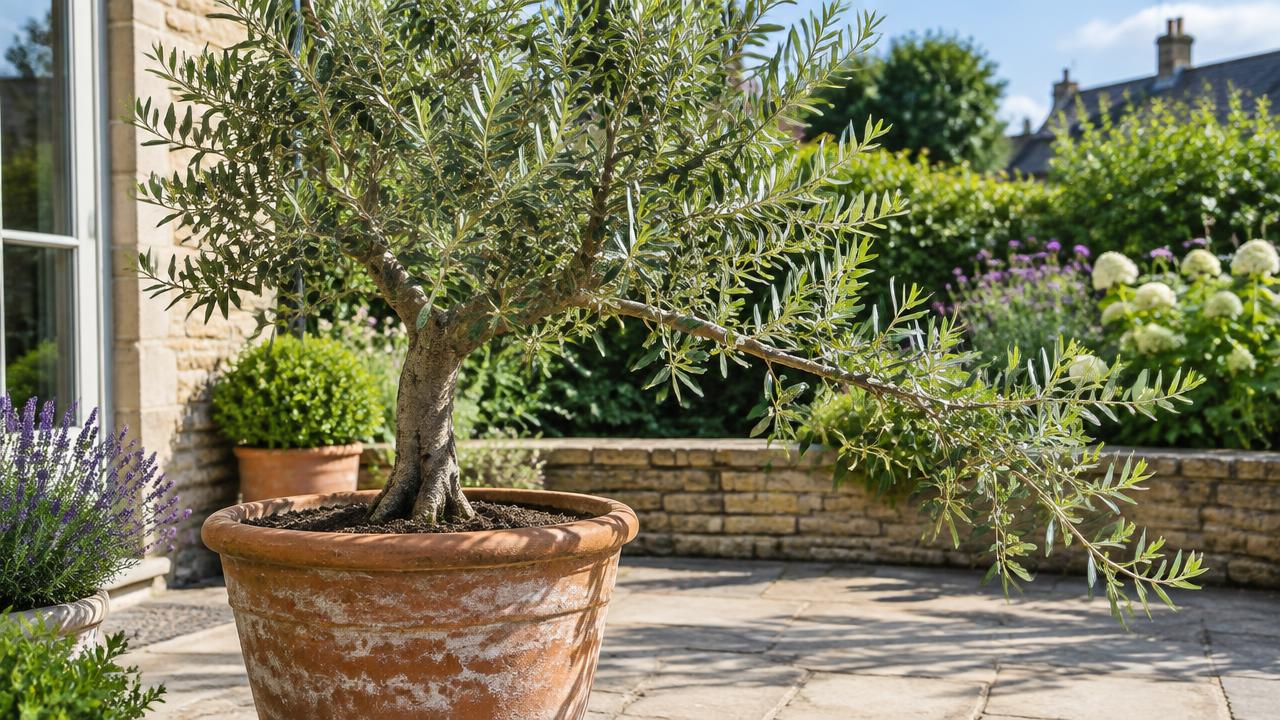
For a young garden-centre olive it should not be the first move. The simpler experiment is to stop clipping and let the whole tree grow for a few seasons, and for many patio olives that will be enough. A sacrifice branch earns its place later, when you have a specific aim such as a lower trunk that is thin for the size of the tree, and when you have accepted both the untidy years and the eventual scar.
Would planting it in the ground be faster?
Potentially, because open ground removes most of the root restriction. Bonsai growers use the ground or large training containers for exactly that reason before moving a tree to a smaller pot.
For an olive in Britain, root room is not the only consideration. The RHS asks for well-drained soil and recommends containers in colder areas and on heavier, wetter soils. Planting an olive into persistently wet ground to speed up its trunk is a poor trade, and where you lack a sunny, sheltered, sharply drained site, a progressively larger pot gives you more control.
Should I cut the top off?
Not for the sake of the trunk. Removing the leader can be useful when you are setting up a particular branch structure, but that is a shaping decision and does nothing to add girth. The order that works is to grow first and shape second, and pruning takes over again once the trunk is where you want it and the tree has to be held at its final size.
How long will it take?
Years, and that is about as precise as it is possible to be. There is no defensible figure in centimetres per year for an olive in a British container, because starting size, root volume, light, warmth, water, feeding and the amount of growth you leave on the tree all change the result.
The RHS gives 20 to 50 years as the time an olive takes to reach its ultimate height. That does not mean waiting decades to see any change, since a tree given room and left unclipped will thicken noticeably faster than one that is not. It does mean that the rugged, fissured look of an old olive comes with age and cannot be produced by technique in a few summers.
What I would do with a thin potted olive
I would not start with specialist training. I would put the tree in the sunniest sheltered spot I had, check the rootball in spring and pot it on one size if it was congested, and keep it watered and top-dressed through the growing season.
Then I would leave the canopy largely alone for several seasons, taking out only dead or damaged wood and obvious structural problems. Only once that free growth had done its work would I consider whether a sacrifice branch had a job to do. It is less exciting than a pruning trick, but the thin olive is not waiting for the right cut. It is waiting to get bigger.
FAQ
Does pruning make an olive trunk thicker?
No. Pruning shapes how a tree develops, but removing healthy leaf area also slows its overall growth. The RHS places olives in its light-pruning group, so hard pruning is not a shortcut to a heavier trunk.
Should I put my olive in a bigger pot?
Only if it needs one. Check the rootball in spring, and if it is congested and you want more growth, move up one pot size. A bigger pot helps by removing a restriction, so it does nothing for a tree that still has room.
Should I keep an olive root-bound?
Not if growth is the aim. Root restriction is useful for holding a container tree at a manageable size, which is a different goal from building a trunk.
What is a sacrifice branch?
It is a bonsai training technique. A branch or leader that is not part of the final design is left to grow freely to help thicken the trunk, then removed. The cost is the wound left behind when it comes off.
How quickly will my olive trunk thicken?
There is no reliable rate. Root volume, light, warmth, water, feeding, age and pruning all affect it. For a potted olive in Britain, think in years and do not expect a dramatic change in one season.
READ THE FULL GUIDE
The Complete Guide to Growing Olive Trees in Pots →
RELATED POSTS
- Seasonal
Is Autumn Really the Best Time to Plant a Pot?
- Getting Started
Drought-Tolerant Plants for Pots
- Seasonal
Don't Wrap Every Pot Just Because It's October
Robin is a small-space grower writing for everyone working with a courtyard, balcony, window box, patio or sunny sill. Edible and leafy, both kept alive in the kind of light real small spaces actually get.
✦ Free with the newsletter — the small-space starter sheet
Grow Anywhere — a free weekly email.
The Potted Club newsletter. A short note from Robin — what to sow, one plant problem solved, and the best new guide.
FREE WEEKLY EMAIL · NO SPAM · UNSUBSCRIBE ANYTIME