
How to Take Hardwood Cuttings in November
How to take hardwood cuttings this November and root them in a deep pot or a garden trench, which shrubs, climbers and fruit work best, and what to expect over the next year, with RHS advice.
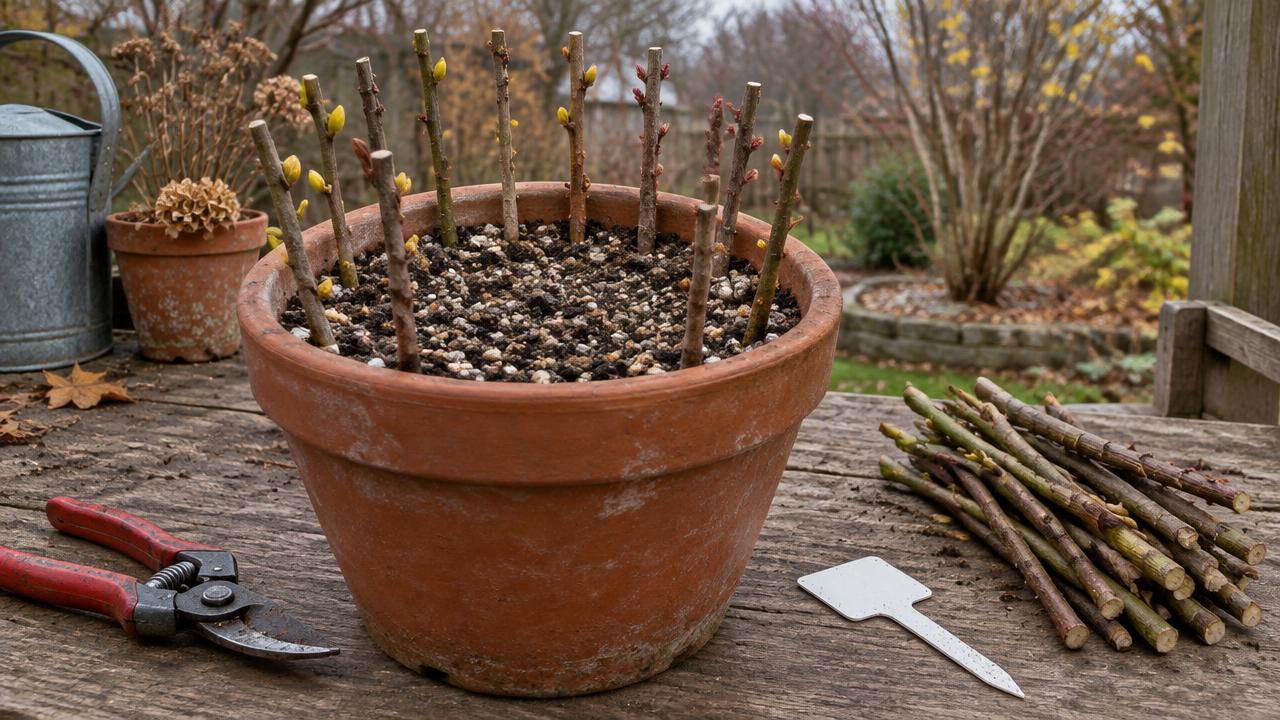
Once the leaves have dropped, many of the shrubs in a garden can be multiplied for nothing more than a pot of compost and a few minutes with the secateurs. Hardwood cuttings are taken from bare, dormant stems, and the RHS describes them as an easy and reliable way to propagate many deciduous plants. They need almost no equipment, don't need a heated propagator, and will sit quietly in a sheltered corner all winter while they root. This covers which plants work, how to take and prepare the cuttings, how to root them in a pot or a trench, and what to expect between now and next autumn.
Why November is the time
The RHS says hardwood cuttings can be taken from mid-autumn until late winter, and that the ideal time is just after leaf fall or just before the buds break in spring. Its November advice lists them as one of this month's jobs. By now, most deciduous shrubs have dropped their leaves and their new stems have firmed up, which is exactly the material you want.
The one thing to avoid is severe frost. The RHS advises not taking cuttings when temperatures fall below about minus 5°C, so if a hard cold spell arrives, wait for it to pass. Our article on what to cut back in autumn covers which shrubs to shorten now, and the prunings from some of them can make good cuttings.
Which plants work
A wide range of deciduous plants root well from hardwood cuttings. The RHS lists shrubs including abelia, buddleja, cornus, deutzia, forsythia, philadelphus, ribes, roses, symphoricarpos and viburnums. Climbers such as honeysuckle, jasmine, vines and parthenocissus can be grown this way, along with willow and poplar. For anyone growing fruit, gooseberries, blackcurrants, redcurrants and whitecurrants, figs and mulberries are all suitable.
The RHS November advice also mentions euonymus, hydrangea and holly. Holly and evergreen euonymus need a different approach from leafless deciduous shrubs, and the RHS says the best method for evergreen hardwood cuttings is the one used for semi-ripe cuttings, which our propagation guide explains. Some euonymus are deciduous, so check which kind you have. If you are new to cuttings, start with an easy deciduous shrub such as forsythia, a flowering currant or a rose, and with a plant you already have growing well.
If the parent plant is grafted, as many roses are, a cutting will grow on its own roots rather than on the original rootstock. The new plant may not grow with quite the same vigour or size as its parent. For fruit trees, which rely on their rootstock to control size, hardwood cuttings are not a substitute for buying a grafted tree, and the fruit the RHS lists for this method are currants, gooseberries, figs and mulberries rather than apples or pears.
Choosing and preparing the stems
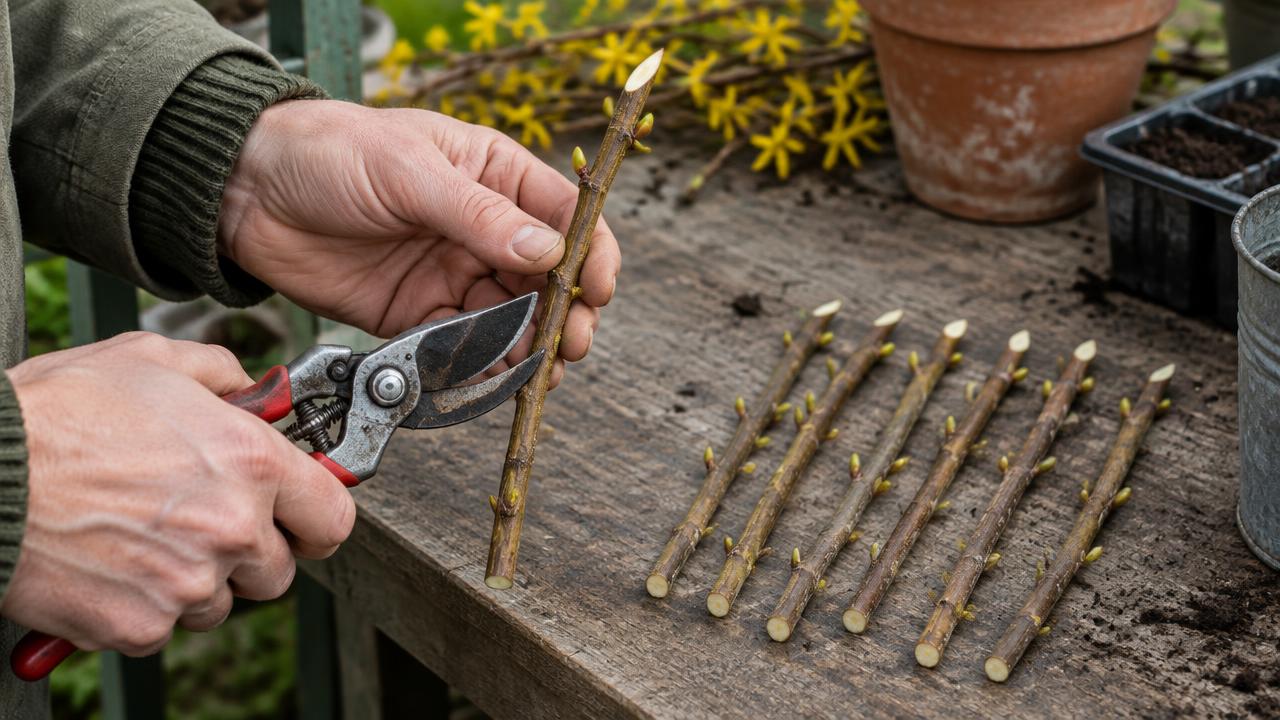
Look for vigorous, healthy shoots of this year's growth, the stems that grew over the summer. The RHS describes the right material as woody but pliable. Avoid thin, weak shoots and anything showing signs of disease. Cut off the soft growth at the very tip, because it won't root.
Then cut the stem into sections 15 to 30cm long. The cuts at each end are different on purpose. At the top, the RHS suggests a sloping cut just above a bud, so rain runs off it. At the base, make a straight cut just below a bud or pair of buds. The difference means you always know which end goes into the compost, which matters, because a cutting pushed in upside down is very unlikely to root.
The RHS suggests dipping the base of each cutting in a rooting compound if you have one, but it isn't essential. Plants with soft, pithy stems are an exception to the usual method. For elder, the RHS suggests cutting through the heel, where the shoot joins the older branch, instead of below a bud.
Rooting cuttings in a pot
For a small garden or patio, a deep pot with drainage holes is the simplest method. The RHS suggests that if you only have a few cuttings, you can skip the trench and use deep pots instead, filled with a gritty mix of half coarse grit and half peat-free multipurpose compost. The grit keeps the mix open and well drained, which matters in a wet winter.
Choose a pot deep enough to bury about two-thirds of each cutting, and push the cuttings in around the edge so that a few buds show above the surface. The RHS gives no spacing for pots, so simply leave enough room between stems that they aren't crowded. Firm the compost around them, water the pot, and label it with the plant name and the date, because bare stems all look much the same by spring.
The RHS suggests keeping pots of cuttings in a sheltered cold frame or unheated greenhouse, and making sure they don't dry out. If you have neither, a sheltered spot outside, out of the wind and away from the heaviest rain, is worth trying with hardy plants, although results are likely to be less reliable in prolonged frost or heavy rain. Stand the pot on pot feet so it drains. Keep it outside rather than in a heated room. The cuttings are dormant, and the RHS method is designed for cool, sheltered conditions rather than warmth.
The trench method
If you have a patch of spare ground, a trench lets you take far more cuttings at once. The RHS suggests a sheltered site with well-drained soil. Dig in a bucketful of garden compost per square metre, make a narrow slit trench with a spade, and put a layer of sand in the bottom to help drainage.
Insert the cuttings with two-thirds of each one below the surface, leaving a few buds above ground, and space them 10 to 15cm apart, with 40cm between rows if you are planting more than one. For single-stemmed plants such as gooseberries, the RHS suggests leaving just one bud above ground, or rubbing off the extra buds, so the plant grows on a short clean stem. Firm the soil back around the cuttings when you have finished.
Slow rooters
Some plants take longer than others. Dogwoods are on the RHS list of shrubs to propagate in November, but rooting speed and success vary, and the RHS names cornus, along with laburnum, among hardwood cuttings that may take longer to root. For these, it suggests tying the cuttings into bundles of 10 to 12 and keeping them in a frame or a pot of moist sand over winter.
In early spring, before the buds break, the bundles can be planted out in a trench about 12.5cm deep. The RHS also says that dogwoods benefit from a cloche or cold frame, and that cuttings in cold conditions in general may root better with some protection.
Aftercare
Hardwood cuttings need very little attention, but a few checks help. The RHS advises checking trenches after frost and firming the soil back around any cuttings that have been lifted. In a pot, the same applies if the compost heaves. After prolonged rain, check that the pot is still draining freely and that the compost hasn't washed away from the stems. Water during dry spells, especially in spring and summer once the cuttings are growing, because they must not be allowed to dry out.
Watch for animals too. The RHS notes that rabbits and deer may need keeping off where they are a problem, and that mice and rats can also be a nuisance. In a small garden, a pot on a bench or a sheltered table is usually out of the way of most of them.
Why cuttings fail
Most failures come down to a handful of avoidable problems, and nearly all of them are covered by the RHS method. Cuttings taken from thin, weak or soft shoots, rather than firm growth from this year, are less likely to root, which is why the soft tip is always removed. A cutting inserted the wrong way up is very unlikely to root, which is what the sloping top cut prevents. Too little of the stem buried is another common slip, so aim for the two-thirds the RHS recommends.
After that, water is usually the problem, in one direction or the other. The RHS stresses that cuttings must not dry out, and that applies just as much in a sunny spring as in summer. But a pot that sits in a saucer of rainwater all winter can rot the base of the cuttings before they root, which is why a gritty mix, free drainage and pot feet matter. Finally, frost can push cuttings up out of the compost, so check them after a hard frost and firm them back in.
What to expect over the next year
Don't expect anything to happen quickly. The RHS explains that the cuttings callus over winter and form roots in spring. New leaves will appear as the weather warms, but leaves may open before many roots have formed, so don't take them as a sign the cutting is ready to move.
Resist the temptation to pull them up to check. The RHS advises leaving hardwood cuttings in place until the following autumn, then planting them out or potting them on. Cuttings that root more slowly can be potted on or planted out after they have rooted, also in the autumn. Not every cutting will root, and results vary between plants and growing conditions. Taking several healthy cuttings of each plant improves the chance of ending up with at least one new plant, for the cost of a bag of compost and some grit. The RHS November advice includes checking hardwood cuttings taken the previous year, so make a note to look at this year's next November.
FAQ
When should I take hardwood cuttings?
The RHS says from mid-autumn until late winter, ideally just after the leaves have fallen or just before the buds break in spring. Avoid taking them during severe frost, below about minus 5°C.
Which plants can I propagate from hardwood cuttings?
The RHS lists many deciduous plants, including buddleja, cornus, deutzia, forsythia, philadelphus, ribes, roses, viburnums, honeysuckle, jasmine, willow, currants, gooseberries and figs. Its November advice also suggests euonymus, hydrangea and holly.
Can I root hardwood cuttings in a pot?
Yes. For a small number of cuttings, the RHS suggests deep pots with drainage holes, filled with a 50:50 mix of coarse grit and peat-free multipurpose compost, kept in a sheltered cold frame or unheated greenhouse and not allowed to dry out.
Do I need rooting powder?
It isn't essential, but the RHS suggests dipping the base of each cutting in a rooting compound if you have one available.
How long do hardwood cuttings take to root?
The cuttings callus over winter and root in spring. The RHS advises leaving them in place until the following autumn before planting out or potting on. Some, such as cornus, take longer.
READ THE FULL GUIDE
How to Propagate Plants →
RELATED POSTS
Robin is a small-space grower writing for everyone working with a courtyard, balcony, window box, patio or sunny sill. Edible and leafy, both kept alive in the kind of light real small spaces actually get.
✦ Free with the newsletter — the small-space starter sheet
Grow Anywhere — a free weekly email.
The Potted Club newsletter. A short note from Robin — what to sow, one plant problem solved, and the best new guide.
FREE WEEKLY EMAIL · NO SPAM · UNSUBSCRIBE ANYTIME