
How to Grow Garlic in Pots
How to plant garlic in pots this autumn, which garlic to buy, why it needs the winter cold, and how to look after it until harvest next summer, with RHS advice.
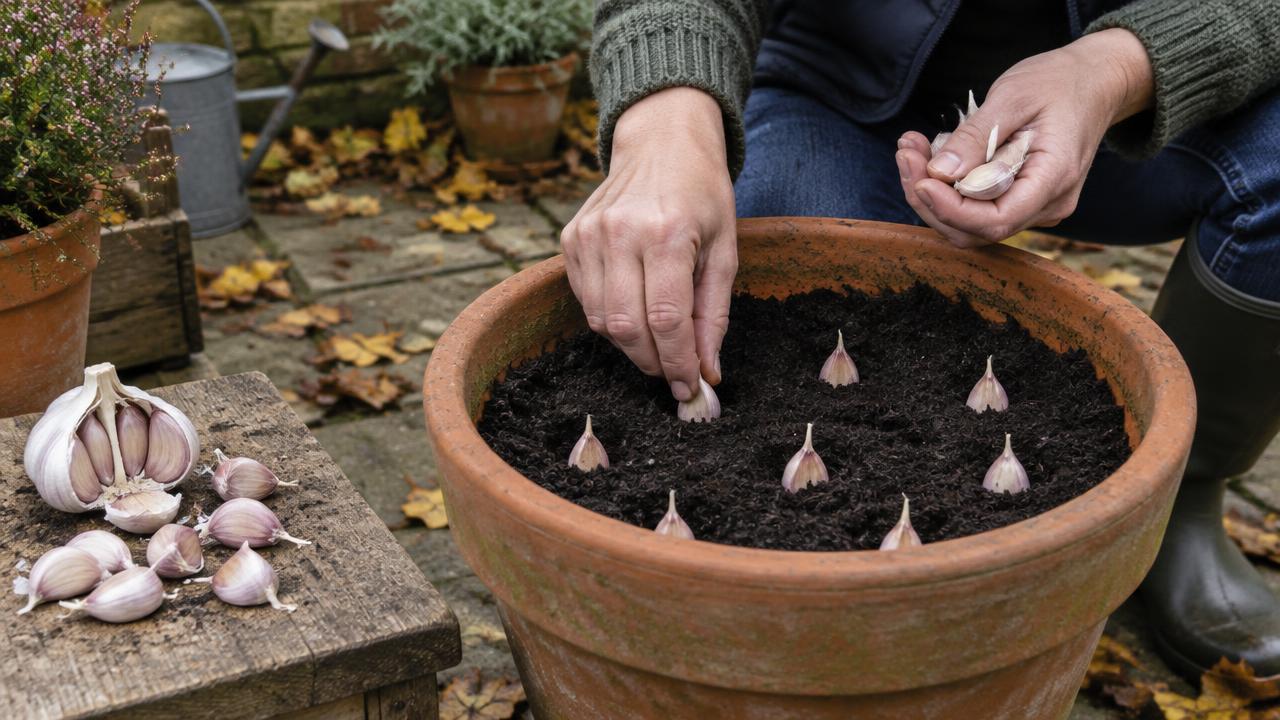
Garlic is a crop you plant just as the weather turns cold, and one of the easiest to grow in a pot. You plant it now, leave it outside through the winter, and lift it next summer, with very little to do in between. It needs the cold to grow well, so there is no need for a greenhouse or a sunny windowsill, just a deep pot, the right garlic and a sunny spot outside. This covers what to buy, how to plant it, and how to look after it until harvest.
Why garlic goes in now
Garlic needs a cold spell to form a good bulb. The RHS says most varieties need roughly one to two months at temperatures between 0 and 10°C, and that without enough winter cold, the bulbs may fail to divide into cloves. That is why it is usually planted from mid-autumn to early winter, giving it the whole winter outside before it starts growing strongly in spring.
Some garlic can be planted in late winter or early spring instead, and the RHS says spring-planted garlic is ready from mid-summer to early autumn. Autumn planting gives it the longest season, though, and an earlier harvest, usually from late spring to early summer. It also suits a small space well. A pot of garlic takes up little room, needs no support, and stays out of the way on a patio or balcony until it is ready. It fills a container through the months when it would otherwise sit empty, and because autumn-planted garlic comes out in early summer, the pot is usually free again in time for a summer crop.
What to buy
Don't plant a bulb from the kitchen. The RHS says it isn't recommended to plant garlic bought from the supermarket, because it may not suit the British climate and there is a risk of introducing disease. Buy named varieties from a garden centre or mail-order supplier instead, which are widely available in autumn and spring.
There are two main types. Hardneck garlic produces fewer, larger cloves with a stronger flavour, and the RHS says it stores for about four to six months but is more prone to bolting. Softneck garlic produces smaller, more tightly packed cloves, rarely bolts, and stores for longer, with the RHS saying autumn-planted softneck can keep well into the following winter.
The varieties the RHS recommends are all softnecks. 'Solent Wight' is described as well adapted to the British climate and stores well. 'Germidour' is a reliable variety with large bulbs, 'Cristo' has a strong flavour, and 'Arno' stores well.
Choosing a pot and compost
The RHS suggests peat-free multipurpose compost in a pot at least 25cm deep. Make sure the pot has drainage holes, and stand it on pot feet or bricks over winter so it isn't sitting in water.
Garlic needs full sun, so put the pot in the brightest spot you have. In the ground, the RHS suggests digging in well-rotted manure or garden compost before planting, but a pot filled with fresh multipurpose compost is ready to go as it is. If you have a choice of containers, a longer trough lets you fit more cloves in a row at the right spacing than a round pot of the same depth.
Planting the cloves
Split the bulb into individual cloves just before you plant, taking care not to damage them, and set aside any that are soft, mouldy or damaged rather than planting them. Plant each one with the flat end down and the pointed end up, with the tip about 2.5cm below the surface of the compost. The RHS suggests the same spacing in a pot as in the ground, which is 15cm between cloves.
Water the pot lightly after planting to settle the compost, and then leave it alone. If you garden on heavy or wet soil and want to plant out later, the RHS suggests starting cloves in modules of peat-free compost instead, one clove per module, kept slightly moist but not wet in a cool, sheltered spot such as a ventilated cold frame. They can then be planted out in spring.
Looking after it over winter
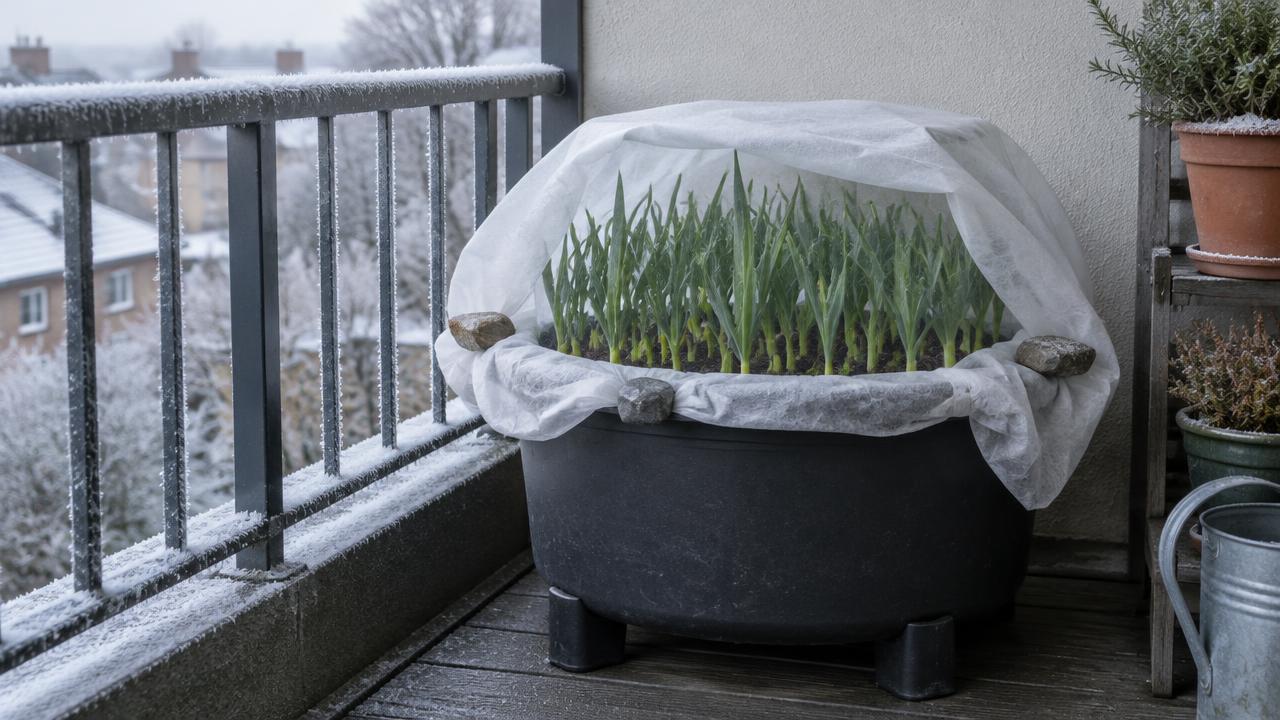
The main jobs in winter are protecting the cloves and keeping the compost from getting waterlogged. The RHS warns that birds sometimes pull up newly planted cloves, so cover the pot with netting or horticultural fleece until the cloves are well rooted. It suggests plastic-free netting where you can.
There is a second reason to cover the pot now. The RHS says allium leaf miner, a fly whose larvae tunnel into the leaves and stems of garlic, onions and leeks, is most active from September to November and again from March to April. It advises protecting plants with insect-proof mesh during those periods, so a fine mesh over the pot this autumn does both jobs at once. Put it back on in March for the spring peak.
Leave the pot outside. Bringing garlic indoors or into a heated porch defeats the point of planting it in autumn, because it needs the cold. What it doesn't want is to sit in sodden compost for weeks. In the modules, the RHS advises keeping compost slightly moist but not wet, and the same principle applies to pots. If a pot is standing in a saucer of rainwater, take the saucer away. Our article on potted herbs in a wet winter covers how to rescue a pot that is too wet.
Pots also dry out faster than the ground, and the RHS advises checking containers regularly. In a dry spell, especially if the pot is in the rain shadow of a wall, give it a little water.
Spring care
Garlic starts growing strongly in spring, and this is when watering matters most. The RHS says to water during dry spells in spring and early summer to improve bulb size, but to avoid wetting the leaves, which can encourage fungal problems. Once the bulbs are large and well formed and the leaves begin to yellow, stop watering, because the RHS warns that watering at that stage can cause the bulbs to rot.
Yellowing leaves are a normal sign that garlic is ripening in early summer, but yellowing in early spring usually means something else. In a pot, the first thing to check is the compost. Push a finger in and see whether it is sodden or bone dry, because either can stress the roots, and adjust from there before suspecting anything worse.
Keep the pot free of weeds, because garlic needs full sun and doesn't compete well. The RHS advises weeding by hand rather than hoeing, which can damage the bulbs. If your garlic produces a flower stalk, remove it as soon as it forms, so the plant puts its energy into the bulb. The RHS says young stalks picked while still in bud can be eaten, sautéed, barbecued or roasted.
Problems to watch for
Garlic is generally straightforward, but the RHS lists a few problems worth knowing about. One of the most common is rust, a fungal disease that causes bright orange pustules on the leaves, usually from mid-summer until late autumn. The RHS says infection is worse where plants have plenty of nitrogen but are short of potassium, so take care with fertiliser, and that crowding raises humidity and makes infection more likely. That is one more reason to keep to the 15cm spacing in a pot rather than squeezing extra cloves in. Clear away all the leaves and debris at the end of the season.
White rot is far more serious. It causes yellowing, wilting leaves and rotting roots and bulbs, and the RHS says the resting bodies of the fungus can survive in soil for at least 15 years and are effectively impossible to get rid of once they arrive. It spreads in contaminated soil, on tools and on muddy boots, so avoid bringing soil from an allotment or another garden into your pots. If your garlic does get white rot, don't reuse that compost for onions, garlic or leeks.
Allium leaf miner shows up as lines of white marks on the leaves, with maggots or brown pupae in the stems and bulbs, often followed by rot. Onion fly maggots can also damage roots and bulbs. The RHS says crop rotation matters for leaf miner, because adults can emerge from pupae in the same ground if alliums are grown there again. In a pot, the equivalent is to start each year with fresh compost.
Buying named garlic from a reputable supplier, rather than planting kitchen bulbs, is the simplest way to avoid bringing problems in from the start.
Harvesting and storing
The RHS says autumn-planted garlic is ready from late spring to early summer, once the leaves turn yellow. Don't leave it too long, because bulbs lifted late tend to split and store poorly. Before lifting the whole pot, gently loosen the compost around one plant and look at the bulb. If it is a good size with clearly defined cloves and intact papery skins, the rest are likely ready too. In a pot, you can then simply tip the compost out and lift the bulbs carefully by hand, handling them gently to avoid bruising.
Dry the bulbs thoroughly in a single layer in the sun, such as in a well-ventilated greenhouse, or in a dry, airy shed, keeping them below 30°C. The RHS says this takes two to four weeks. Once the leaves are dry and rustle, cut them off and store the bulbs somewhere cool and dry at around 5 to 10°C. Hardneck garlic keeps for four to six months, and softneck for up to a year.
FAQ
When should I plant garlic in pots?
The RHS says garlic is usually planted from mid-autumn to early winter, because most varieties need a cold period of one to two months at 0 to 10°C. Some varieties can be planted in late winter or early spring instead.
Can I plant garlic from the supermarket?
The RHS doesn't recommend it. Supermarket garlic may be unsuited to the British climate and could introduce disease. Buy named varieties from a garden centre or mail-order supplier.
How deep does a pot for garlic need to be?
At least 25cm deep, according to the RHS, filled with peat-free multipurpose compost. Plant cloves 15cm apart, as you would in the ground.
Should I bring garlic pots indoors for the winter?
No. Garlic needs a period of cold to form bulbs. Without enough cold, the RHS says bulbs may not divide into cloves. Keep pots outside, but don't let them sit in waterlogged compost.
When is garlic ready to harvest?
The RHS says autumn-planted garlic is ready from late spring to early summer, once the leaves turn yellow. Lift it promptly, because bulbs left too long tend to split and store poorly.
READ THE FULL GUIDE
Container Growing Fundamentals →
RELATED POSTS
Robin is a small-space grower writing for everyone working with a courtyard, balcony, window box, patio or sunny sill. Edible and leafy, both kept alive in the kind of light real small spaces actually get.
✦ Free with the newsletter — the small-space starter sheet
Grow Anywhere — a free weekly email.
The Potted Club newsletter. A short note from Robin — what to sow, one plant problem solved, and the best new guide.
FREE WEEKLY EMAIL · NO SPAM · UNSUBSCRIBE ANYTIME