
A Hosepipe Ban Is Tightening in October. What Does That Mean for Your Pots?
South East Water has tightened its hosepipe ban in Sussex and ten companies still have restrictions in force. Here's what that means for pots in autumn, and why now is the time to think about next summer.
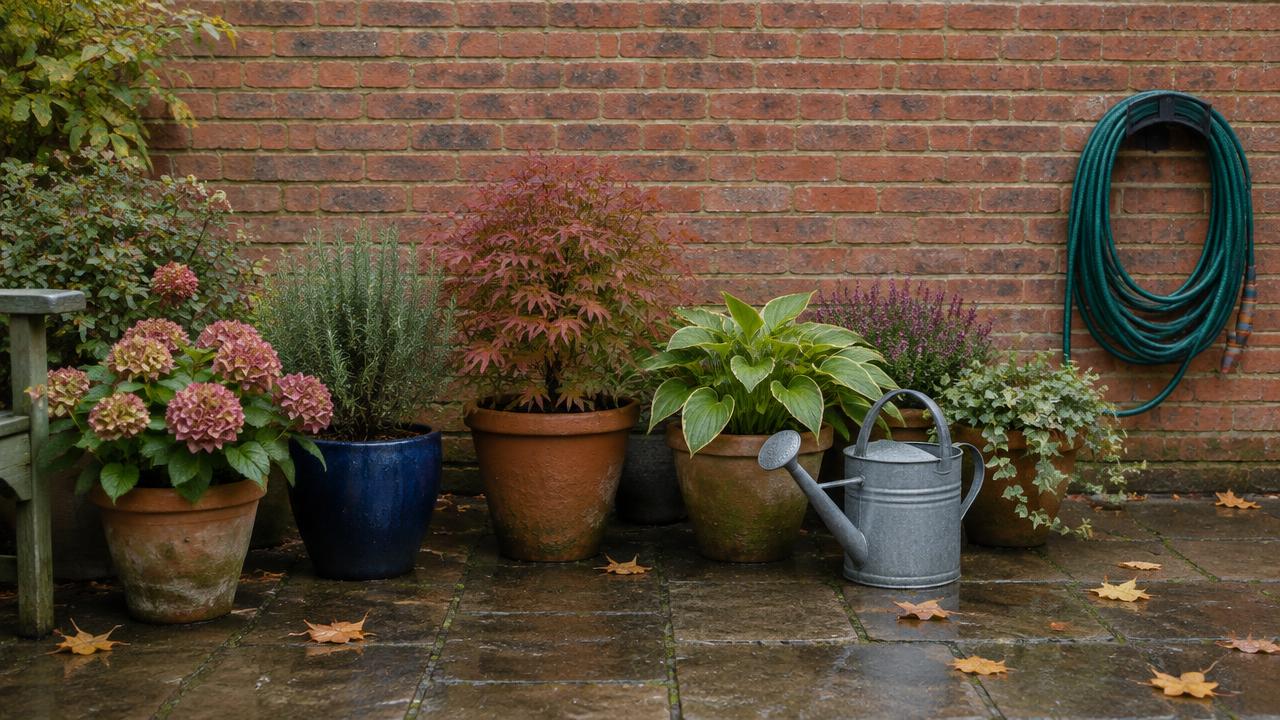
A hosepipe ban tightening in October sounds like news from the wrong season, when most of us are watering far less. For pots it changes less than the headline suggests, though some containers still need water this month, and the reason the bans are still here says a good deal about next spring.
What has changed in Sussex
South East Water announced that it was tightening the hosepipe ban in its Sussex supply area, and the updated rules took effect on 9 October. The company's own summary is that previously permitted exemptions have been removed, except where hosepipe use is necessary for health, safety or welfare. Its guidance says the age-based exemptions have ended, that being on the Priority Services Register no longer exempts a customer automatically, and that watering trees and hedging by hosepipe is no longer exempt.
The reason is the state of the supply. South East Water says Sussex received just over 56 per cent of its expected rainfall between March and August, and Ardingly Reservoir, which is one of the two reservoirs supplying the area, was 22.8 per cent full when the change was announced on 2 October. The company says the restrictions are likely to continue until water resources have recovered, and that they are under constant review. It has also applied for a Non-Essential Use Ban, which would affect some commercial and non-household use. That is a separate measure, it needs government approval, and it is not what came into force on 9 October.
Where bans are still in force
Sussex is the place where the rules have tightened, but it is far from the only place still under a ban. The Environment Agency's report for the week to 1 October lists temporary use bans in force at Affinity Water, Anglian Water, Bristol Water, Cambridge Water, Essex and Suffolk Water, Southern Water in Hampshire and the Isle of Wight, South East Water, South West Water, Thames Water and Wessex Water. It puts the number of people affected at about 30 million, and reports no bans lifted that week. The details differ from one company to the next and can change after a report is published, so check your own supplier's page for what applies to you now.
Does it matter in October?
Less than it would have in July, and for two reasons. The first is that a hosepipe ban restricts the hosepipe and not the watering. South East Water's guidance for Sussex says that hand watering with tap water using watering cans and buckets is allowed. It also says that a hosepipe connected to a water butt is not restricted. The tightened Sussex rules removed the earlier exemption for drip and trickle systems; those systems remain exempt in some other South East Water supply areas, so check the rules for your address. A balcony or a patio of containers is watered from a can anyway, which was the point of our July piece on what the bans mean for pots.
The second reason is the season. Demand for water generally falls in autumn, as growth slows and the days cool, although how far it falls depends on the size of the pot, the plant in it, how exposed it is and what the weather does. The RHS says deciduous and dormant plants in containers rarely need watering in winter. It also calls overwatering the most common cause of loss in container plants, which makes October a month for holding back.
What still needs watering
Less is not the same as none, and the pots that still need water are easy to miss because the weather feels wet. The RHS says evergreens and conifers in containers may still need water over winter, especially if they have been moved under cover where rain cannot reach them, and it suggests checking them at least weekly.
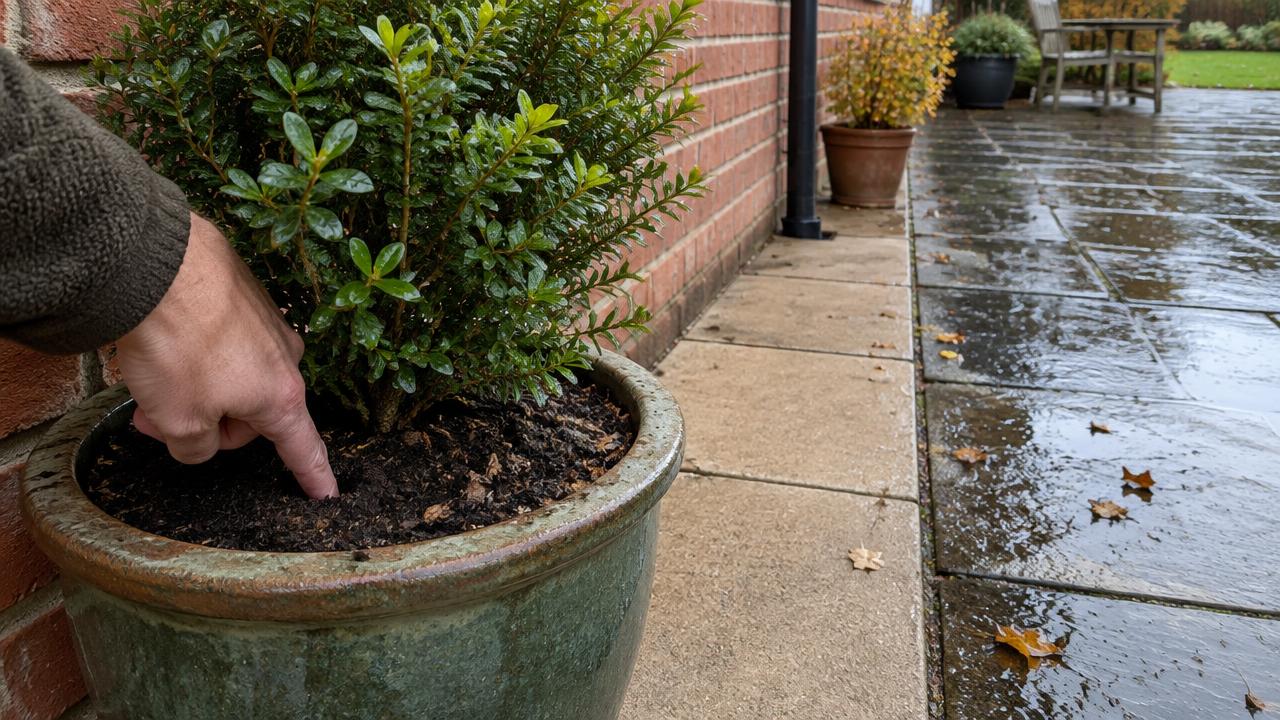
Position matters as much as the plant. The RHS notes that the rain shadow of a wall can be enough to keep a pot dry, which is useful when compost is sodden and a problem when it is not. If you have followed last week's advice and grouped your pots against the house for shelter, they are now sitting in that rain shadow, and a week of rain may barely have reached them. Push a finger into the compost before assuming the weather has done the job.
Containers planted this autumn deserve the same check while their roots are establishing. Whatever you are watering, the RHS advises against doing it when frost is forecast.
Why it matters for next year
The more important point is why bans are still in place in October at all. The Environment Agency reports that reservoir storage across England was 55 per cent for the week ending 29 September, which it puts at 19.4 per cent below average for the time of year. Sixteen reservoirs or reservoir groups were less than half full, and six, Ardingly among them, were classed as exceptionally low. That is a national snapshot for one week, and it does not describe the position of any single water company.
September did not help. England had 65 per cent of its long-term average rainfall for the month, and the east and south-east had about half. Ten of the Environment Agency's areas remain in drought status. Its report says further significant rainfall is needed to return to normal water resource conditions for many water companies, and that concerns remain about refilling reservoirs over the winter.
Nobody can say from here whether restrictions will still be running in spring. What the figures do say is that this is not a ban waiting for the first wet week to end it, and that a container gardener in an affected area should not plan next summer on the assumption that the hosepipe will be back.
What you can do about it now
In July we said this was the summer to fit a water butt. If you did not, autumn is the better moment, because a butt fitted now fills over winter. It needs a roof to collect from, a gutter downpipe to take the water from and a firm, level base to stand on, and the RHS lists house, garage, shed and greenhouse roofs as suitable. It says even a small roof collects large volumes, and estimates that a small shed roof in dry south-east England may yield 2,500 to 3,500 litres a year, roughly ten to fifteen standard butts' worth. It suggests slimline models where space is tight, and raising the butt high enough to get a watering can under the tap.
Stored rainwater has limits worth knowing. The RHS says it suits established plants but not seedlings, which risk damping-off disease, and that it should be used regularly to keep it fresh. Under the Sussex rules you cannot fill a butt from a mains hosepipe, which rather defeats the object in any case.
A balcony with no roof to collect from has fewer options, and the watering can remains the main one. Greywater is a short-term help and not a replacement for clean water. South East Water lists it as an option, and the RHS attaches conditions. It should be used within 24 hours, applied with a watering can, and alternated with rain or mains water to stop salts building up. The RHS advises using it mainly on ornamental plants, and avoiding any water that contains bleach, disinfectant, dishwasher salt or harsh cleaners.
The last thing is free. Next summer's watering is decided partly by what you plant and what you plant it in, and autumn and spring are when those decisions get made. Larger pots dry out more slowly than small ones, and plants that tolerate dry spells ask less of a watering can in July.
FAQ
Can I still water my pots during a hosepipe ban?
Yes. A ban restricts hosepipes, not watering. South East Water confirms that hand watering with tap water from a watering can or bucket is allowed under its tightened Sussex rules. Check your own supplier's page for the detail where you live.
What changed in Sussex on 9 October?
South East Water removed the exemptions that had previously applied in its Sussex supply area. Hosepipes can now be used only where it is necessary for health, safety or welfare.
Do pots need watering in October?
Usually much less than in summer, but some do. The RHS says deciduous and dormant container plants rarely need watering in winter, while evergreens and anything under cover should be checked at least weekly. Newly planted containers and pots sheltered by a wall need checking too.
Can I use a hosepipe from a water butt?
In South East Water's area, yes. Its guidance says a hosepipe connected to a water butt is not restricted, though you cannot fill the butt from a mains hosepipe.
When will the hosepipe bans end?
There is no date. South East Water says its restrictions are likely to continue until water resources recover, and the Environment Agency says further significant rainfall is needed for many companies.
READ THE FULL GUIDE
How to Water Plants Properly →
RELATED POSTS
Robin is a small-space grower writing for everyone working with a courtyard, balcony, window box, patio or sunny sill. Edible and leafy, both kept alive in the kind of light real small spaces actually get.
✦ Free with the newsletter — the small-space starter sheet
Grow Anywhere — a free weekly email.
The Potted Club newsletter. A short note from Robin — what to sow, one plant problem solved, and the best new guide.
FREE WEEKLY EMAIL · NO SPAM · UNSUBSCRIBE ANYTIME