Your Houseplants Aren't Unhappy. They're Short of Light
Falling autumn light can look like a watering, feeding or pot problem. Here's how to recognise low-light symptoms and give houseplants more of what they actually need.
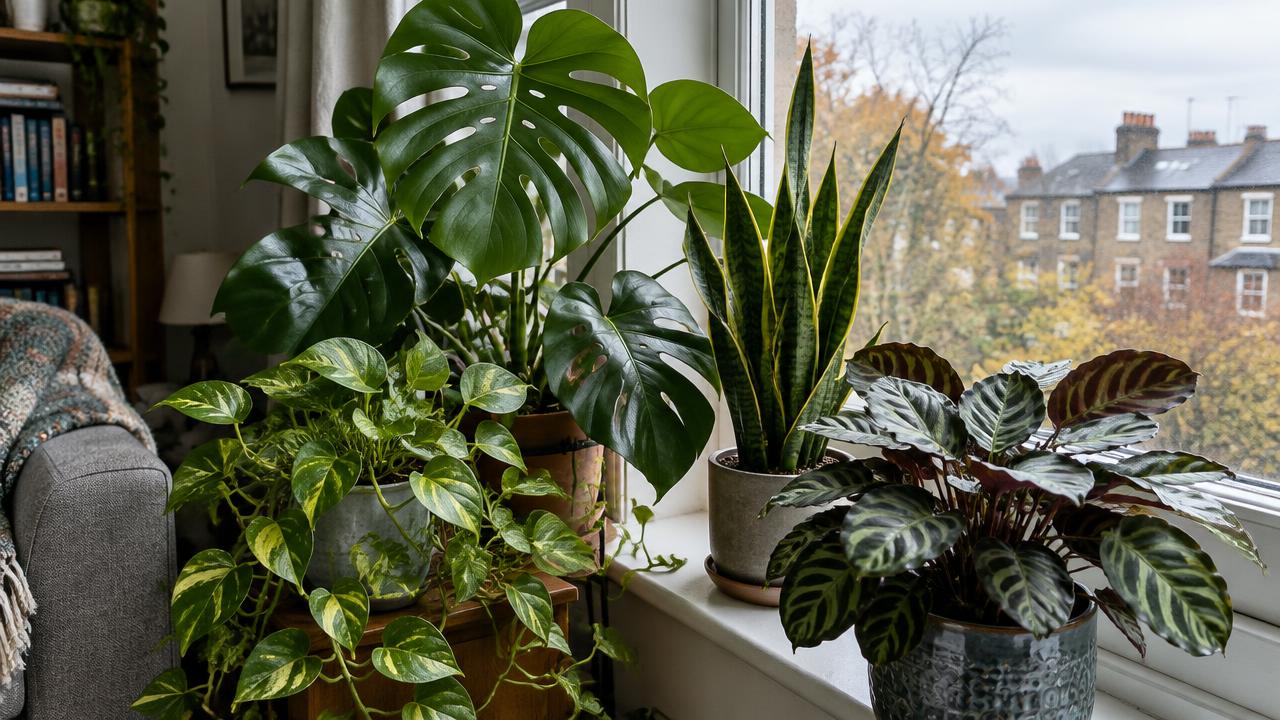
A plant that was thriving in July can be quietly going backwards by October, and the usual response is to water it, feed it or repot it. Most of the time the actual problem is the one thing people don't think to change: how much light it's getting.
The variable nobody adjusts
Ask most people what changes for houseplants in autumn and they'll say watering. Some will mention heating. Light gets less attention, which is odd, because it's one of the biggest environmental changes taking place indoors.
A British winter is genuinely dark. Days shorten at both ends, the sun sits low enough that it barely clears neighbouring buildings, and cloud does the rest. The window that delivered good growing light in June delivers a fraction of it in December.
Plants respond immediately. Photosynthesis slows, growth slows, and a plant that was putting out a new leaf every fortnight stops. That part is normal. What isn't is a plant receiving too little light to maintain healthy growth: depending on the species, it may stretch towards the light, produce weaker new growth or shed leaves it can no longer support efficiently.
What light-starved actually looks like
The symptoms are specific once you know them, and they're consistently misread. University of Minnesota guidance identifies leggy stems reaching towards a light source as a characteristic response to inadequate light.
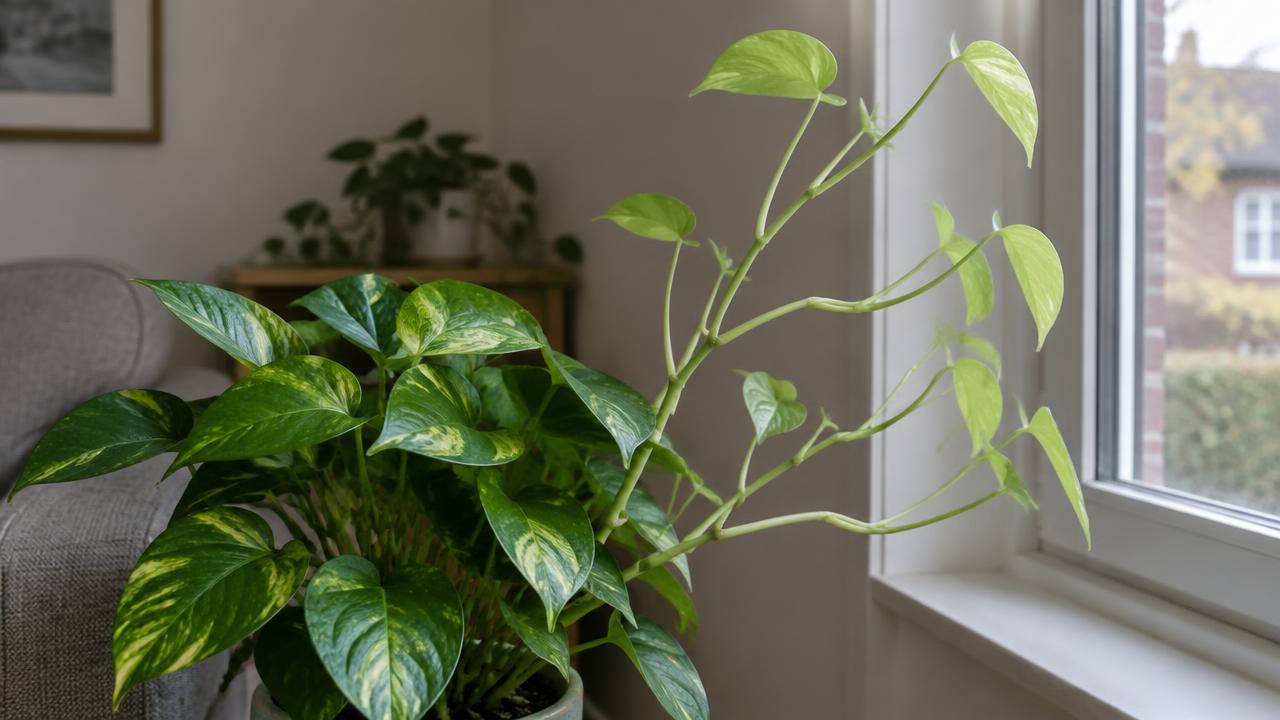
Stretching. Stems lean and elongate towards the light source. In a bad case a plant visibly leans across a room.
Longer gaps between leaves. This is the clearest sign and the one worth learning. Compare the spacing of this year's growth with older growth further down the stem. Wide, bare stretches of stem between leaves mean the plant is investing in reaching rather than in leaves.
Smaller, thinner, paler new growth. New leaves emerge undersized and a lighter green than the established ones.
Variegation fading. Some variegated plants produce greener growth in lower light. The non-green areas of variegated leaves contain little or no chlorophyll, so strongly variegated plants generally need brighter conditions than equivalent green forms. Greener new growth can therefore be a clue that conditions are too dim, although variegation is also controlled by the plant's genetics and isn't a light meter on its own.
Lower leaves dropping. A plant shedding its oldest, shadiest leaves is cutting loose tissue that's costing more than it earns.
Notice how many of those could be mistaken for something else. Pale small leaves look like a feeding problem, leaf drop looks like a watering problem, and slow growth looks like the plant needing a bigger pot. All three misreadings lead somewhere unhelpful.
Winter changes the calculation
Many tropical foliage plants are kept away from strong direct summer sun because it can scorch leaves. Winter changes that calculation: shorter days, a lower sun and generally weaker light mean a position that was too exposed in June may be useful by December.
The RHS recommends moving houseplants nearer windows in winter, with brighter south- or west-facing positions often useful where appropriate. That doesn't mean every tropical plant suddenly wants hours of direct sun, but the brightest position in the house is much less threatening than it was in midsummer.
So the plant you moved off the sunny sill in spring should probably go back for the winter, then come off again in March. It costs nothing.
There is one trade-off. A bright windowsill can also be one of the coldest places in the room at night. Keep tender foliage from pressing against very cold glass and, particularly with single-glazed windows or during frosty weather, move sensitive plants slightly further into the room overnight.
Distance matters more than you think
Light intensity decreases rapidly as a plant moves away from its source. How quickly depends on the direction and size of the window, the season, neighbouring buildings, trees, curtains and the room itself, so there is no universal distance at which a position becomes "low light".
Your eyes aren't much use for judging it. Human vision adjusts remarkably well across light levels, so a corner that looks pleasantly bright to you can provide far less usable light to a plant than the windowsill a short distance away.
So if a plant is showing signs of insufficient light, moving it substantially closer to your brightest suitable window is one of the first things to try. You don't necessarily need another windowsill either: a stand, stool or piece of furniture near the window turns otherwise unused space into a much better growing position.
In a small flat, think of good natural light as limited growing space. Give the brightest positions to the plants that need them most, and choose genuinely shade-tolerant plants for the rest.
Free things that help
None of these cost anything and all of them do more than a bottle of feed.
Move plants closer to the window. Often the biggest free improvement available. Even a relatively small move can substantially increase the light reaching the leaves.
Clean the windows. Dirt and grime reduce light transmission, so this is one of the simplest ways to make the most of limited winter daylight.
Clean the leaves. Dust on foliage blocks light at exactly the point it's needed. Wipe larger smooth leaves with a damp cloth. It looks like cosmetic tidying and isn't.
Rotate plants weekly. Otherwise one side gets everything and the plant grows lopsided.
Open the curtains properly. A curtain half-drawn across a windowsill costs the plant behind it a significant part of the day.
Prioritise the strongly variegated ones. If good positions are limited, they have the stronger claim.
Grow lights, honestly
Don't assume that because a room looks illuminated, a nearby household lamp is providing meaningful growing light. What matters to the plant is the amount and spectrum of light reaching its leaves over time, and purpose-designed LED grow lights make that much easier to provide predictably. Position and run one according to its output and the plant's needs rather than assuming any lamp will do.
Whether it's worth buying depends on you. If you've got a genuinely dark flat and want plants that need real light, a grow light is the honest solution rather than a gimmick. If you've got a decent windowsill and you're prepared to choose plants that suit it, you don't need one.
What a grow light shouldn't be is a way of keeping a light-hungry plant alive in a position that was never going to work, when the simpler answer was to put a different plant there.
What not to do
Three reflexes worth resisting, because all of them make a light problem worse.
Don't automatically feed it. Fertiliser can't compensate for inadequate light. As growth slows in autumn and winter, most houseplants need less feeding or none at all. Plants that remain actively growing in good natural light or under effective grow lights may be different, so respond to growth rather than the calendar alone.
Don't repot it. A bigger pot doesn't supply light, and repotting a plant that's already struggling in autumn adds a second problem to the first, as we covered in our piece on why repotting is a spring job.
Don't automatically water it more. Lower light and slower growth generally reduce water use, so adding water because a plant looks unhappy can make matters worse if the compost is already wet. Check the compost rather than diagnosing thirst from the leaves alone, as our autumn watering piece sets out.
Choosing for what you've actually got
The honest version of low-light plant lists is that many entries survive rather than thrive, and "tolerates low light" often means "declines slowly enough that you won't notice for a year."
Some genuinely do cope. Aspidistra, the cast-iron plant, earned its name. Snake plants and ZZ plants tolerate relatively low light better than many houseplants, though neither suits a genuinely lightless corner. Pothos manages in surprisingly poor light, producing smaller leaves and longer gaps between them. Among palms, parlour palm and kentia tolerate fairly low light, which most palms don't. Strongly variegated plants, succulents and cacti are poor candidates for dim positions.
The most useful reframing for a small space is to stop asking what will survive here and start asking what will actually be happy here.
FAQ
How do I know if my houseplant needs more light?
Look for stretching towards the window, noticeably longer gaps between leaves on new growth, smaller or paler new leaves, fading variegation, and lower leaves dropping. Compare new growth with older growth further down the stem.
Should I move my houseplants in winter?
Often yes, and towards better light rather than away from it. The RHS recommends moving houseplants to brighter positions in winter, including south- or west-facing windowsills where appropriate. Reassess in spring as light levels rise.
Is a windowsill dangerous in winter?
It can be cold at night, particularly with single-glazed windows or during frosty weather. Use the brighter position during the day, but keep tender foliage from touching very cold glass and move sensitive plants slightly further into the room overnight if necessary.
How far from a window can a plant sit?
There's no useful universal distance. A metre from a large unobstructed south-facing window can provide very different conditions from a metre from a small north-facing one. Treat distance as important, but judge the window, season and plant together. If growth is stretching or weakening, move the plant closer to a suitable window.
Do grow lights actually work?
Purpose-designed LED grow lights do. Don't assume a household lamp is providing meaningful growing light simply because the room looks bright. Position and run the light according to its output and the plant's needs.
Why is my variegated plant turning greener?
Some variegated plants produce greener growth in lower light because the green areas contain more chlorophyll. It can therefore be a sign that conditions are too dim, but variegation is also influenced by genetics, so don't use it as a diagnosis on its own.
Should I feed a plant that looks like it's struggling in autumn?
Not simply because it looks unhappy. Fertiliser can't correct inadequate light, and most houseplants need less or no feed as growth slows. Plants still actively growing in strong light or under grow lights may be different.
READ THE FULL GUIDE
Best Indoor Plants for Beginners →
RELATED POSTS
Robin is a small-space grower writing for everyone working with a courtyard, balcony, window box, patio or sunny sill. Edible and leafy, both kept alive in the kind of light real small spaces actually get.
✦ Free with the newsletter — the small-space starter sheet
Grow Anywhere — a free weekly email.
The Potted Club newsletter. A short note from Robin — what to sow, one plant problem solved, and the best new guide.
FREE WEEKLY EMAIL · NO SPAM · UNSUBSCRIBE ANYTIME