
How to Keep Potted Herbs Alive Through a Wet British Winter
Why winter rain and waterlogged compost kill more potted herbs than cold, how to rescue a pot that is too wet, and what rosemary, thyme, sage, oregano, mint, chives, parsley, tarragon and basil each need until spring.
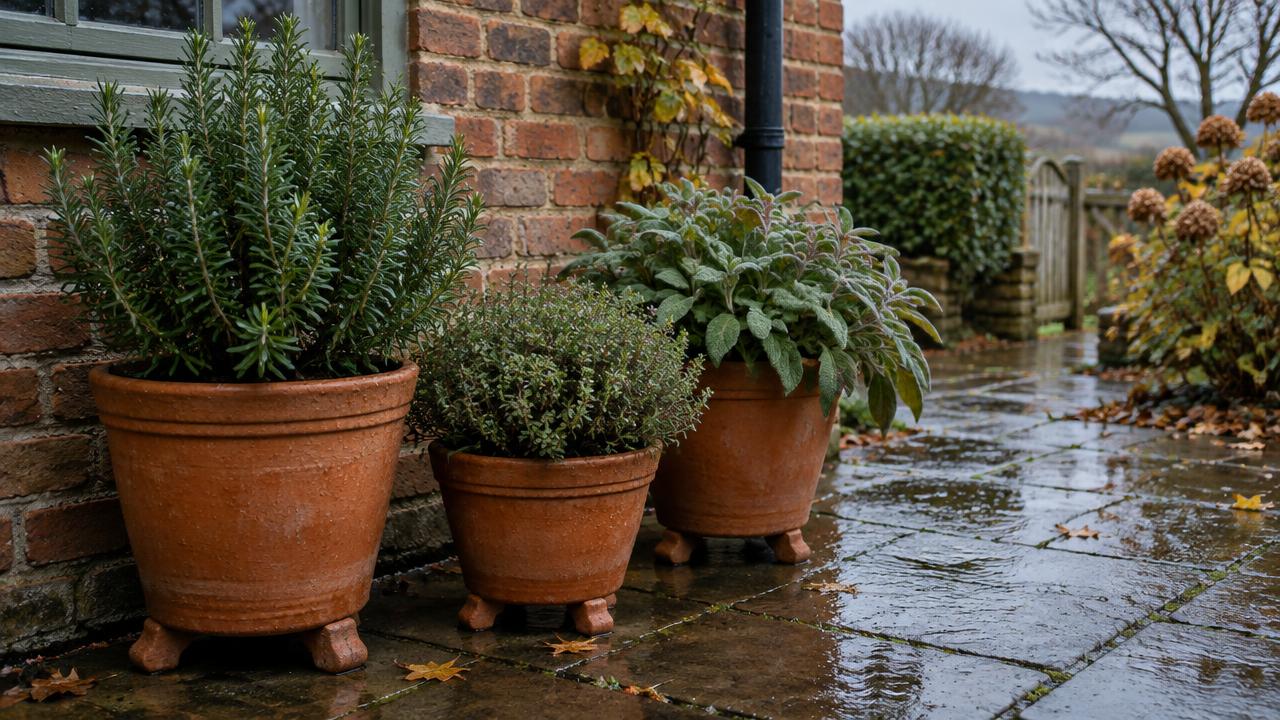
After a summer spent worrying about drought, the problem for potted herbs this winter is likely to be the opposite. Established rosemary, thyme and sage are hardy enough for most British winters, and cold alone is often not what kills them. What usually finishes them is weeks of rain and compost that never gets the chance to drain, leaving the roots sitting in water until they rot. This explains which herbs are most at risk, how to rescue a pot that is already too wet, and what each of the common herbs needs between now and spring.
Why wet compost does the damage
The RHS advice for herbs in containers is that over winter they must not be allowed to freeze solid, become saturated by rain or dry out completely. For the woody Mediterranean herbs, saturation is the one to watch. Its rosemary advice says cold, wet compost can cause the roots to rot and die, and it gives the same warning about excess winter rain for thyme, sage and oregano.
That changes what winter care looks like. Wrapping a pot in fleece does little for a herb whose compost is waterlogged, while getting it out of the worst of the rain does a great deal. A pot also behaves differently from the open ground. The RHS warns that container plants are prone to waterlogging in winter and stresses the need for good drainage. In a pot, water has nowhere to go if the drainage holes are blocked or the pot is standing in a saucer.
Rescuing a pot that is too wet
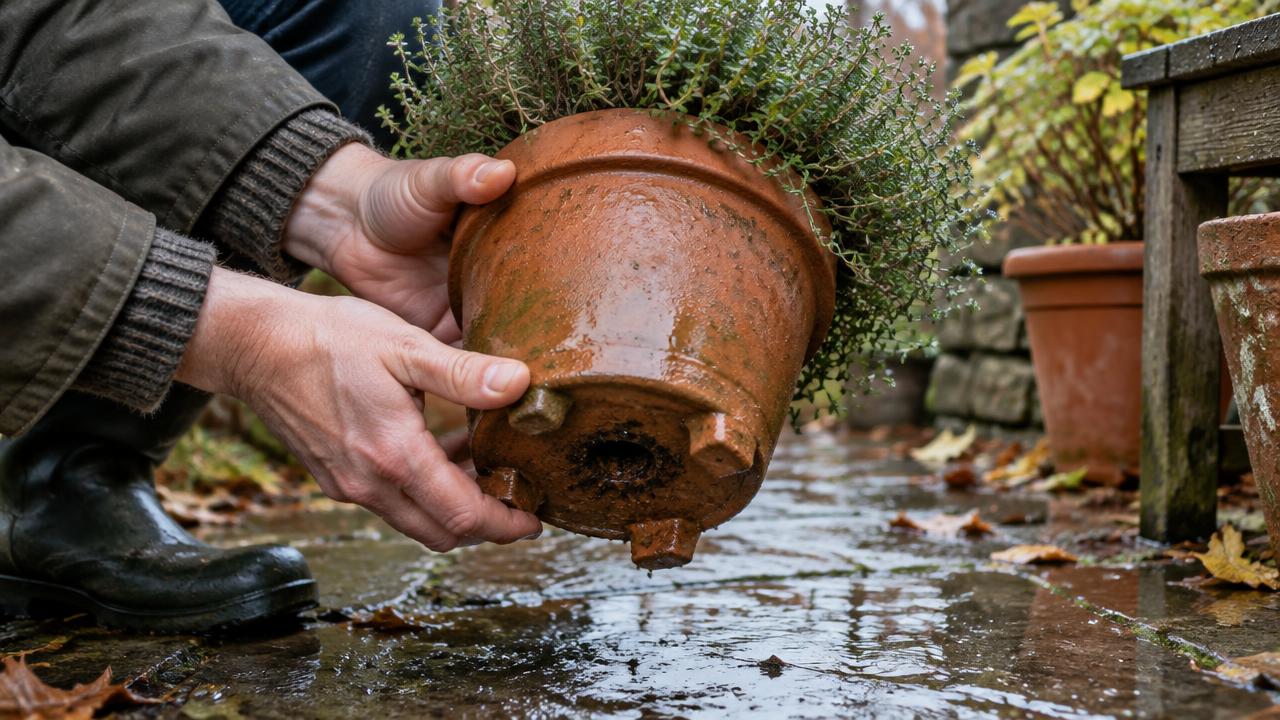
If a pot has been sitting in the rain for weeks, start with the saucer. The RHS advises removing trays and saucers before winter so pots are not left standing in water. A saucer full of rainwater keeps the compost wet however good the drainage holes are. Then raise the pot. The RHS suggests standing containers on bricks or pot feet to keep the drainage holes clear.
Check the drainage holes themselves. If water is not running out freely after rain, the RHS advises checking for a blockage. It can be compacted compost, roots, or simply a pot pressed flat against wet paving. Clear what you can from underneath with a pencil or stick.
Next, move the most vulnerable herbs out of the rain. The RHS suggests the rain shadow of a wall, a cold frame or even an open-fronted shed, and in particularly wet areas a sheet of glass or plywood propped over the pot to keep off heavy rain. In very wet periods, its general container advice is to move plants under temporary cover if the compost becomes sodden, until it has dried out a little.
Finally, check the compost before you water anything. A herb in waterlogged compost can look as though it needs water, because the RHS explains that waterlogged roots are short of oxygen and cannot take up water, which can make a plant wilt even when it is wet. Push a finger a few centimetres into the compost. If it is wet, leave it alone and let it drain.
Repotting a waterlogged herb in midwinter is usually more disturbance than it is worth. The time to fix the compost itself is spring, when the RHS recommends a gritty, well-drained mix with up to 25 per cent coarse grit or perlite added to a loam-based compost such as John Innes No 1. It also warns that herbs can easily rot if they are overpotted, so a small plant in a much bigger pot of compost is more likely to stay wet.
Sheltered is not the same as dry
Moving a herb into a rain shadow solves one problem but can create another. A pot tucked under the eaves may get almost no rain at all, and evergreen herbs still lose some water through their leaves in winter. The RHS advises checking evergreens in containers at least weekly in winter and watering if needed, and avoiding watering if frost is forecast.
Its aim for herbs in pots is compost that is moist but never soggy, avoiding swings between dryness and saturation. So if you have moved your rosemary next to the house, it may need a small drink during a dry spell even in December. Give just enough to moisten the compost, and let any excess drain away.
Rosemary, thyme, sage and oregano
These four can stay outside through most British winters, provided they are not left standing in wet compost. They are the herbs that most need everything in the rescue section above.
Rosemary is hardy in most of the UK. The RHS says established plants can survive down to about minus 8°C, but that pots are more vulnerable than plants in the ground because their roots can freeze. In colder spells, it suggests clustering pots together, wrapping them, or moving them to a porch, greenhouse or sheltered wall. Thyme dislikes damp conditions, especially in winter, and the RHS says most garden-centre thymes are hardy, although a few less hardy types are better moved under cover, so check the label.
Sage is generally hardy, but excess winter rain can rot its roots, so the RHS advises moving container plants somewhere sheltered, such as against a wall. Oregano is reliably hardy in its common forms, and the RHS says it is important to protect it from waterlogging over winter, which will cause the roots to rot, by moving pots near a building out of heavy rain. If very cold weather is forecast, the RHS suggests wrapping containers in bubble polythene to stop the compost freezing.
Leave pruning until spring for all four. The RHS advises trimming rosemary after flowering, sage in mid to late spring and oregano in late spring, and warns against cutting rosemary or sage back into old wood, which may not regrow.
Mint, chives, parsley and French tarragon
These behave quite differently, and the main risk is giving up on a healthy plant. Mint is fully hardy and dies back over winter, and the RHS says it regrows each spring. You can cut off the old stems any time from late autumn until spring, just before the new shoots appear. Chives die back in autumn too and return in spring, and the RHS suggests potting up a clump for a sunny windowsill if you want leaves through winter.
Parsley is a biennial and dies down outside over winter. The RHS says it will keep producing new leaves under a cloche or cold frame, or indoors, given enough light and warmth, but advises against keeping plants into a second year for leaves, so plan to sow or buy fresh in spring.
French tarragon is the one to watch in this group. The RHS says its top growth dies back after the first hard frost and the plant resprouts in spring, so an empty-looking pot is normal. But it also says French tarragon can struggle in UK winters because of the combination of wet and cold, and dislikes damp conditions. It is best grown in a container for exactly this reason, so it can be moved somewhere dry, such as a porch or greenhouse, or at least into a rain shadow beside a building.
Basil and other tender herbs
Basil cannot stay outside through a British winter at all. The RHS says it will only survive if brought indoors into a warm, bright, frost-free place, such as a sunny windowsill, conservatory or greenhouse. The RHS also treats sweet marjoram as tender, sowing it indoors and planting out only after the risk of frost has passed, so do not confuse it with hardy oregano when deciding what to leave outside. Our guide to growing basil on a windowsill covers keeping it going indoors.
What to leave until spring
Leave buying new herbs, repotting and hard pruning until the weather warms up. The RHS advises waiting until late spring to buy new herb plants for containers, because winter-planted herbs are vulnerable to root damage in cold, wet compost. Spring is also the time to replace any thyme or sage that has gone woody and bare, rather than cutting it hard back, and to repot herbs that have spent the winter in compost that would not drain, into a grittier mix and a pot that suits their size.
Until then, the job is simple. Take away the saucers, lift the pots, clear the drainage holes, move the woody herbs out of the heaviest rain, and check the compost before you water. Most potted herbs will come through a wet winter if their roots are not left sitting in water.
FAQ
Can rosemary stay outside in a pot over winter?
Usually, yes. The RHS says established rosemary can survive down to about minus 8°C, but cold, wet compost can rot its roots, so move the pot somewhere sheltered from heavy rain, such as near a building in a rain shadow.
Should I take the saucers away from my herb pots in winter?
Yes. The RHS advises removing trays and saucers before winter so pots are not left standing in water, and raising pots onto bricks or pot feet to keep the drainage holes clear.
Do potted herbs need watering in winter?
Sometimes. The RHS advises checking evergreen plants in containers at least weekly in winter and watering if needed, but not if frost is forecast. Pots in a rain shadow under eaves can dry out even in a wet spell.
My French tarragon has disappeared. Is it dead?
Not necessarily. The RHS says its top growth dies back after the first hard frost and the plant resprouts in spring, although French tarragon can struggle with the combination of wet and cold, so keep the pot somewhere dry.
Can I leave basil outside over winter?
No. Basil is tender, and the RHS says it will only survive winter indoors, in a warm, bright spot such as a sunny windowsill, conservatory or frost-free greenhouse.
READ THE FULL GUIDE
Container Growing Fundamentals →
RELATED POSTS
Robin is a small-space grower writing for everyone working with a courtyard, balcony, window box, patio or sunny sill. Edible and leafy, both kept alive in the kind of light real small spaces actually get.
✦ Free with the newsletter — the small-space starter sheet
Grow Anywhere — a free weekly email.
The Potted Club newsletter. A short note from Robin — what to sow, one plant problem solved, and the best new guide.
FREE WEEKLY EMAIL · NO SPAM · UNSUBSCRIBE ANYTIME