
Wind Damage in the Garden. What to Do Before and After a Storm
How to protect pots, hanging baskets and balcony plants before strong winds, and how to assess and deal with wind damage safely afterwards, including the damage that isn't obvious.
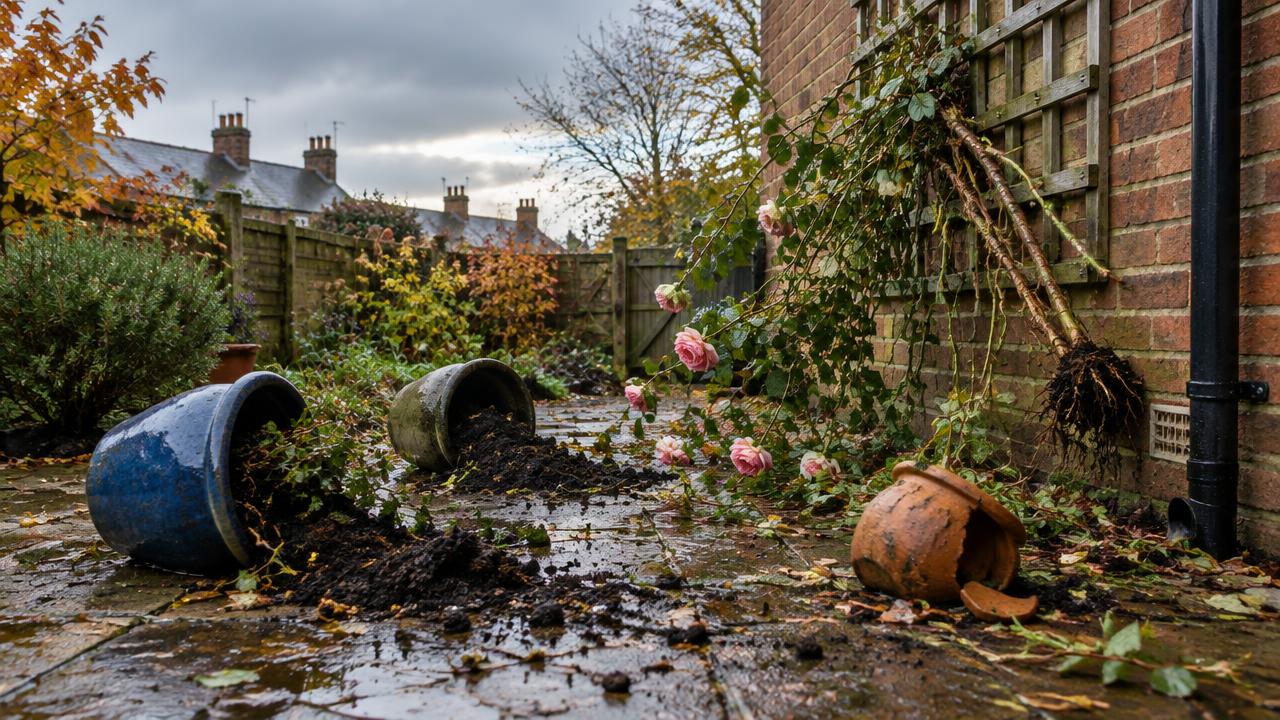
Wind damage is not always the obvious kind. A pot on its side and a snapped branch are easy to spot, but a shrub can stay upright with its roots loosened, and an evergreen can look fine for a week before its leaves turn brown. Equally, a plant that looks battered may recover without being cut back at all. This covers the few things worth doing before strong winds, and then how to work through the damage safely afterwards, including what to leave alone until conditions improve.
Before the wind arrives
The Met Office advice before a storm is to secure loose objects, such as ladders and garden furniture, that could be blown into windows, and that includes plant pots on a balcony or windowsill. In a small garden, the containers to worry about are the tall, top-heavy ones in light pots, hanging baskets on exposed brackets, and window boxes on upper floors where a fall could hurt someone below.
Move tall pots into the shelter of a house wall, or lay them on their sides on the ground if there is nowhere sheltered. Take down hanging baskets from exposed brackets and stand them somewhere protected, and check that window boxes are fixed securely. The RHS suggests grouping containers together near a house wall in winter for protection, although it also warns against spots where buildings funnel the wind.
For a balcony or patio that catches the wind every winter, a longer-term fix is worth considering. The RHS says a windbreak that filters 50 to 60 per cent of the wind, such as netting or a woven screen, is ideal, and warns that solid walls and fences can push wind over the top and create turbulence just behind them.
Then stay indoors. The Met Office advises staying inside as much as possible during a storm and not going out to repair damage while it is still in progress. Nothing in a small garden is worth the risk of being out in it.
After the storm, start with safety
Wait until the wind has properly dropped before going out. The Met Office warns that walls, buildings and trees may have been weakened, so do not walk too close to them, and advises keeping away from the sheltered side of boundary walls and fences. Do not touch electrical or telephone cables that have come down or are hanging loose.
Look for fallen fence panels, loose trellis, broken glass from a cold frame or greenhouse, and branches hanging half-detached from a tree before you start on the plants. For any tree damage beyond what you can reach safely from the ground, the RHS advice is to make an honest appraisal of your own capabilities and, if in doubt, use a professionally qualified tree surgeon or arboriculturist. A tree that is leaning badly should be assessed by someone qualified rather than pulled upright.
Get containers back in order
Once it is safe, right any pots that have blown over and check the roots. If compost has spilled and roots are exposed, top up with fresh compost and firm it gently. A cracked pot may hold together until spring, but if the plant is now loose in a split container, repot it into something sound. Our guide to repotting explains how to do it with the least disturbance.
Collect hanging baskets that have come down and check brackets and window box fixings before putting anything back up. Wet compost makes containers much heavier than they look, and a bracket that has been strained by one storm is more likely to fail in the next.
Check the damage you can't see
The most important check is the one that is easy to skip. Shrubs and young trees that have been rocked back and forth can look fine above ground but be damaged below it. The RHS explains that wind rock can damage roots and lead to water collecting in the socket that forms around the base of the stem, and that movement at soil level can cause rot.
Push gently on the stem of anything recently planted and see whether the rootball moves in the soil or compost. If it does, firm the plant back in, mound soil around the base of the stem and give it more shelter, as the RHS suggests. Check stakes and ties too. The RHS advises making sure they are still intact and well anchored after bad weather, with no signs of rubbing, and that stakes should be no taller than a third of the stem height.
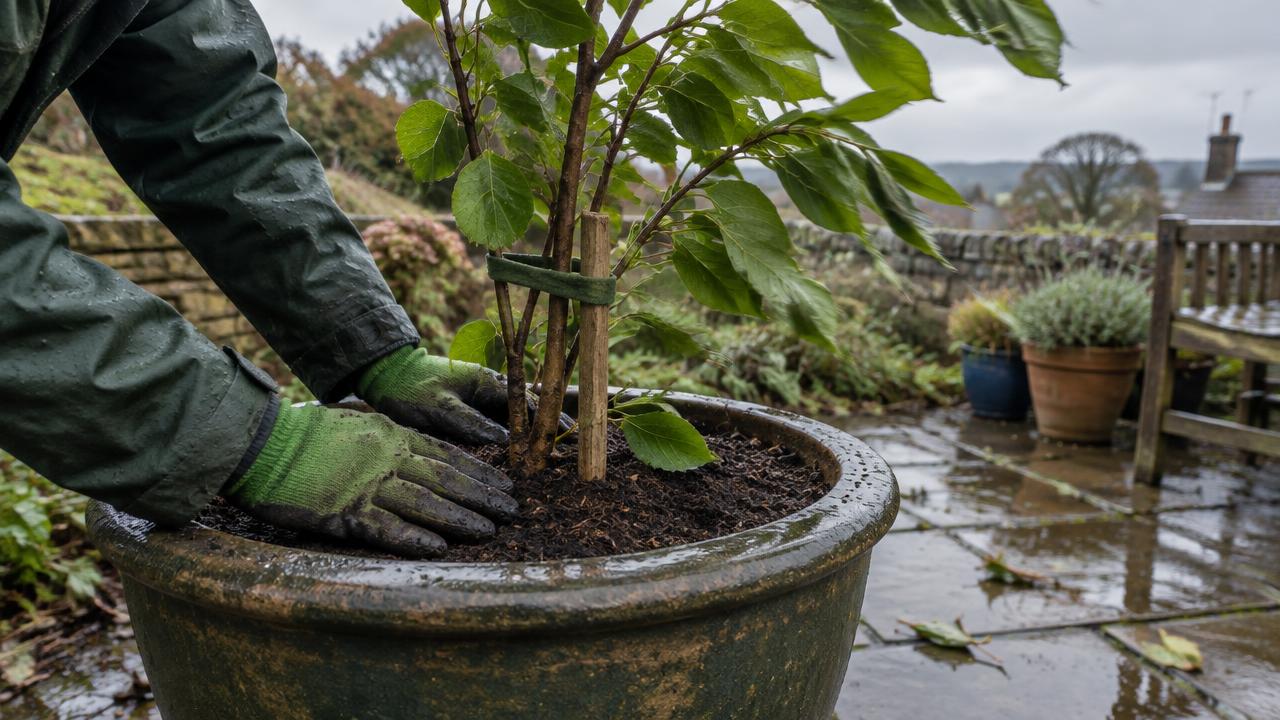
Broken stems and branches
Small, completely broken stems are worth tidying straight away. The RHS says damaged wood can be removed when first noticed, to stop problems spreading into healthy wood. Use clean, sharp tools and cut back to healthy growth, just above a healthy bud or side shoot, so the plant is left with a clean cut rather than a ragged tear.
On a small tree, the RHS advice for a larger branch is to cut just outside the branch collar, the slightly swollen ring where the branch joins the trunk, rather than flush with the trunk, and to make an undercut first so the falling weight does not tear the bark. It says there is no need for wound paint, except on plums and cherries, where it may help keep out silver leaf. Anything heavy or above head height is a job for a professional.
Climbers pulled away from their supports need tying back in once the support itself is secure. The RHS recommends soft twine, or rubber ties for heavier stems, and a figure-of-eight knot on windy sites, which stops the stem rubbing against the support. It warns against wire or metal ties, which cut into stems as they thicken.
Wilting is not always thirst
A plant that wilts after a storm looks as though it needs water, and sometimes it does. Strong winds dry out leaves and compost, especially in exposed pots and baskets. But after a stormy spell there has often been heavy rain as well, and the RHS warns that a waterlogged plant can look short of water and even wilt, because its roots are short of oxygen and cannot take up water.
So check the compost before reaching for the watering can. Push a finger a few centimetres into it. If it is dry, water. If it is sodden, empty any saucers, make sure the drainage holes are clear, and move the pot somewhere sheltered from further rain until it drains. The RHS adds that plants which have been waterlogged are more prone to drought stress afterwards, so keep an eye on them in the next dry spell and water thoroughly if the compost dries out. Our article on container growing fundamentals covers drainage in more detail.
Leaves that turn brown later
A few days after a storm, evergreen leaves may brown at the edges, often on the side that faced the wind. The RHS says this kind of damage is often worse where wind dries out the leaves, and in its advice on wind scorch it notes that large-leaved evergreens are more affected than small-leaved plants and that pot plants are at particular risk.
This does not mean the plant is dying, and it is not a job for now. The RHS advises cutting out scorched foliage from broadleaved evergreens in spring, as growth resumes. Conifers are the exception, and the RHS warns that they often fail to regrow from badly damaged shoots and should not be pruned.
What to leave alone
The temptation after a storm is to cut everything back and start again. Resist it. The RHS says that in most cases a plant will recover from weather damage on its own, and that symptoms can take weeks or even months to show, so a shrub that looks battered now may be perfectly healthy by late spring. Tidy what is broken, firm in what is loose, and leave the shaping and any decision about whether a plant has survived until growth starts again. Our article on protecting pots from frost covers what else is worth doing for containers as winter goes on.
FAQ
Should I go outside during a storm to rescue my plants?
No. The Met Office advises staying indoors as much as possible and not going outside to repair damage while the storm is in progress. Wait until the wind has dropped.
My plant is wilting after a storm. Should I water it?
Check the compost first. Wind can dry plants out, but the RHS warns that waterlogged roots are short of oxygen and can make a plant wilt even when the compost is wet.
Why have the leaves on one side of my shrub gone brown?
The RHS says browning is often worst where wind dries out the leaves, usually on the windward side. For broadleaved evergreens, it advises cutting out scorched foliage in spring rather than straight away.
Should I cut back a storm-damaged plant straight away?
Only the broken parts. The RHS says damaged wood can be removed when first noticed, but leave wider pruning until the right time of year for that plant.
How do I know if a wind-damaged plant is dead?
Usually you can't tell straight away. The RHS says most plants recover from weather damage and that symptoms can take weeks or months to show, so wait until spring before deciding.
READ THE FULL GUIDE
Container Growing Fundamentals →
RELATED POSTS
Robin is a small-space grower writing for everyone working with a courtyard, balcony, window box, patio or sunny sill. Edible and leafy, both kept alive in the kind of light real small spaces actually get.
✦ Free with the newsletter — the small-space starter sheet
Grow Anywhere — a free weekly email.
The Potted Club newsletter. A short note from Robin — what to sow, one plant problem solved, and the best new guide.
FREE WEEKLY EMAIL · NO SPAM · UNSUBSCRIBE ANYTIME