
How to Winter-Proof Pots and Planters
Why pots crack in winter, what frost-proof labels mean, how each material copes with frost, and how to protect window boxes and balcony containers.
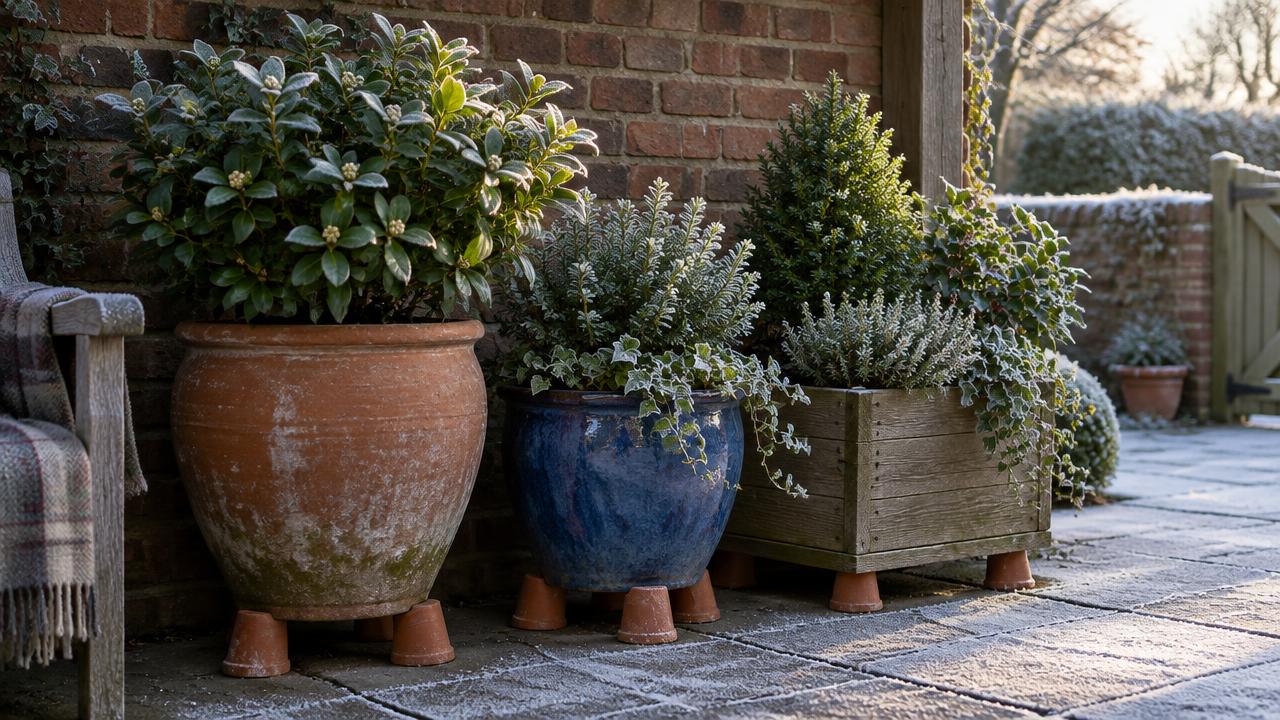
Frost doesn't only damage plants. Every spring, plenty of gardeners find a favourite pot split down the side or flaking at the rim, even though the plant in it came through the winter perfectly well. Most of that damage comes down to water, either soaked into the pot itself or trapped in the compost, and much of it can be prevented with the right container and a few changes before the cold sets in. This covers why pots fail in winter, what the labels mean, how each material copes, and how to look after window boxes and balcony containers.
Why pots crack in winter
The main cause is water inside the material of the pot. Potclays, a UK ceramics supplier, explains that water expands as it freezes, and the force of that expansion can crack a pot or make its surface flake away. Whichford Pottery, which makes terracotta pots in Warwickshire, describes the same process, with moisture inside the clay freezing and expanding until the surface flakes. Repeated freezing and thawing through a winter makes the damage worse, which is why a pot can look fine in December and be flaking by March.
The compost inside the pot adds to the pressure. Wet compost expands as it freezes, and if the pot can't drain, the whole contents can freeze into a solid block that pushes outwards against the walls. Blocked drainage holes make this much more likely. The shape of the pot may play a part as well. In a pot that narrows towards the opening, frozen compost has less room to rise, so more of the force is likely to press against the sides. That doesn't mean every rounded or narrow-necked pot will crack, but it is one more reason to keep these pots well drained, or move them under cover in a cold spell.
Frost-proof or frost-resistant
Labels on pots can be confusing, because frost-proof and frost-resistant are not universal technical standards. One maker's frost-proof pot may have been tested in a very different way from another's, so it helps to tell the difference between a claim on a label, evidence that the pot has been tested, and a written guarantee. Potclays goes further, saying it is almost impossible to make a pot totally frost-proof, because all clays have some porosity.
What makes the difference is how the clay was made and fired. Potclays says low-fired terracotta readily absorbs moisture, while higher-fired clays, and clays with more grog (crushed, pre-fired clay mixed into the body), are better at resisting frost damage. A well-applied glaze reduces how much water the clay absorbs. When you buy a pot, look for information about how it was fired and tested, and check the terms of any guarantee. Whichford Pottery, for example, offers a 10-year guarantee against frost damage to its pots, though it covers frost damage only, not accidental breakage, and not every frost-proof pot comes with anything comparable.
With older pots, inspect them before winter. Learning with Experts, an online horticultural school, notes that glazed pots with a crazed glaze, a network of fine surface cracks, can be more likely to have problems in winter, and that fine cracks in thick rims let water in, where it freezes and flakes the clay. Crazing doesn't mean a pot will fail, but it is worth giving such a pot more shelter. A pot with a visible structural crack is a poor candidate for another winter outside. A repaired pot can still be used decoratively, but don't assume it has regained its original strength or frost resistance.
Pot materials
For winter, the RHS suggests choosing frost-proof terracotta or containers made of plastic, fibreglass or wood. Each behaves a little differently.
Terracotta is the most vulnerable to frost damage if it is low-fired, because it absorbs water. A good-quality, high-fired pot will usually cope with a British winter, but cheap terracotta is best kept for summer or moved under cover. Glazed ceramic absorbs less water than bare terracotta, but the glaze needs to be intact, and water can still get in through the unglazed base or any chips. Plastic and fibreglass don't absorb water and are much less likely to crack from frost, and they are light enough to move easily. The protection any container gives the roots depends on the thickness of its walls, the volume of compost and how exposed it is, and a frost-resistant container doesn't necessarily stop the plant inside it from freezing.
Wooden planters cope well with frost, but timber left standing in water or wet compost for months will eventually rot. Make sure a wooden planter drains freely, raise it off the ground so the base can dry out, and check the joints and fixings before winter, because a loose corner on a heavy planter can open further as wet compost freezes. Metal containers won't crack in the frost, but metal conducts heat readily, so the compost inside can warm and cool quickly as the weather changes. Good drainage and protecting the roots matter more than the container itself.
Drainage, saucers and outer pots
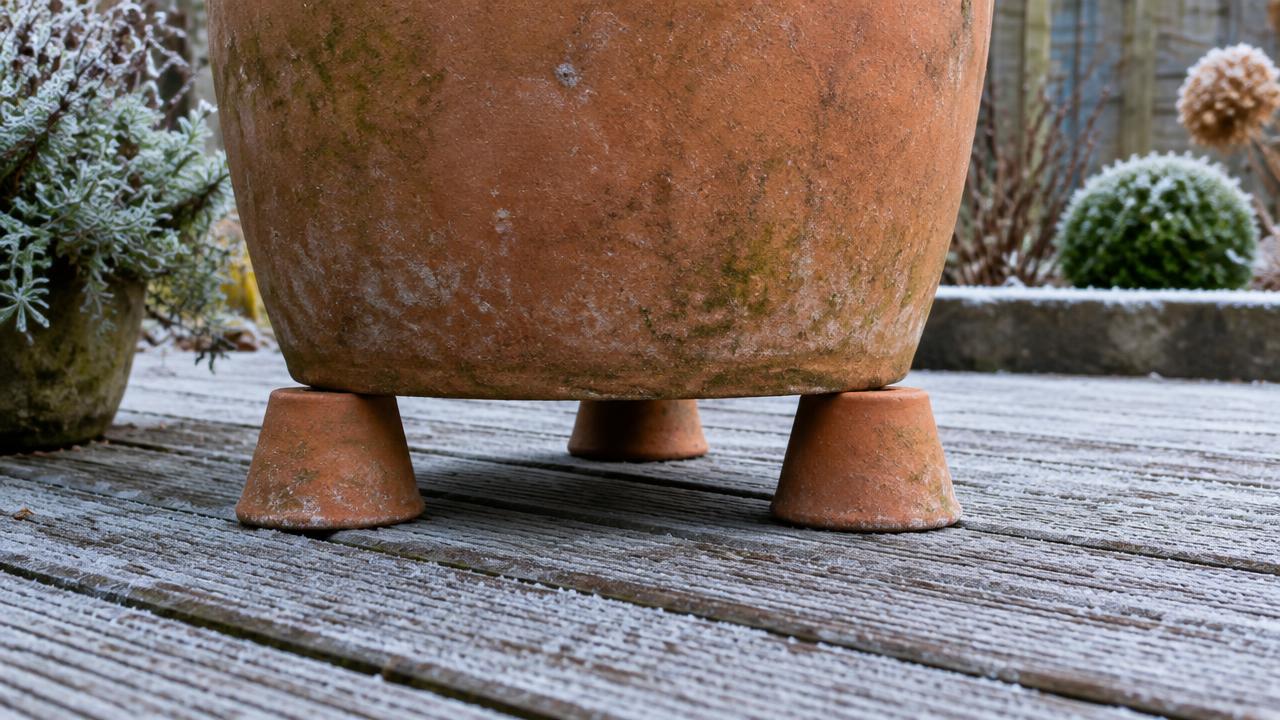
Good drainage is the single most useful thing you can do for a pot in winter. Check that the drainage holes are clear before the cold weather arrives. The RHS advises raising containers on pot feet or bricks to aid drainage, and says this helps prevent the freezing conditions that crack pots. Take pots out of saucers for the winter, because a pot sitting in water can't drain, and the compost stays saturated.
Decorative outer pots need the same attention. Many small-space gardeners grow plants in a plastic nursery pot sitting inside a more attractive container. In winter, rain drains out of the inner pot and collects in the outer one, so the roots end up sitting in water, which can freeze solid in a cold spell. Empty out any water that collects, particularly after heavy rain. Lifting the inner pot onto a few stones helps it drain, but it won't stop the roots flooding if the outer pot keeps filling. Where an outer pot has no drainage hole at all, move the arrangement under cover for the winter or use it only where rain can't collect.
Pots standing directly on timber decking can cause a different problem. Water trapped beneath a heavy container can't dry out, which isn't good for the pot's drainage or for the decking underneath. Pot feet solve both problems, letting water drain away and air circulate beneath the pot.
Wrapping and grouping
Wrapping protects the roots as well as the pot. The RHS suggests bubble-wrapping containers in severe weather to reduce damage to plant roots, keeping pots in dry, sheltered spots grouped together for mutual protection, and plunging pots into the ground with the rim just showing if you have space. Our complete guide to protecting plants from frost covers which plants need this most, and our article on when to protect pots from frost explains why not every pot needs wrapping.
Empty pots
Empty pots left outside fill with rain, and a pot full of water or wet compost is the most likely to crack. If you have pots you won't be using until spring, empty out the compost, which can go on the compost heap or be reused if it is still in reasonable condition, let them dry, and store vulnerable ones, especially cheaper terracotta, in a shed, garage or under some other cover. If they have to stay outside, keep them where rain can't collect in them. Laying a stable pot on its side or turning it upside down can stop it filling with water, but on a windy balcony or roof terrace, a light pot left loose can roll or blow away, so stack or secure them instead.
Window boxes and balcony containers
Window boxes and balcony containers need more attention in winter than pots on the ground. Check the box itself before the winter storms, particularly the base of an older timber box, as well as the brackets and fixings that hold it, above all where a box sits above a path, a pavement or someone else's balcony. A window box full of wet compost is much heavier than a dry one, and a failed fixing could injure someone below.
On a balcony, weight comes first. The RHS warns that there will be strict weight restrictions on balconies that are suspended out from the building, and that large containers full of compost, the plants in them and the people using the space all add up to a considerable weight. It suggests placing heavy containers near load-bearing walls or over a load-bearing beam, which can take more weight than unsupported areas, but that is a starting point, not a guarantee of safety. If you rent, check the building's rules before adding large planters. Where you aren't sure what your balcony can take, ask the building's owner or managing agent for reliable structural information, and get advice from a qualified structural engineer rather than assuming a spot beside a wall is safe. The RHS advice on roof gardens also refers to a structural survey to show whether existing supports are sufficient.
Wind is the other risk. The RHS says that a container filled with a lightweight peat-free compost may need fixing so it doesn't blow over in strong winds. It also notes that solid walls can create turbulence on the side away from the wind, and suggests slatted or mesh screens that filter it instead. In small containers, the RHS says plastic, metal and fibreglass are better than terracotta on balconies, because they lose less moisture. Our article on wind damage covers what to do before and after a storm.
Watering and checks through winter
Containers still need water in winter. The RHS advises watering containers carefully, checking the compost first, because pots can dry out in mild spells, and smaller plants are more susceptible to overwatering or underwatering. Pots sheltered under eaves or against a wall often miss most of the rain. On its page about roof gardens and balconies, the RHS says container plants need watering all year round, except in freezing conditions. Check the compost below the surface on a mild day. If it is dry and has thawed, water enough to moisten the rootball, preferably in the morning, and let the excess drain away before the temperature drops. Avoid watering when frost is forecast. It isn't necessary to feed container plants in winter.
Once a month or so, and after any hard frost or storm, walk round your containers. Check that drainage holes are still clear, no water has collected in saucers or outer pots, wrapping is still in place, and window box fixings are secure. A few minutes of checking through the winter is much cheaper than replacing pots in spring. Our article on keeping potted herbs alive through a wet winter explains how to rescue a pot that has become waterlogged.
FAQ
Why do terracotta pots crack in winter?
Terracotta is porous, so it absorbs water. When that water freezes, it expands, which can crack the pot or make the surface flake away. Wet compost inside the pot expands as it freezes too, which adds to the pressure.
What is the difference between frost-proof and frost-resistant pots?
There is no single standard behind either label, and pottery suppliers say almost no clay pot is completely frost-proof. Higher-fired, well-made pots resist frost better. Check what the maker says about testing and whether it offers a frost guarantee.
Should I take pots out of their saucers in winter?
Yes. A pot standing in water can't drain, and waterlogged compost is more likely to freeze solid and damage roots or crack the container. Raise pots on feet or bricks instead, which the RHS recommends to aid drainage.
Are plastic pots better than terracotta in winter?
Plastic won't absorb water and crack in the way porous clay can, and the RHS includes it among the materials it suggests for winter. A frost-resistant pot doesn't necessarily stop the roots freezing, though, so plants that need protecting may still need their pots wrapping.
Do pots need watering in winter?
Yes, though much less than in summer. The RHS advises checking the compost before watering, because pots can dry out in mild spells. Water on a mild day when the compost has thawed, not when frost is forecast.
READ THE FULL GUIDE
The Complete Guide to Protecting Plants from Frost →
RELATED POSTS
Robin is a small-space grower writing for everyone working with a courtyard, balcony, window box, patio or sunny sill. Edible and leafy, both kept alive in the kind of light real small spaces actually get.
✦ Free with the newsletter — the small-space starter sheet
Grow Anywhere — a free weekly email.
The Potted Club newsletter. A short note from Robin — what to sow, one plant problem solved, and the best new guide.
FREE WEEKLY EMAIL · NO SPAM · UNSUBSCRIBE ANYTIME