
The Complete Guide to Protecting Plants from Frost
How to protect plants from frost with fleece, wrapping and shelter, how to protect pots, and what to do after frost damage, with RHS advice.
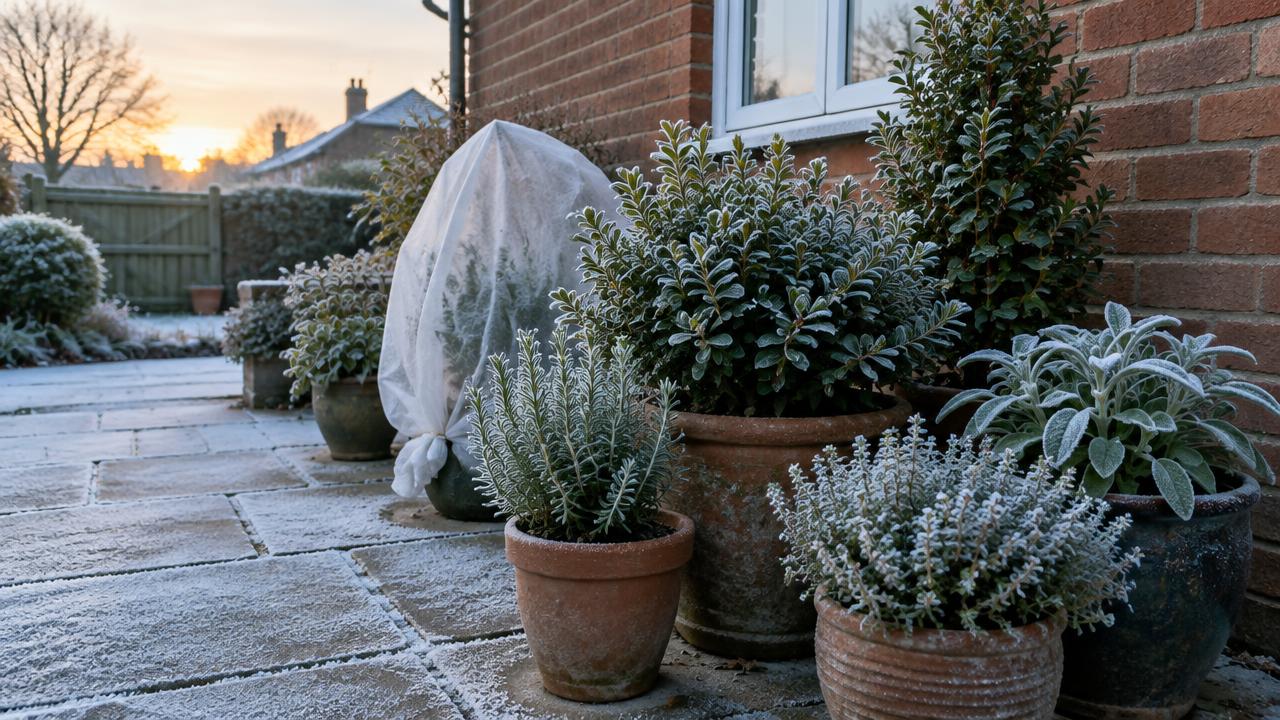
The first frosts of winter can undo months of growing in a single night, but most of the damage is avoidable if you know which plants are at risk and what to do before the temperature drops. This guide explains how frost harms plants, how to read a hardiness rating, and how to protect plants in the ground, in pots and against a wall, using fleece, cloches, wrapping and a few simple changes to where things stand. It also covers what to do the morning after, when the instinct to cut everything back is usually the wrong one.
How frost damages plants
Frost harms plants by freezing the water inside them. The RHS explains that freezing can damage or destroy plant cells, and that repeated freezing and thawing, or very rapid thawing, is particularly harmful. That is why a frost followed by bright morning sun often does more damage than a frost on a grey day. The RHS advises siting early-flowering plants such as camellias and magnolias where they won't catch the morning sun, so their flowers thaw slowly.
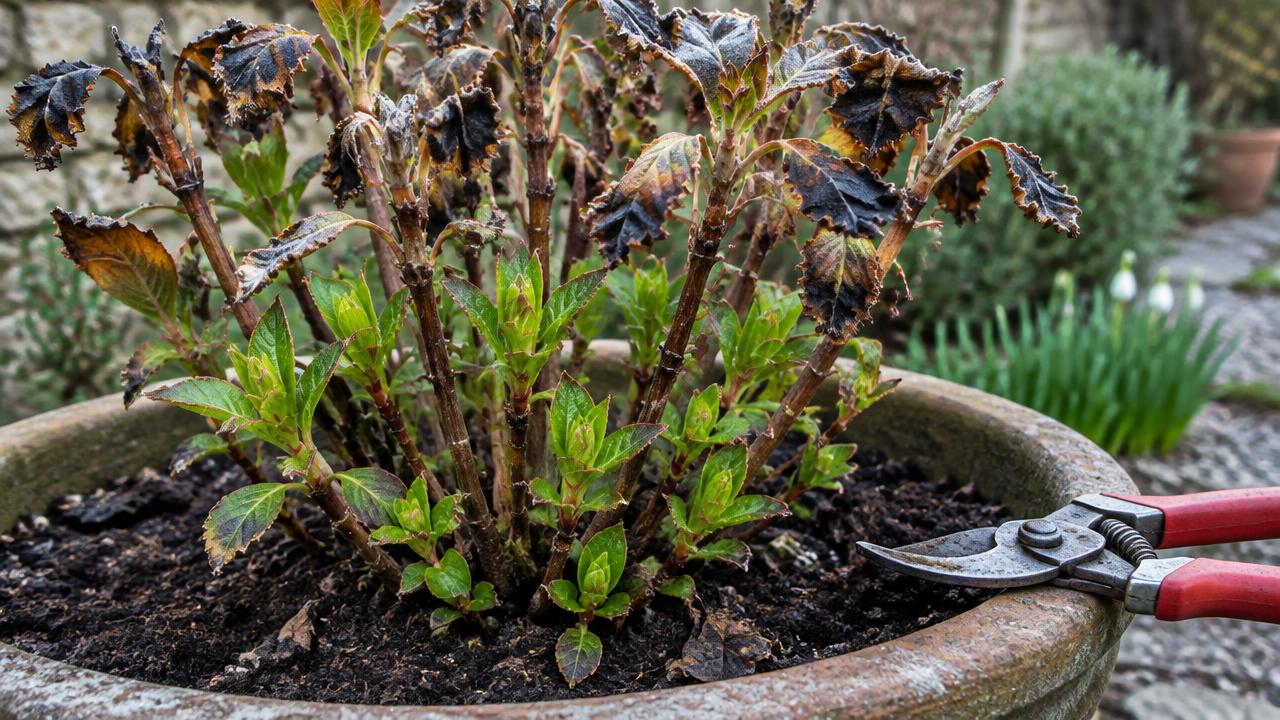
The damage shows up in different ways depending on the plant. The RHS says young growth may show scorched, pale brown patches between the veins of the leaves, and that a hard winter frost can scorch and brown the leaves of hardy evergreens. Tender perennials such as dahlias and cannas are usually blackened by the first autumn frost, and their stems collapse. On woody plants, the damage can take months to appear.
Cold wind makes everything worse. The RHS notes that cold winds after freezing draw moisture out of evergreen foliage, which helps explain why evergreens in exposed spots can turn brown in winter even after fairly modest frosts.
Air frost, ground frost and frost pockets
Not every frost is the same. The Met Office defines an air frost as the air temperature falling to or below the freezing point of water. A ground frost is the formation of ice on the ground, objects or trees, and the Met Office says it can happen without an air frost, because the ground cools faster than the air above it. So a forecast of 2°C does not mean your plants are safe. The surface of the soil, a low-growing plant or the top of a pot can still freeze.
Frost is most likely on clear nights. In its forecast for early November, the Met Office expected frost where skies cleared, while a cloudy night usually stays milder. If the evening is still and the sky is clear, it is worth checking the forecast before you go to bed.
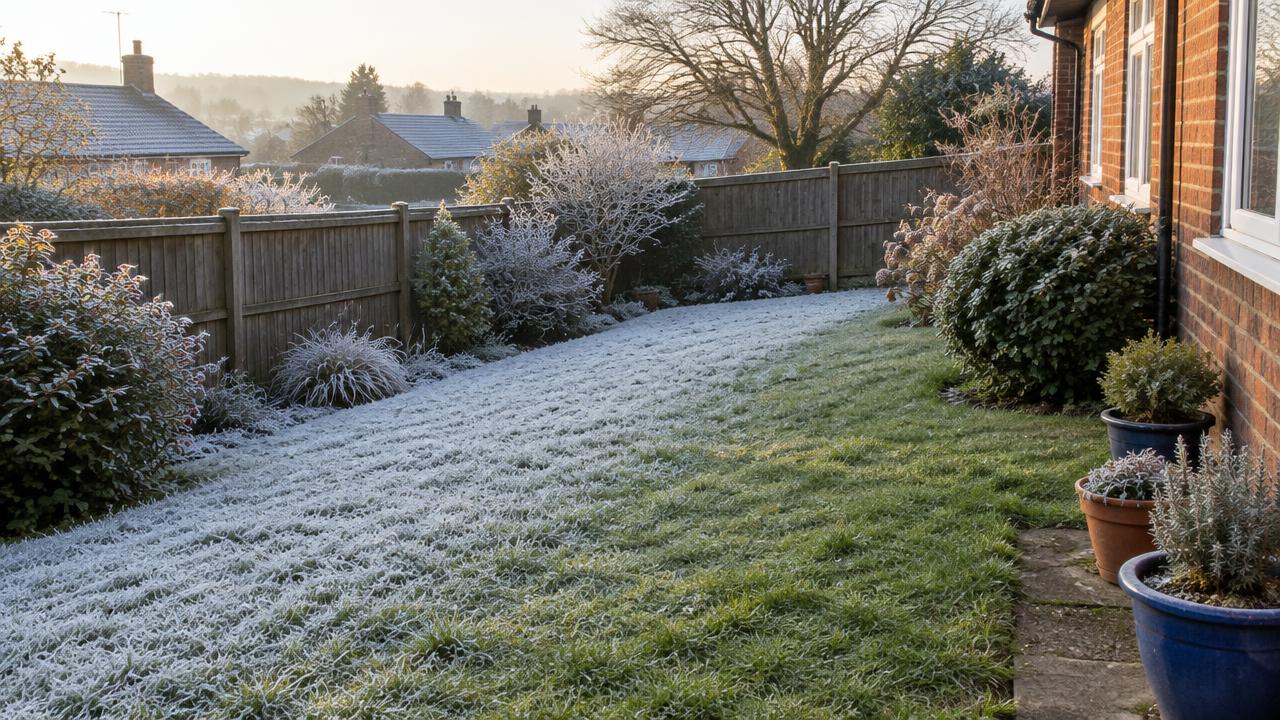
Where a plant stands matters as much as the weather. The RHS explains that cold air settles at low points, and on sloping ground it collects against barriers such as fences, walls and hedges, creating frost pockets. A plant at the bottom of a slope or tucked behind a solid fence on the downhill side can get a much harder frost than one a few metres away. The RHS suggests helping cold air drain away by opening up a gap in a fence or hedge, or thinning the lower growth.
In a small garden, the house itself is usually the best protection. The RHS hardiness ratings note that half-hardy plants may survive elsewhere with wall shelter or a good microclimate, and that some tender plants can stay outside through winter in frost-free inner-city areas. A balcony, a courtyard or the base of a south-facing wall can be milder than an open garden.
Know your plant's hardiness
The quickest way to decide whether a plant needs protecting is to check its hardiness rating. The RHS rates plants from H1a, which need a heated greenhouse all year, to H7, which are hardy in the severest European winters. The rating is based on the lowest winter temperature a plant can be expected to survive, and you will find it on many plant labels and on the RHS plant finder.
| RHS rating | Lowest winter temperature | What it means for a small garden |
|---|---|---|
| H1a to H1c | Above 5°C | Grow as a houseplant or under heated glass in winter |
| H2 | 1 to 5°C | Tender. Won't survive being frozen, so needs frost-free shelter in winter |
| H3 | -5 to 1°C | Half-hardy. At risk from sudden early frosts outside mild areas, but may survive with wall shelter or protection |
| H4 | -10 to -5°C | Hardy in an average winter through most of the UK. Plants in pots are more vulnerable |
| H5 | -15 to -10°C | Hardy in a cold winter. Evergreens may suffer leaf damage, and pots are at increased risk |
| H6 | -20 to -15°C | Hardy through the UK and northern Europe, but many plants in containers will be damaged without protection |
| H7 | Below -20°C | Very hardy, including in exposed upland areas |
Two things stand out from the RHS ratings. The first is that the line between tender and hardy sits between H3 and H4, so anything rated H3 or lower needs a plan for winter. The second is how often the ratings mention pots. From H4 to H6, the RHS warns that plants in containers are more vulnerable, and even at H6, it says many container plants will be damaged unless they are protected. A plant that sails through winter in a border can struggle in a pot, because its roots are surrounded by cold air rather than insulated by the ground.
The RHS describes the ratings as a guideline only, because many other factors affect hardiness. Wet soil, wind, an exposed site and the age of the plant all make a difference, so treat the rating as a starting point and adjust for your own garden.
Which plants are most at risk
Some plants need attention every winter. The RHS lists tender new growth and blossom, tender perennials, bedding plants and tender vegetables such as potatoes and tomatoes among the most vulnerable. Newly planted specimens are more susceptible than established ones, so anything you planted this autumn deserves a little extra care in its first cold spell.
Evergreens and plants in pots are also singled out. The RHS says both are at particular risk. For evergreens, cold wind after freezing draws moisture from the leaves, and in pots, the roots have far less protection than in the ground. Early-flowering shrubs such as camellias and magnolias are at risk in a different way, since it is their flowers and buds that suffer when a frost is followed by sun.
For most small gardens, that adds up to a fairly short list. Bedding and tender perennials such as pelargoniums, dahlias and cannas, borderline shrubs, young plants, and anything in a container that is less than fully hardy are the plants to think about first. Our article on which plants to bring indoors before frost covers the tender ones that are better off under cover.
Before the frost arrives
The best frost protection starts before the cold weather does. The RHS advises choosing plants that are hardy enough for your conditions, avoiding frost pockets when planting, and siting tender plants in a warm, sunny spot. In a small space, that often means keeping the most precious plants close to the house, where the walls offer some warmth and shelter from wind.
Avoid feeding with nitrogen late in the season. The RHS warns that late feeding encourages soft growth that is more vulnerable to frost. It also suggests leaving last season's growth on tender plants such as penstemons until spring, rather than cutting them back in autumn.
Tender perennials need a decision before the first frost. The RHS advises lifting tender perennials before the first frosts, or wrapping plants that can't be moved. Mulching the roots of tender plants and moving containers to sheltered spots also helps. If you garden on a balcony or patio, this is the moment to move pots together and closer to the building, before you need to.
Frost nights: fleece, sheets and cloches
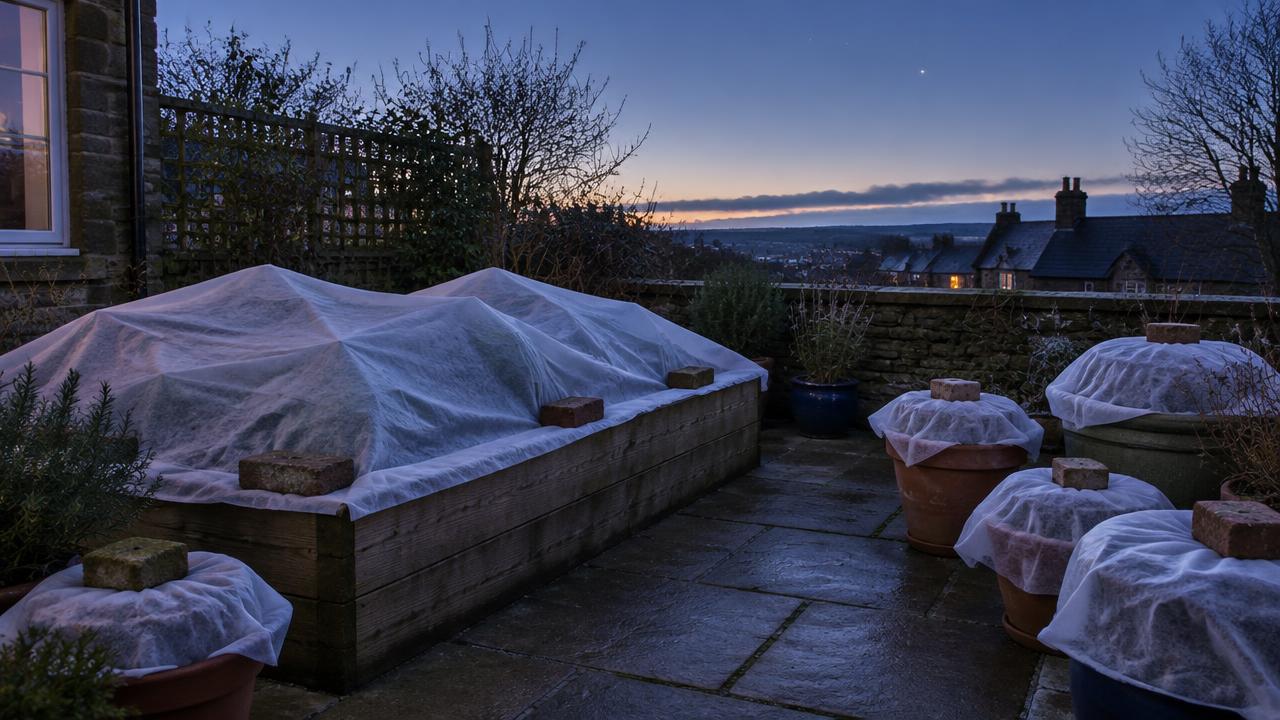
When frost is forecast, a simple cover does a lot of good. The RHS suggests covering plants overnight with a double layer of fleece or an old sheet. It says heavier grades of fleece give about 2°C of protection from frost, and that fleece is usually used without supporting hoops, laid directly over or around the plants. The RHS recommends re-used or plant-based horticultural fleece where you can.
That 2°C is a useful margin rather than a guarantee. It can be the difference between a light frost that blackens a pelargonium and one that leaves it untouched, but it won't save a tender plant through a hard freeze. For plants that can't survive being frozen at all, a cover outside is a short-term measure, and moving them under cover is the safer option. Shelter isn't the same as frost-free, though. An unheated greenhouse, porch or shed keeps off rain and wind but can still fall below freezing on a cold night, and the RHS defines frost-free storage as somewhere with a night-time minimum of 4°C.
Cloches give a little more structure. The RHS describes them as low, portable covers of glass or rigid plastic that protect plants from wet and cold weather, and says they offer frost and rain protection for autumn-sown crops. Glass bell cloches don't need weighing down, but the RHS warns that plastic cloches can blow away if they are not well anchored, so peg them down firmly. For root crops in freezing weather, it suggests stuffing black plastic cloches with straw for extra insulation.
Covers need managing too. The RHS advises removing protective covers when long periods of very mild weather are forecast, because plants left wrapped through a mild, damp spell can sweat and rot. Check under fleece regularly, and take it off during mild days rather than leaving it on for weeks.
Protecting plants in containers
Pots are where frost catches out many small-space gardeners. In a container, the roots are separated from the cold air only by a few centimetres of compost and the wall of the pot, rather than being insulated by the surrounding ground. That is why the RHS hardiness ratings warn so consistently that plants in pots are more vulnerable.
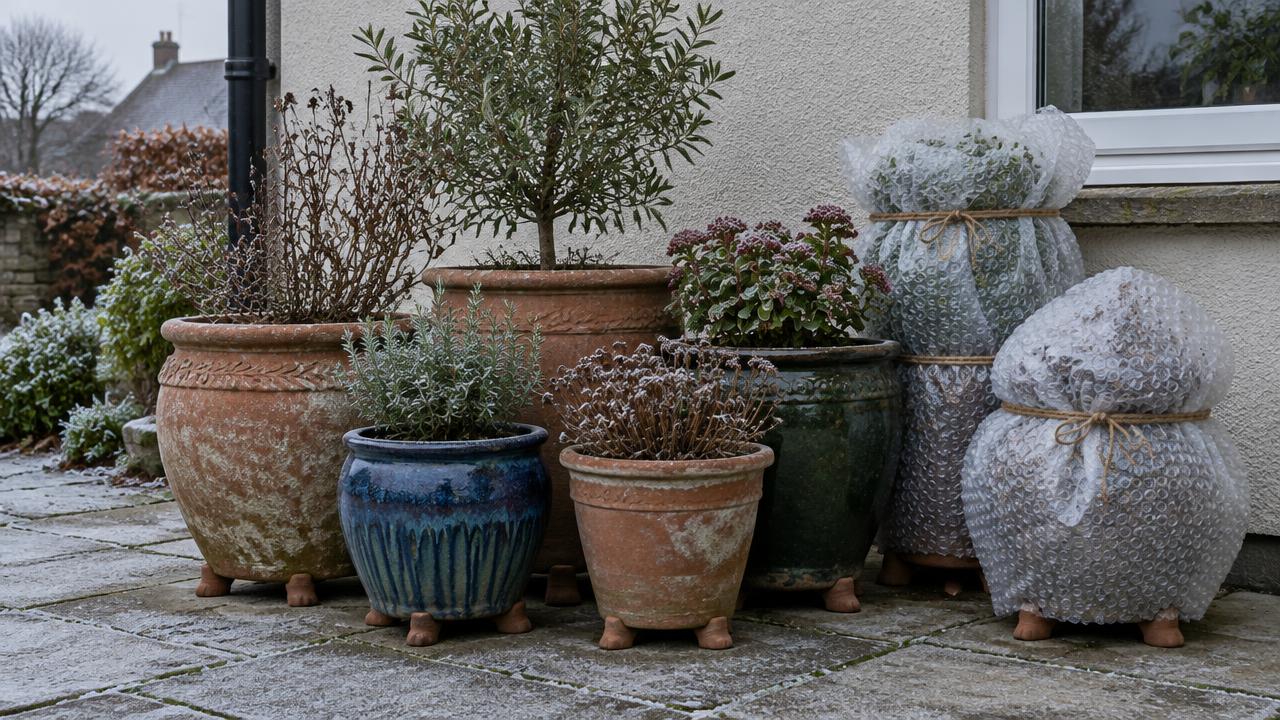
The RHS suggests keeping containers in dry, sheltered areas, grouped together for mutual protection. To stop the roots freezing, it advises wrapping pots with bubble polythene or straw. Another option, if you have a patch of soil, is to plunge the pot into the ground with the rim just showing, so the soil insulates the roots.
The pot itself needs to survive too. The RHS suggests choosing frost-proof terracotta or containers made of plastic, fibreglass or wood for winter, and raising pots on feet or bricks, which aids drainage and helps prevent the freezing conditions that crack them. A frost-proof pot protects the container rather than the plant, so a tender plant still needs protecting whatever it is growing in.
Wet compost makes frost worse. A pot standing in a saucer of water or a pot with blocked drainage holes freezes into a solid block, which can damage the roots and crack the container. The RHS advises checking evergreens in containers at least weekly in winter and watering if they need it, but not when frost is forecast, so water on a mild morning and let the excess drain away before the temperature drops. Our article on how to winter-proof pots and planters covers drainage, pot feet and which materials stand up to frost, and our earlier article on when to protect pots from frost explains why not every pot needs wrapping.
Mulching crowns in the ground
For some tender perennials growing in the ground, the RHS says a thick, dry mulch over the crown of non-woody plants may be all the protection they need. It gives cannas, dahlias, deciduous agapanthus and globe artichokes as examples of plants that can overwinter under mulch in mild areas. Use straw, garden compost, chipped bark or well-rotted manure, at least 5cm thick, applied between November and February.
This is an option for suitable plants in sufficiently mild conditions, not a way to keep every tender plant outside. The RHS recommends it for sheltered, well-drained parts of the garden. On heavy, wet soil, in a cold area or in a garden that regularly gets hard frosts, lifting and storing tender perennials under cover is usually the safer choice, and our article on which plants to bring indoors before frost covers that.
Wrapping larger tender plants
Some plants are too big to move and too tender to leave uncovered. The RHS says winter wrapping is required for tender plants such as bananas and tree ferns, and it also suggests wrapping borderline shrubs such as Pittosporum tobira and Cestrum, and plants such as Callistemon in cold or exposed sites.
The materials are simple. The RHS suggests biodegradable or re-used fleece, hessian, bracken and straw to insulate plants from cold and wind. For a tree fern, it advises tying the fronds upright and packing straw or bracken into the centre to protect the crown, then wrapping the whole bundle in fleece. For a banana, it suggests building a chicken-wire frame around the stumps and filling it with straw. Where water could collect and freeze under the wrapping, the RHS says a waterproof cover is essential.
Timing matters. The RHS advises putting winter wrappings in place at the first warning of frost, usually between September and November. In spring, once the danger of frost has passed and new growth has started, it suggests removing wrappings in stages or on a dull day, so the plant can adjust gradually rather than being exposed to bright sun and wind all at once.
Snow and wind
Snow is mainly a problem on anything with branches. The RHS warns that snow sitting on hedges or the crowns of trees can break branches, and advises shaking it off early, before it builds up. Hedges pruned so they taper towards the top shed snow more easily.
Wind is the other winter hazard. The RHS suggests that fences which let about 50 per cent of the wind through give better shelter than solid ones, which create gusts and turbulence. Temporary woven hurdles or netting can give short-term shelter to plants in an exposed spot, and on a windy site, the RHS says permanent windbreaks such as hedges may be needed. For balconies and roof terraces, where wind is often a bigger problem than cold, our article on wind damage covers what to do before and after a storm.
Lawns and frozen ground
Frost affects the ground as well as the plants in it. The RHS advises avoiding walking on a frosty lawn, because the blades of grass turn brittle in the cold and break, and footprints across frozen grass can leave brown marks that take a long time to fade. If you need to cross a lawn to reach a shed or a bed on a frosty morning, a plank or a path of stepping stones keeps the damage in one place.
The same applies to soil. Frozen ground can't be dug or planted, and the RHS advises against planting trees and shrubs into soil that is frozen or waterlogged. If bare-root plants arrive in a cold spell, heel them in or keep the roots damp until the ground thaws, as our complete guide to bare-root planting explains. On a balcony, the equivalent is not to repot or plant up containers while the compost is frozen, but to wait for a milder day.
After a frost
The morning after a frost, resist the urge to tidy up. The RHS advises cutting out frost-damaged growth only once no more frost is expected, back to an undamaged side shoot or bud. Once you have pruned, the RHS suggests applying a general-purpose fertiliser to help the plant produce new growth. The timing matters here. A plant damaged in November still has months of cold ahead, and feeding it then would only encourage soft growth for the next frost to catch. Assessing, pruning and feeding are jobs for spring, once the risk of severe frost has passed and the plant is starting to grow again.
Check newly planted shrubs too. The RHS notes that frost can lift young plants out of the soil, so firm them back in once the ground has thawed. Plants in pots may need a little water once the compost has thawed, if it has dried out under cover.
Above all, don't give up on a plant too soon. The RHS says a damaged plant may regrow from buds at or below soil level, and that recovery may not show until early summer. If it hasn't regrown by mid-summer, that is the time to replace it. Plenty of plants that look finished in late winter are growing again by early summer.
Common frost mistakes
Most frost problems come from doing too much or too little in the wrong place. Wrapping every plant in the garden wastes effort on hardy plants that don't need it, while giving tender plants a layer of fleece when they really need frost-free shelter. Laying plastic sheeting or bags directly on leaves traps condensation and can damage the foliage it touches, so use fleece, or keep plastic on a frame with some ventilation. Assuming an unheated greenhouse or shed is frost-free catches out a lot of gardeners in the first hard freeze. Cutting back damaged growth straight after a frost, or feeding to perk a plant up, encourages new growth just when it is most likely to be hit again. And leaving covers on for weeks through a mild, damp spell can do as much harm as the frost, because plants sweat and rot underneath.
A winter routine for small spaces
Most of what keeps plants safe through frost comes down to a few habits. In autumn, check the hardiness of anything new, move the most tender plants under cover, and group pots together in the most sheltered spot you have, close to the house and out of any frost pocket. Keep fleece or an old sheet somewhere you can reach it on a cold evening. Bear in mind where you are growing, too. Pots on a balcony are exposed on several sides and often to wind, so they usually need more help than the same pots in an enclosed courtyard, which can be sheltered from wind but still cold enough on a still night to damage tender plants.
Through the winter, keep an eye on the forecast on clear, still evenings, cover vulnerable plants overnight, and take covers off again in mild weather. Keep compost in pots moist but not waterlogged, and make sure water can drain away. In spring, unwrap gradually, wait until the frosts are over before pruning damaged growth, and give anything that looks dead until mid-summer before you decide.
FAQ
How do I know if a plant needs protecting from frost?
Check its RHS hardiness rating on the label or the RHS website. H1 and H2 plants won't survive being frozen, H3 plants are at risk from early frosts outside mild areas, and even hardy H4 to H6 plants are more vulnerable when grown in pots.
How much protection does garden fleece give?
The RHS says heavier grades of fleece give about 2°C of protection from frost. For a cold night, it suggests a double layer of fleece or an old sheet over vulnerable plants.
Should I wrap my pots for winter?
Only where the roots are at risk. The RHS suggests grouping containers in a dry, sheltered spot and wrapping pots in bubble polythene or straw to stop the roots freezing. Plants that are fully hardy in the ground may still need this in a pot.
Should I cut off frost-damaged leaves straight away?
No. The RHS advises waiting until no more frost is expected, then cutting damaged growth back to an undamaged bud or side shoot, and then feeding to support regrowth. In practice, that means waiting until spring rather than pruning or feeding in November.
Is my plant dead after a frost?
Not necessarily. The RHS says frost-damaged plants may regrow from buds at or below soil level, and that recovery may not show until early summer. Only replace a plant if it hasn't regrown by mid-summer.
FURTHER READING
- Getting Started
Container Growing Fundamentals
- Getting Started
The Complete Guide to Bare-Root Planting
- Getting Started
The Complete Guide to Planting Tulips
RELATED POSTS
Robin is a small-space grower writing for everyone working with a courtyard, balcony, window box, patio or sunny sill. Edible and leafy, both kept alive in the kind of light real small spaces actually get.
✦ Free with the newsletter — the small-space starter sheet
Grow Anywhere — a free weekly email.
The Potted Club newsletter. A short note from Robin — what to sow, one plant problem solved, and the best new guide.
FREE WEEKLY EMAIL · NO SPAM · UNSUBSCRIBE ANYTIME