
What to Do with Your Summer Pots Now They've Finished Flowering
How to deal with summer containers in late October, from bedding that has finished to pelargoniums and fuchsias worth saving, what to do with the old compost and whether to replant or store the pot.
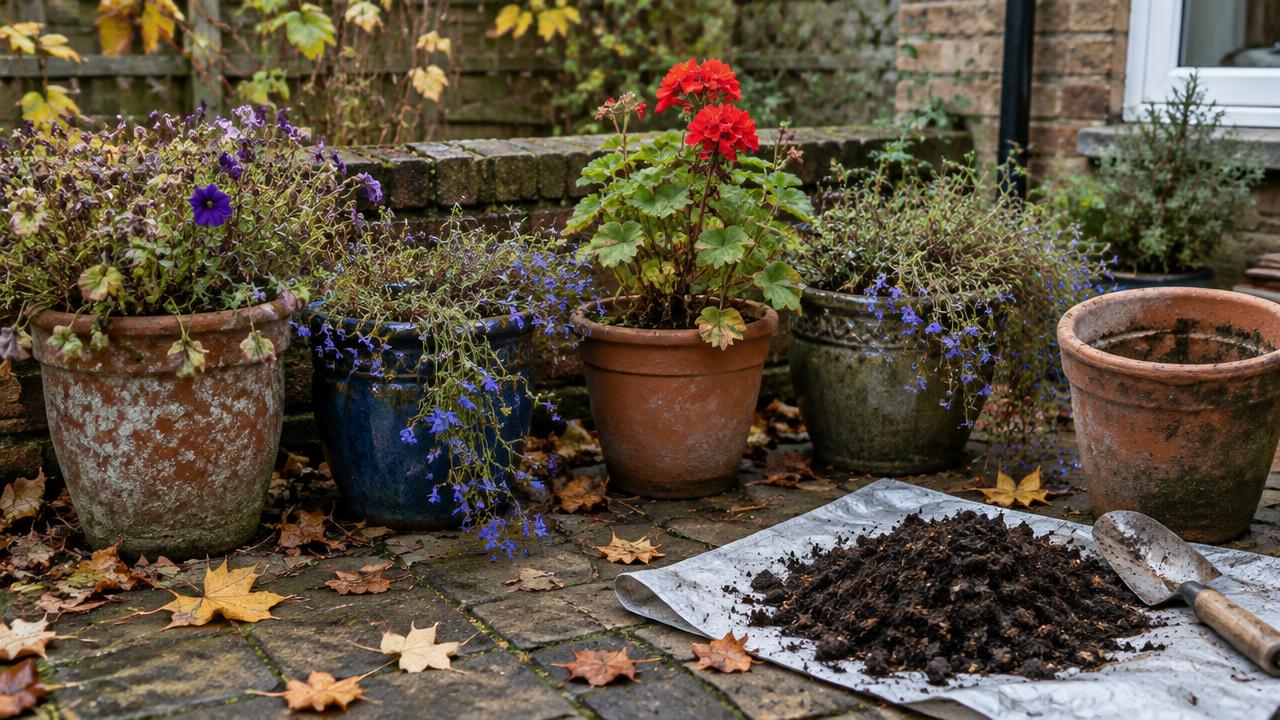
By the second half of October, most summer containers are past their best. On a balcony or a small patio, where every pot has to earn its space, the question is what to do with them next. The answer depends on what is in each pot, because finished bedding, tender plants that could be kept and hardy plants that can stay outside all need different treatment. This goes through each, then what to do with the old compost and the empty pot.
Start by working out what is in each pot
A mixed summer container usually holds plants with very different futures, and treating them all the same is where most autumn mistakes happen. There are three groups to look for. Annual bedding, such as petunias, lobelia, bacopa, nemesia and most fibrous begonias, flowers for one summer and then finishes. Tender perennials, such as pelargoniums, many fuchsias, tender salvias, osteospermums and tuberous begonias, would carry on for years in a warmer climate but will not survive a hard British frost outside. Hardy plants, such as many grasses, heucheras, lavender and hardy fuchsias, will come through winter outdoors.
Timing matters for the middle group. The RHS advice for tender plants is to protect them at the first sign of frost, which usually comes between September and November, so late October is the point to decide rather than leave it until a cold night forces the issue. If you are not sure what a plant is, the label is the best guide. The RHS notes that hardy and tender fuchsias look very similar, so it is worth checking before you assume either way.
Annual bedding that has finished
This is the easy decision. Annual bedding has done what it was bought for, and the RHS describes bedding begonias, for example, as usually grown as annuals. Once the plants are leggy, yellowing or no longer flowering, lift them out, knock off the compost and put them on the compost heap.
If something is still flowering well, including nasturtiums or cosmos in a sheltered spot, there is no need to pull it out early. It can stay until the first frost finishes it, which gives you a few more weeks of colour while you sort the rest of the pots.
Tender perennials, and whether they are worth saving
This is the group with real choices, and the honest answer is that not everything is worth keeping. A pelargonium that has grown into a fine plant over several summers, or a fuchsia standard that took years to train, is worth the effort. A single trailing verbena that cost a couple of pounds in May probably is not, especially if your only frost-free space is a windowsill.
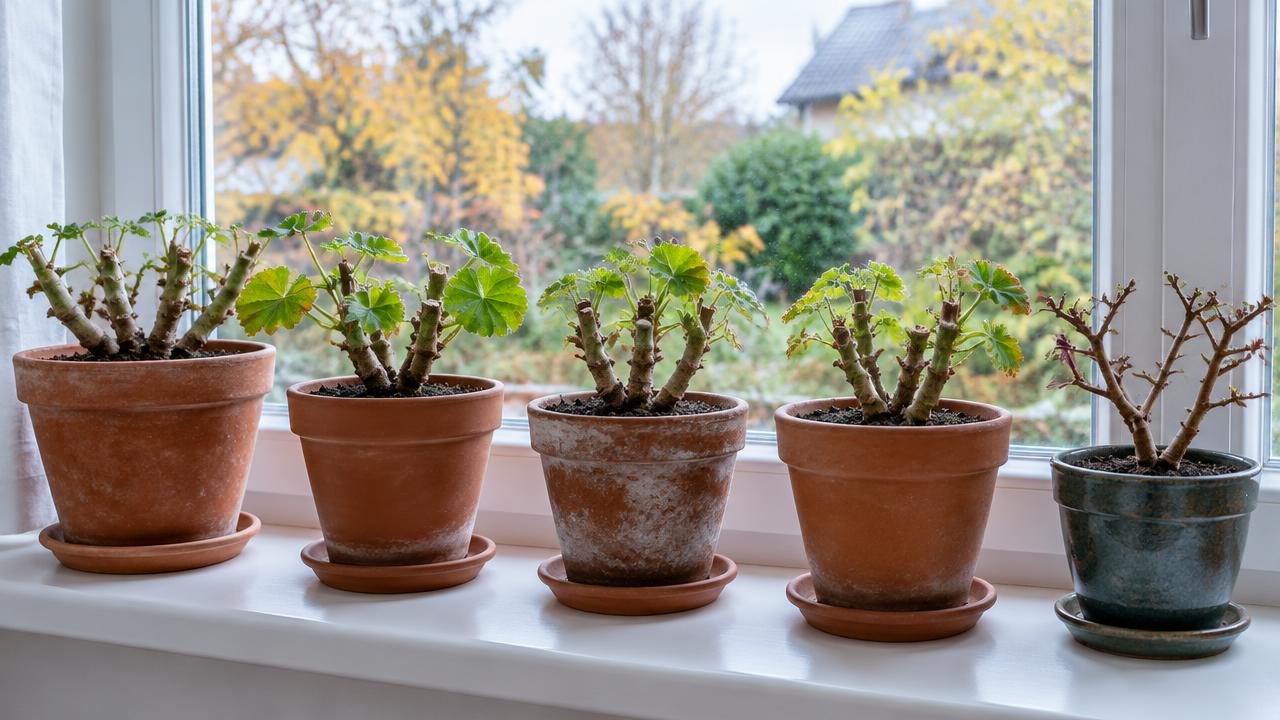
Pelargoniums are the most rewarding to keep. The RHS advises bringing them in before the first autumn frosts and keeping them in a light, airy, frost-free place. If space is tight, they can be cut back to about 10cm. Plants kept in active growth need checking at least once a week and watering when the compost shows signs of drying, while those cut back for winter need barely any water until growth resumes in spring. The RHS notes that many will carry on flowering if kept at 7 to 10°C, which makes a cool, bright windowsill in a spare room a reasonable home. Lifting pelargoniums, shaking off the soil and storing them bare-rooted is the space-saving option, but the RHS calls it the least reliable method and says it only suits varieties with tough, woody stems.
Tender fuchsias need a frost-free place too. The RHS defines frost-free as a night-time minimum of 4°C, but the most tender fuchsias, rated H1C, need a minimum of 5 to 10°C, so check the label. The RHS suggests cutting this year's growth back to a framework of stems about 7.5 to 15cm tall and keeping the compost just moist. A frost-free windowsill or conservatory will do. Standards need protection even if the variety is hardy. The RHS also advises against keeping old plants that are riddled with pests or disease, which is a good test for any tender plant you are tempted to save.
Tuberous begonias are kept as tubers rather than plants. The RHS advises lifting them before the first frosts and cutting back on watering once the leaves start to yellow naturally. Once the tubers have dried, store them in lightly damp peat-free compost or sand in a frost-free place, ideally at around 7°C, and check them now and then, since they can rot in storage.
Tender salvias can be kept in their pots somewhere light and frost-free over winter, according to the RHS. Osteospermums vary. Many, such as the popular Daisy Mae types, are rated H3 by the RHS, which means hardy only in coastal and relatively mild parts of the UK, so in colder gardens they are better treated as tender.
Cuttings are the space-saving way to keep a plant. Late summer is the usual time for many tender perennials, and the RHS says winter is too late, but the window has not entirely closed for pelargoniums, which the RHS says can be taken as softwood cuttings from spring to autumn. Cuttings taken this late may be slower to root, so if you have healthy shoots it is worth trying, but keeping the parent plant is the more dependable option. Rooted cuttings need bright, frost-free conditions of around 7°C, kept on the dry side.
Making the decision without a greenhouse
Most people with a small garden do not have a greenhouse, and that changes the calculation. A bright windowsill in a cool room holds only a few pots, a garage or shed may be frost-free but is usually too dark for plants that are still in leaf, and a warm living room is too warm and too dark for a plant meant to be resting. The RHS does suggest a garage attached to a house or a shed for dormant tubers, which need no light, so begonias are easy to keep where pelargoniums are not.
A practical rule is to keep the plants that would be expensive or slow to replace, or that you are fond of, and let the cheap bedding go. Two or three pelargoniums on a windowsill and a bag of begonia tubers in the shed take up very little space, while trying to keep a whole patio of tender plants usually means keeping them badly.
Hardy plants that can stay outside
Hardy plants can stay where they are, but pots offer roots far less protection than the ground. The RHS hardiness ratings note that plants in pots are more vulnerable to frost than the same plants in the ground, and our article on protecting pots from frost explains what to do. In short, group pots together near the house wall, which the RHS says helps protect roots from the cold, remove saucers for winter, and wrap or move the most exposed pots when hard frost is forecast.
If a hardy plant has outgrown its pot or the compost is exhausted, autumn is a reasonable time to move it into the ground, if you have some, where it will be better protected over winter.
What to do with the old compost
Old compost does not need to go to waste. The RHS says compost from pots is generally safe to reuse, because container plants are unlikely to suffer soil-borne diseases. It does need refreshing first, because compost breaks down and compacts over time. Tip it out, remove the larger roots, rub it back to a loose texture and mix in garden compost or well-rotted manure at roughly 70 per cent old compost to 30 per cent new material. Hungry plants may need some fertiliser as well. If the compost is very old and tired, the RHS suggests using it as a mulch around established trees and shrubs, or spreading it about 7.5cm deep on beds and borders.
Before reusing it, check for vine weevil. The grubs are plump, C-shaped, white and legless, with light brown heads, and they live among the roots. The RHS says containers are the most likely place for serious damage and that most plant losses happen between September and March, when the grubs are becoming fully grown. If you find them, the RHS suggests spreading the compost thinly on a tarpaulin or hard surface so birds can eat the grubs, then sweeping it up and reusing it. Check again for any remaining grubs before using it around susceptible plants, and do not reuse compost from a pot where a plant died of a serious root problem.
Roots and spent plants
Most spent bedding and its roots can go on the compost heap. Diseased material needs a little more thought. The RHS says home compost bins rarely get hot enough to kill plant diseases, although common leaf diseases such as powdery mildew and rust do not usually survive once the material has fully broken down. Anything with a more persistent problem is better sent to the council green waste collection, where the composting temperatures are high enough to kill most diseases.
The empty pot
Once a pot is empty, you can replant it now, leave it until spring or clean it and put it away. Replanting is the most cheerful option. Our article on what you can still plant and sow in mid-October and our bulb planting guide cover what will give you colour this winter or next spring, from violas and cyclamen to tulips planted in November.
If you are not replanting, store empty pots somewhere dry, or turn them upside down if they have to stay out, so they do not fill with water and freeze. Pots left planted should be raised slightly and kept off saucers so they can drain through the winter.
FAQ
Should I pull up summer bedding that is still flowering?
No. Leave it until the first frost finishes it, unless you need the pot for winter planting.
Can I keep pelargoniums without a greenhouse?
Yes. A cool, bright, frost-free windowsill works, and the RHS says many keep flowering at 7 to 10°C.
Are fuchsias hardy?
Some are and some are not. The RHS says hardy and tender types look so similar that the label is the best guide.
Can I reuse compost from my summer pots?
Usually, yes, once it is refreshed with about 30 per cent garden compost or well-rotted manure and checked for vine weevil grubs.
Is it too late to take cuttings?
For most tender perennials, largely yes, but pelargonium softwood cuttings can still be tried in autumn.
READ THE FULL GUIDE
Container Growing Fundamentals →
RELATED POSTS
Robin is a small-space grower writing for everyone working with a courtyard, balcony, window box, patio or sunny sill. Edible and leafy, both kept alive in the kind of light real small spaces actually get.
✦ Free with the newsletter — the small-space starter sheet
Grow Anywhere — a free weekly email.
The Potted Club newsletter. A short note from Robin — what to sow, one plant problem solved, and the best new guide.
FREE WEEKLY EMAIL · NO SPAM · UNSUBSCRIBE ANYTIME