HOME / GUIDES / GETTING STARTED
The Complete Guide to Planting Bulbs
When to plant every kind of bulb, how deep, and what to do afterwards. Containers, borders and grass, plus the mistakes that stop bulbs flowering again.
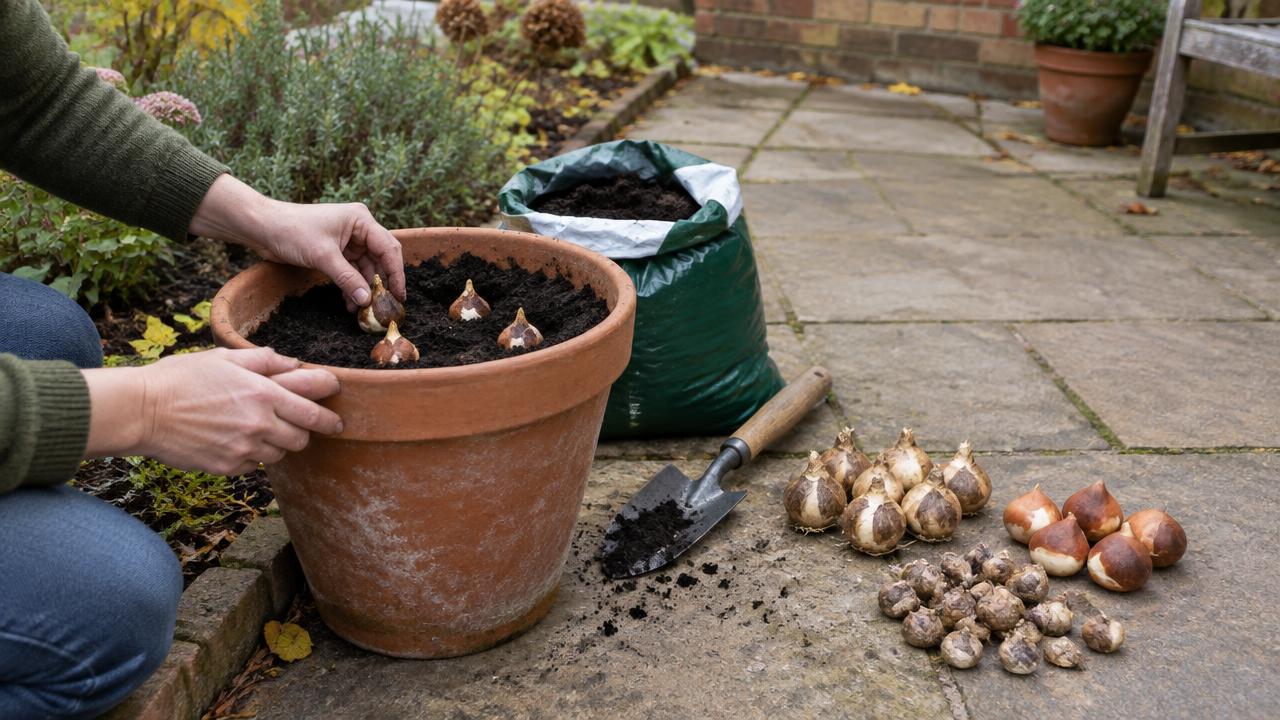
Bulbs are among the least demanding things you can grow and among the easiest to get subtly wrong. Plant them at the right time and depth and they need remarkably little from you; get the site, timing or aftercare wrong and they may quietly stop flowering. This is everything worth knowing, in one place.
What a bulb actually is
"Bulb" is gardening shorthand rather than a precise botanical term.
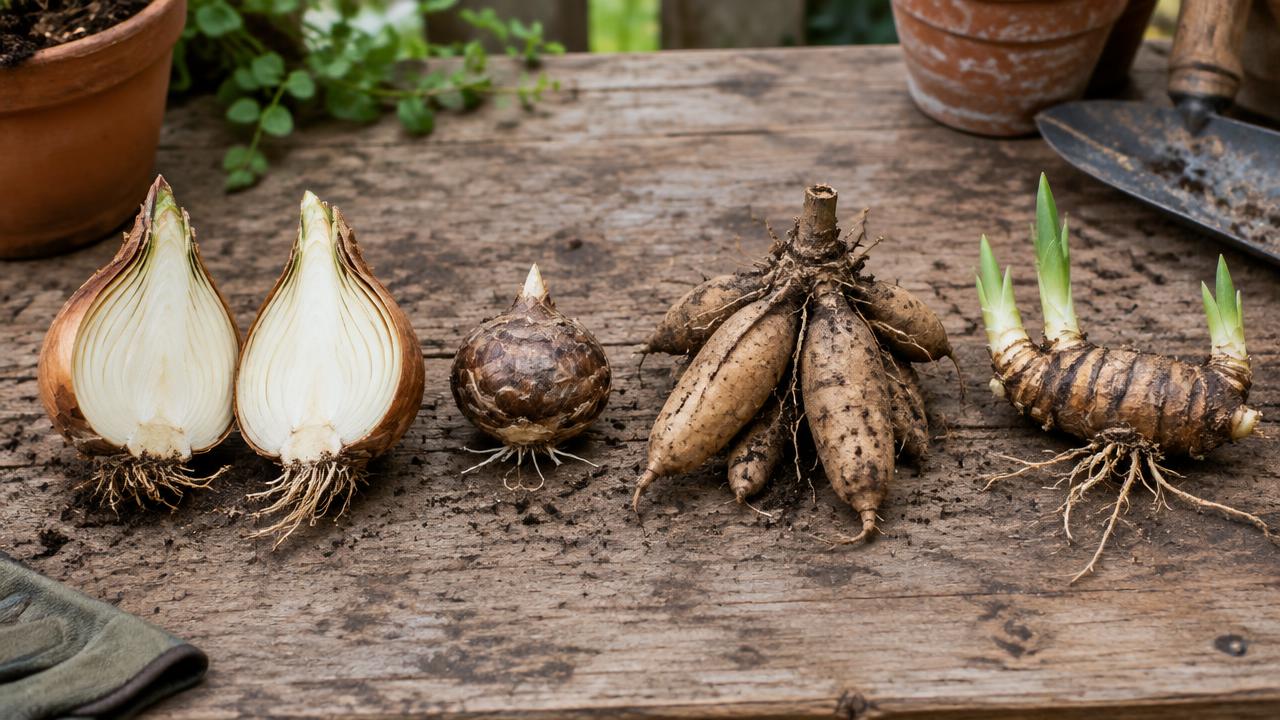
A true bulb, such as a daffodil or tulip, is essentially a compressed shoot surrounded by fleshy storage scales. Cut one open and its layered construction is obvious. A corm, such as a crocus or gladiolus, looks superficially similar but is a swollen stem base. A tuber is another storage structure: dahlias have tuberous roots, while cyclamen form tubers. A rhizome, found in plants including cannas and many irises, is a modified stem that grows horizontally.
The distinction isn't botanical trivia. It stops one rule being applied to everything in the bulb aisle. The familiar advice to plant at two or three times the bulb's depth works for many true bulbs and corms. It does not mean a dahlia tuber or iris rhizome should automatically receive the same treatment.
When to plant: the calendar
The broad logic is simple: most bulbs are planted while dormant, before their period of active growth.
Spring-flowering bulbs. Daffodils, crocus, hyacinths, muscari, scilla and many other spring-flowering bulbs go in during autumn. RHS bulb guidance recommends planting daffodils, crocus and hyacinths preferably by the end of September, while its broader growing guidance gives September and October as the main window and notes that earlier planting is generally better. That makes September an excellent month to start, not a cliff edge after which spring bulbs suddenly fail.
Snowdrops are a useful exception to the shopping logic. Dry bulbs are sold in autumn, but snowdrops are prone to drying out in storage and are often more reliably established freshly lifted or bought "in the green" around or after flowering.
Tulips. Tulips can also be planted during autumn, but there's no need to rush them into warm September soil. The RHS specifically recommends November in its general planting guidance, and its tulip guidance gives a broader September-to-November planting period. Later planting into cooler conditions can also reduce the risk of tulip fire, caused by Botrytis tulipae. Buy the varieties you want while they're available, store the bulbs somewhere cool, dry and ventilated, and plant later.
Hardy summer-flowering bulbs. Many of these are also planted in autumn. Alliums, lilies and crocosmia are familiar examples. The RHS places hardy summer-flowering bulbs broadly in September and October, while ornamental alliums are generally planted in early to mid-autumn. They're worth distinguishing from spring bulbs because their job is different: many alliums flower in May and June, extending the display after earlier bulbs have finished.
Tender summer-flowering bulbs. Tender plants generally wait until spring. Gladioli are planted in early spring. Dahlias, begonias and cannas are likewise spring jobs, with timing influenced by frost risk and whether they're being started under protection.
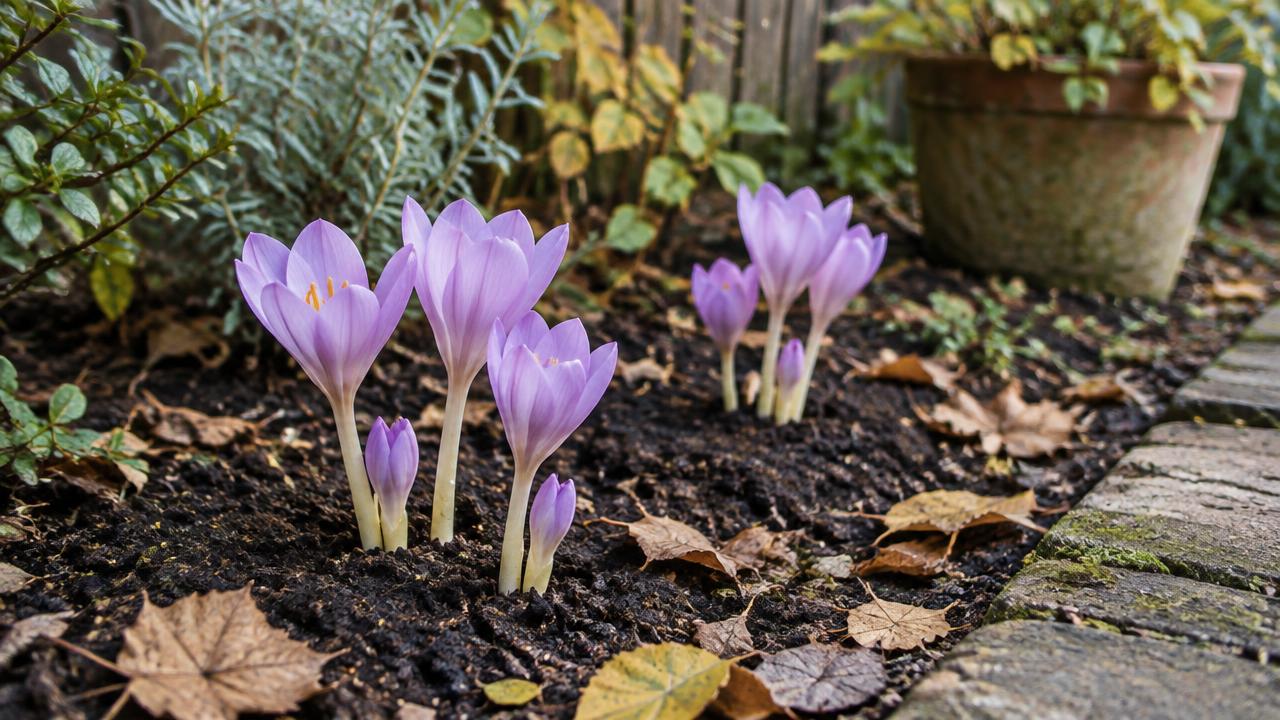
Autumn-flowering bulbs. These are planted earlier than many gardeners expect, generally by late summer. Nerines, autumn-flowering crocus and colchicum can provide flowers from late summer into autumn, when much of the spring bulb display is a distant memory.
Quick reference
| Bulb | Plant | Typical flowering | Worth knowing |
|---|---|---|---|
| Daffodil (Narcissus) | September-October | February-May | September ideal |
| Crocus | September-October | February-April | Excellent for naturalising |
| Hyacinth | Early autumn | March-April | Strong scent; prepared bulbs differ |
| Muscari, scilla | September-October | February-April | Compact and useful in small spaces |
| Iris reticulata | Autumn | February-March | Excellent in containers |
| Fritillaria | Early autumn | Spring | Some dislike drying out |
| Snowdrop | Autumn as dry bulbs; also in green | January-March | Fresh or in-green plants often establish better |
| Allium | Early-mid autumn | May-July | Many need sun and good drainage |
| Lily | Autumn or spring | June-August | Requirements vary by type |
| Tulip | Autumn, often November | April-May | Later planting useful |
| Gladiolus | Early spring | Summer | Tender types need frost consideration |
| Dahlia | Spring | Summer-autumn | Tuberous roots, not true bulbs |
| Colchicum | Summer-early autumn | Autumn | Toxic if eaten |
| Nerine | By late summer | Autumn | Likes a warm, sunny site |
Buy well, then don't forget the bag
A healthy dormant bulb should generally feel firm and substantial for its size. Avoid bulbs that are soft, extensively mouldy, badly damaged or clearly rotting. A loose or damaged papery outer tunic isn't necessarily a problem; the bulb beneath matters more than cosmetic perfection.
Size matters within a cultivar because larger mature bulbs often have greater reserves, but comparisons between species are meaningless. A crocus corm is supposed to look tiny beside a daffodil.
Most dry bulbs are best planted reasonably soon after purchase. If you need to hold them, tulips being the obvious example, keep them somewhere cool, dry and ventilated rather than sealed in plastic or left in a warm room. Fritillaries and snowdrops deserve particular attention because excessive drying during storage can compromise them.
Choose the site before you dig
"Sunny and well drained" describes the preference of many bulbs, not all of them.
Tulips and many ornamental alliums generally prefer plenty of sun and free-draining soil. Daffodils are more adaptable. Snowdrops and several other woodland bulbs can exploit the light beneath deciduous trees before the canopy closes. Snake's head fritillary, Fritillaria meleagris, suits moisture-retentive conditions far better than bulbs adapted to dry summer soils.
This matters particularly in small gardens where conditions can change over a few metres. A bed beneath a deciduous tree, a dry strip against a wall and a container on an exposed balcony aren't interchangeable planting sites. Match the bulb to the conditions rather than trying to force every bulb into the same recipe. The same site-first thinking sits behind container growing fundamentals: the pot, compost, position and plant all have to fit one another.
How deep should you plant?
For most familiar true bulbs, a good starting point is two to three times the bulb's own depth, measured from the top of the bulb to the soil surface. A large daffodil therefore sits substantially deeper than a crocus.
Shallow planting is worth avoiding. The RHS notes in its planting-depth guidance that bulbs planted too shallowly are more prone to drying out, which can weaken them.
There are exceptions. Some alliums are planted more deeply. Rhizomes may sit close to the surface. Temporary container displays can sometimes be planted more shallowly than permanent plantings. If the packet or species-specific guidance gives you a depth, use it.
Which way up?
For an obvious true bulb, the pointed end goes up and the flatter basal plate, where the roots develop, goes down.
Corms and tubers can be less obvious. If you genuinely cannot identify the top, placing it on its side is a reasonable solution, and the shoot will generally reorient itself as it grows.
There is no prize for spending ten minutes trying to identify the top of a crocus.
How far apart?
In a permanent border, allow enough room for the bulbs to grow and, where appropriate, multiply. Around two to three bulb widths is a useful rough guide for many ordinary plantings, but species-specific spacing takes precedence.
For a more natural effect, avoid rigid rows. RHS guidance for naturalising bulbs suggests scattering bulbs across the area and planting them where they land, while checking they aren't so close together that future overcrowding becomes a problem.
Containers can be planted much more densely because you're creating a concentrated display rather than establishing a colony.
Planting bulbs in borders
For a handful of bulbs, individual holes are fine. For a larger drift, opening a wider planting area is often easier and produces a less regimented result.
Prepare the soil, position the bulbs at their correct depth and spacing, then replace the soil and firm it gently. If the ground is dry, water afterwards to settle the soil around them.
Don't automatically put a handful of grit underneath every bulb. If the whole site is poorly drained, a small pocket of grit at the bottom of one hole doesn't transform the surrounding soil. Improve the wider soil structure where practical, use raised planting, grow in containers or choose bulbs suited to the conditions.
A planting hole in dense, wet soil isn't magically well drained because its bottom contains gravel.
Planting under deciduous trees
Bulbs can make unusually efficient use of the ground beneath deciduous trees and shrubs. In late winter and early spring, sunlight still reaches the soil before the canopy fills, and snowdrops, crocus, narcissus and woodland bulbs can complete a significant part of their annual cycle during that window.
Work around substantial established roots rather than chopping through them to create planting holes. And remember that competition for water increases once the tree comes into active growth. Choosing a plant adapted to the site remains more useful than repeatedly trying to correct the site afterwards.
Bulbs in containers
Containers suit bulbs exceptionally well, especially where outdoor space is limited.
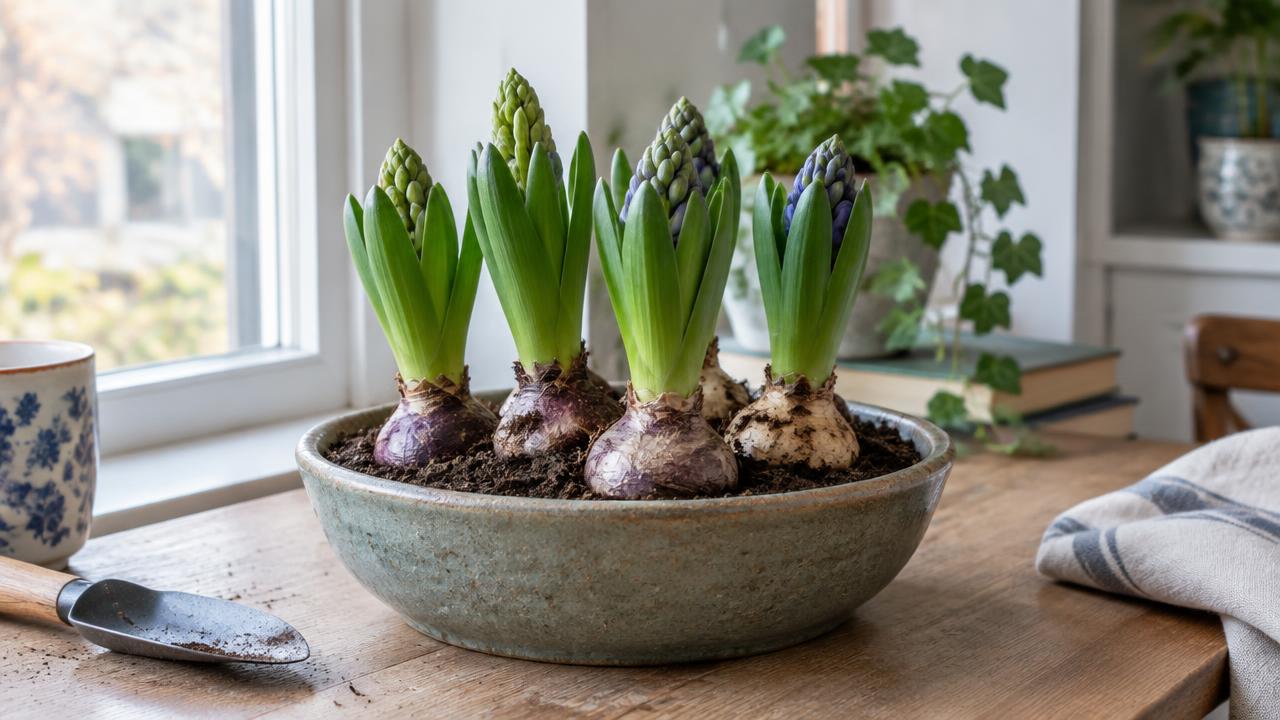
Choose enough depth. The pot needs room for the bulb at its correct planting depth and compost underneath for roots. A shallow bowl is fine for some small bulbs. It isn't automatically suitable for a large daffodil or a multi-layered display. Drainage holes are non-negotiable.
Use the right compost. For a one-season display, a peat-free multipurpose compost with added horticultural grit provides an appropriate free-draining medium. For bulbs remaining in the container for several years, a loam-based peat-free compost mixed with grit provides greater long-term structure. If a plant has more particular needs, soil and compost pH, explained covers when the growing medium genuinely matters.
Forget the drainage layer. You don't need a thick layer of gravel or broken terracotta in the bottom. What matters is a growing medium that drains appropriately and drainage holes through which water can actually escape. If a pot sits flat on paving and the holes become obstructed, pot feet can help. The same point applies to autumn pot planting, where winter wet is often a bigger risk than cold alone.
Plant more densely. Temporary container displays can be planted more closely than bulbs in a border, and the RHS's bulbs in containers guidance suggests bulbs can sit only around a bulb's width apart. Dense doesn't mean crushed together, though: leave compost around them and avoid pressing bulbs against the sides of the pot.
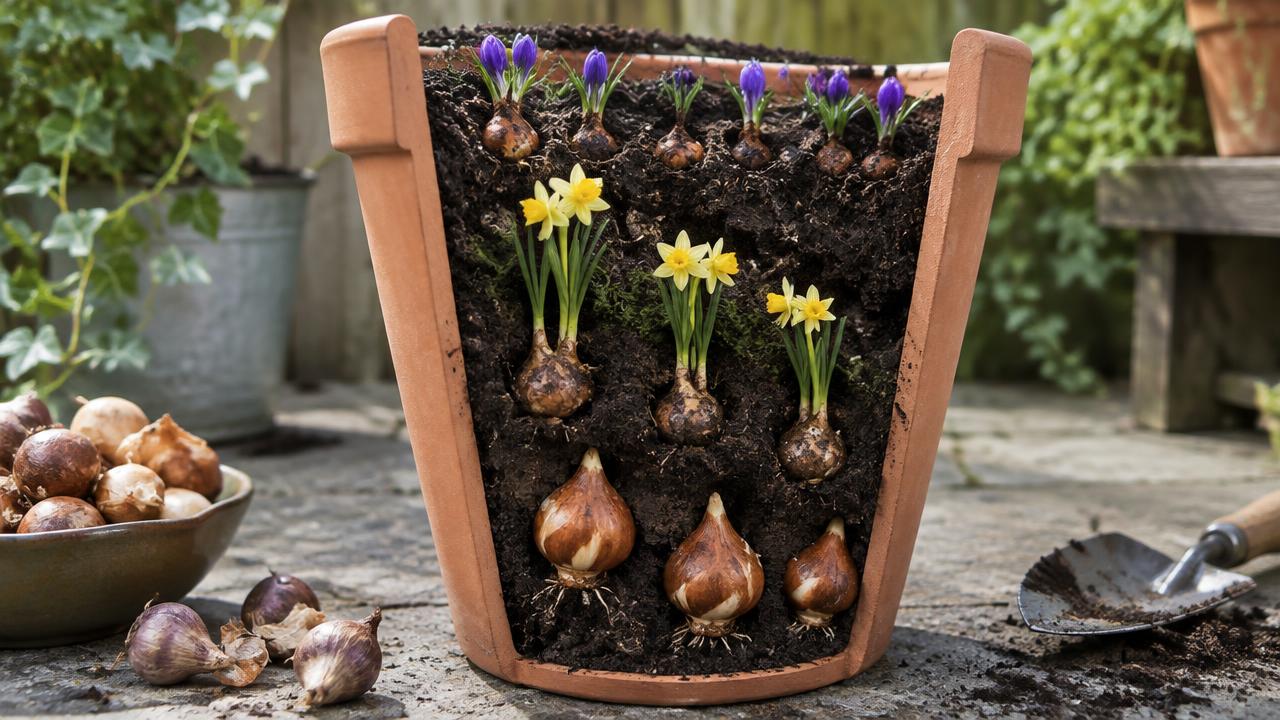
Does a bulb lasagne work?
Yes. The name is questionable. The technique isn't.
Layering bulbs at different depths lets one container produce several waves of flowers. A simple combination might be tulips at the bottom, dwarf narcissus in the middle, and crocus or muscari at the top.
Offset each layer rather than stacking bulbs directly above one another, leaving routes for the lower shoots to emerge.
The point isn't simply to squeeze in the maximum number of bulbs. It's succession. For a balcony or tiny patio, getting crocus, narcissus and tulips from the same footprint is useful. If you have plenty of room, separate pots are easier to manage and can be moved into prominence as each reaches its peak.
Naturalising bulbs in grass
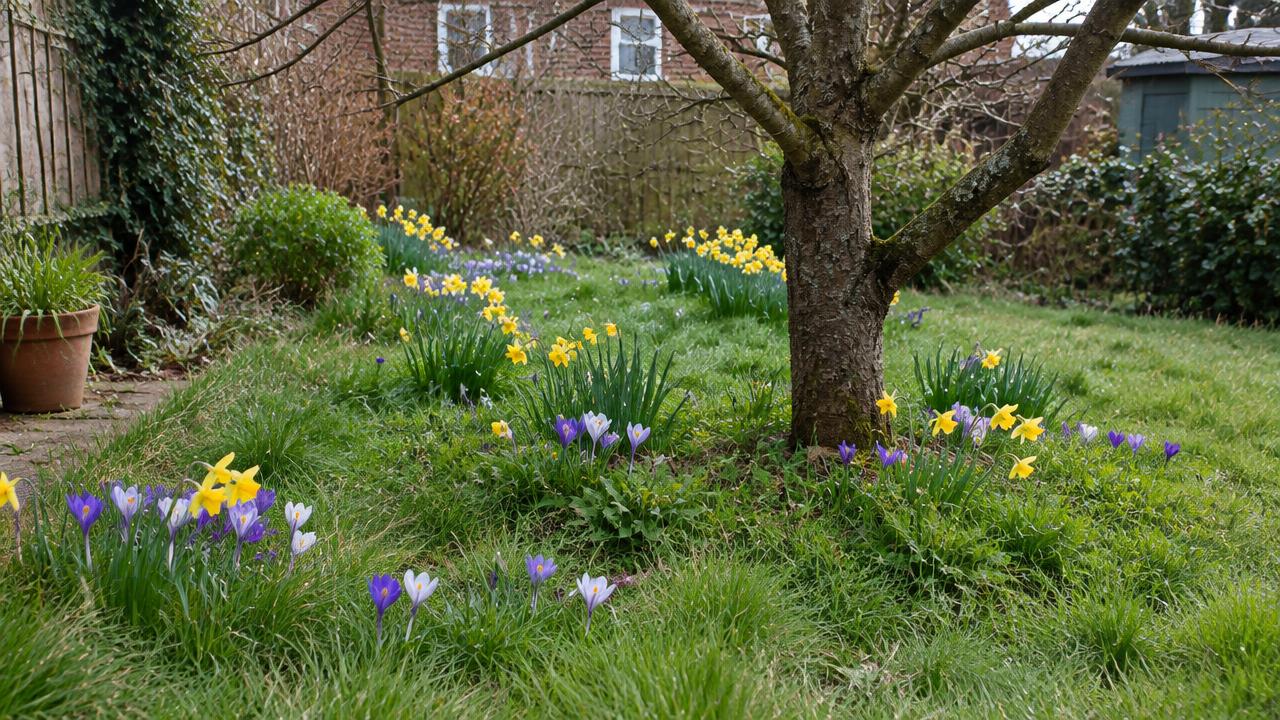
Naturalising means planting bulbs permanently through grass so they can establish, multiply and create increasingly informal drifts. Crocus, daffodils and snowdrops are classic choices.
Scatter the bulbs rather than laying them out in a grid, then plant where they fall. A bulb planter makes individual holes in turf relatively easy.
The planting is the easy part. The mowing is what determines whether the display lasts.
Bulb leaves remain active after flowering, photosynthesising and rebuilding the underground reserves needed for the following year's growth. The RHS advises waiting at least six weeks after flowering before mowing areas containing bulbs such as daffodils, and ideally waiting until the foliage has yellowed. Cut repeatedly while the leaves are still green and you interrupt that replenishment. Over time, flowering can decline or stop.
That makes bulb choice important too. Early bulbs fit into grass more easily because their foliage finishes earlier. A bulb that remains leafy well into summer may be a poor choice for a lawn you want to mow regularly.
Watering and feeding
Outdoor autumn-planted bulbs in open ground often need very little additional watering once established because rainfall does the job. Water after planting if the soil is dry.
Containers require more judgement. A pot under eaves can remain dry during a week of rain; another exposed to repeated downpours can become saturated. Once growth begins, don't let actively growing container bulbs repeatedly dry out. Our watering guide is useful here because the same check-before-you-water principle applies to bulbs as much as houseplants.
Feeding matters most where you're asking bulbs to perform again. Bulbs in reasonably fertile open ground generally don't need indiscriminate annual feeding, while container bulbs have access to a much smaller nutrient reserve. For bulbs you intend to keep, the RHS recommends feeding container-grown bulbs during active growth with a potassium-rich liquid feed, stopping as foliage dies down. The broader principles are the same as in feeding plants properly: match the feed to the job and don't use fertiliser as a substitute for diagnosis.
After flowering: the bit that decides next year
If there is one piece of bulb aftercare worth remembering, it's this: green leaves stay.
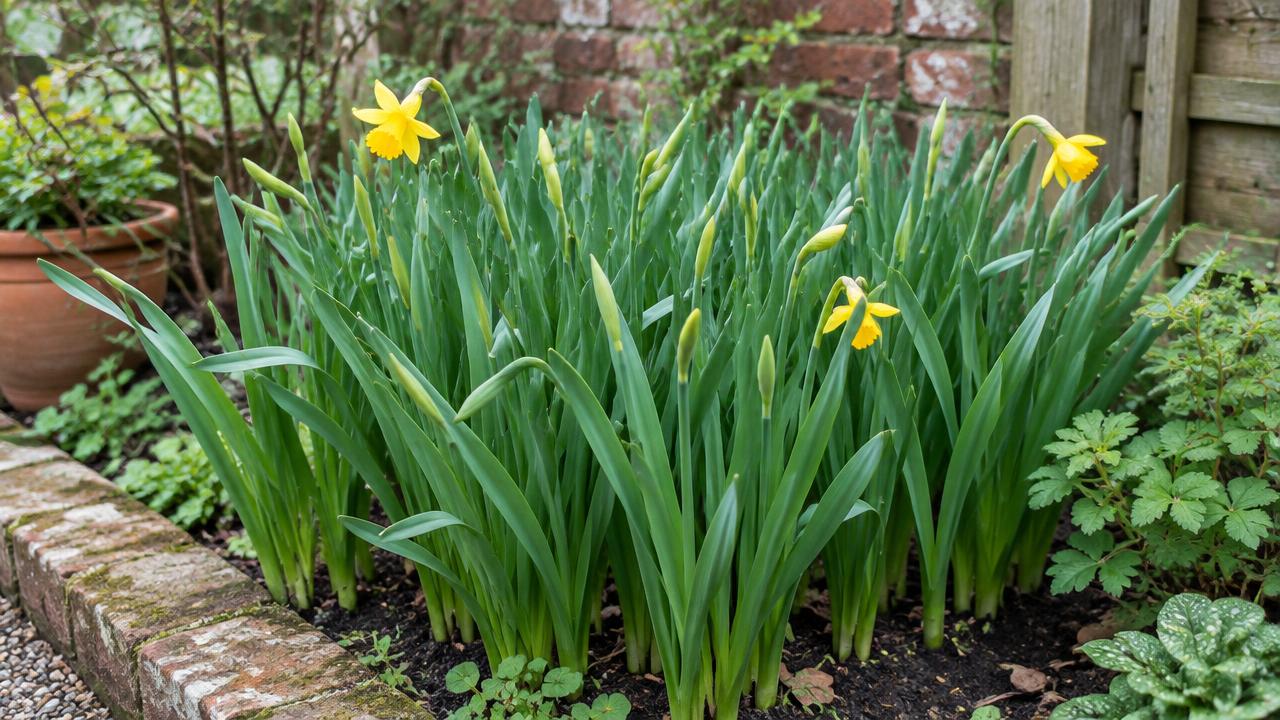
After the flowers finish, the foliage continues photosynthesising. That energy replenishes the bulb and helps form the following year's growth and flowers. Cutting leaves off because they look untidy interrupts that process. So does knotting daffodil foliage into bundles, an old tidying practice that restricts the functioning leaf area.
Deadheading is different. Removing faded flowers from true bulbs and corms can stop energy being spent on seed production where seed isn't wanted. Remove the flower. Leave the functioning leaves. The same distinction underpins the advice in should you deadhead, or let it go to seed: you are choosing what the plant spends its energy on.
Once the foliage has yellowed, become straw-like and died naturally, it has finished its job. Container gardeners have an advantage here: move the pot somewhere less conspicuous while the foliage declines.
Leave, lift or replace?
Not every bulb needs the same end-of-season treatment.
Leave them. Daffodils, crocus, snowdrops, muscari and many alliums can remain in the ground for years where conditions suit them. Some will multiply and form increasingly large colonies. Eventually a congested clump may need lifting and dividing.
Lift tender plants. Dahlias, cannas and other frost-sensitive storage organs need different treatment. Depending on where you garden and how exposed the site is, they may need lifting and overwintering somewhere frost-free, or containers may be moved under protection. They are not simply daffodils with a different flowering season.
Decide what you're doing with tulips. Many highly bred display tulips are at their most impressive in their first year. Some will return, and specialist and species tulips can perennialise well in suitable conditions, while other bedding tulips become progressively less impressive. You can leave them, lift and store them, or treat the display as temporary and replace them. Choose deliberately rather than assuming every tulip behaves like a daffodil.
Forcing bulbs indoors
Forcing means manipulating a bulb's environment to produce flowers earlier than it would naturally.
Prepared hyacinths are the classic Christmas example. They've already received treatment from the grower and need planting early enough to complete their rooting and shoot-development period. The precise timing varies by cultivar, which is why the packet matters. RHS hyacinth guidance separates prepared bulbs from ordinary garden hyacinths for exactly this reason.
Paperwhite narcissus are different again and don't require the same prolonged cold treatment. Hippeastrum, commonly sold as amaryllis, follows its own indoor growing cycle.
The broader lesson is that "indoor bulb" isn't one horticultural category. Check the plant and whether it has been specially prepared rather than applying the hyacinth method to everything.
Why bulbs stop flowering
Leaves with no flowers are often described as blindness, particularly in daffodils. It isn't one diagnosis.
The leaves were removed too early. Premature mowing or cutting prevents the bulb replenishing its reserves after flowering. This is why the six-week mowing rule matters in grass.
The plant dried out. Severe dryness during active growth can cause foliage to die prematurely, again reducing the bulb's opportunity to build reserves. This is particularly easy to do in containers.
The bulbs are overcrowded. A successful clump can eventually become so congested that flowering declines. Lift and divide once the foliage has died back.
They were planted too shallowly. Shallow bulbs are more exposed to drying and unstable conditions and may become progressively weaker.
Conditions are wrong. Too much shade for a sun-loving bulb, persistent waterlogging or poor container conditions can all reduce performance.
It may be the bulb. Not every cultivar is a reliable long-term performer. This is especially relevant to highly bred tulips.
Don't reach automatically for fertiliser. Work out which part of the growing cycle failed.
Rot, squirrels and other failures
A soft, collapsing bulb usually has a more fundamental problem than insufficient feeding. Persistent waterlogging is a major cause of bulb rot, and poor-quality or damaged bulbs can also decay during storage or after planting. If several bulbs fail in the same saturated position, change the conditions rather than simply buying replacements.
Squirrels are a different problem. Tulips and crocus can be dug up soon after planting, particularly where freshly disturbed soil advertises exactly where you've been working. Physical exclusion is more reliable than folklore. Secure mesh over a newly planted container or bed can prevent digging, provided it is installed and monitored so wildlife cannot become trapped.
Slugs and snails can damage emerging shoots, but diagnose the problem before treating it. A few ragged leaves on a vigorous daffodil don't require an emergency response. If damage repeats in pots, the practical checks in why the slugs are back are a better starting point than scattering treatments blindly.
Distorted or scorched-looking tulip growth can indicate tulip fire. Affected material should be removed rather than allowed to become a continuing source of infection.
One safety note
Some familiar bulbs are potentially harmful if eaten, and some can irritate skin.
Colchicum, often called autumn crocus or meadow saffron, deserves particular attention because the RHS classifies it as toxic if eaten and toxic to pets, and advises wearing gloves and other protection when handling it.
Daffodils, hyacinths and tulips are also potentially harmful if eaten, and some bulbs can irritate the skin.
This isn't a reason to avoid growing bulbs. It is a reason to wear gloves where recommended, wash your hands after handling, and not leave loose bulbs somewhere that a child or pet is likely to investigate.
Planning a bulb display that lasts
The most efficient bulb planting isn't necessarily the one with the most varieties. It's the one that uses time as well as space.
A simple sequence can run from snowdrops and Iris reticulata in late winter, through crocus, muscari and narcissus, into tulips, followed by alliums and then summer-flowering lilies. Exact flowering times depend on cultivar, site and weather. The principle doesn't.
If your garden is a patio, a balcony or a few square metres of border, you can't create more ground. But the same ground can flower several times. That's where bulbs become particularly useful.
FAQ
When should I plant bulbs?
Spring-flowering bulbs are generally planted in autumn, hardy summer-flowering bulbs in autumn, tender summer-flowering bulbs in early spring and autumn-flowering bulbs by late summer. Individual plants vary, so species-specific timing takes precedence.
How deep should I plant a bulb?
For many familiar bulbs, roughly two to three times the bulb's own depth is a useful rule. Follow specific instructions where they differ.
Which way up do bulbs go?
For most true bulbs, pointed end upwards and flat basal plate downwards. If you genuinely cannot identify the top, planting sideways is usually preferable to deliberately planting upside down.
Why didn't my bulbs flower?
Possible causes include foliage being removed too early the previous year, drought during active growth, overcrowding, shallow planting, unsuitable light or drainage, or the natural performance of the cultivar.
When can I mow over daffodils in grass?
Wait at least six weeks after flowering and ideally until the foliage has yellowed naturally.
Do I need gravel in the bottom of a bulb pot?
No. Use a suitable free-draining growing medium and make sure the pot has functioning drainage holes.
Can bulbs stay in containers all year?
Many hardy bulbs can, provided the container has suitable compost, drainage and enough space. Long-term pots eventually need maintenance as bulbs multiply and the growing medium deteriorates.
Do bulbs need feeding?
Not automatically. Bulbs in reasonably fertile ground may need little additional feeding. Container bulbs you want to keep benefit more from feeding during active growth while the foliage is still green.
FURTHER READING
- Getting Started
Container Growing Fundamentals
- Getting Started
Soil and Compost pH, Explained
- Getting Started
Starting and Repairing a Lawn
RELATED POSTS
Robin is a small-space grower writing for everyone working with a courtyard, balcony, window box, patio or sunny sill. Edible and leafy, both kept alive in the kind of light real small spaces actually get.
✦ Free with the newsletter — the small-space starter sheet
Grow Anywhere — a free weekly email.
The Potted Club newsletter. A short note from Robin — what to sow, one plant problem solved, and the best new guide.
FREE WEEKLY EMAIL · NO SPAM · UNSUBSCRIBE ANYTIME