HOME / GUIDES / GETTING STARTED
The Complete Guide to Growing Olive Trees in Pots
How to grow an olive tree in a pot, from compost, watering and feeding to pruning, winter protection and developing a thicker trunk.
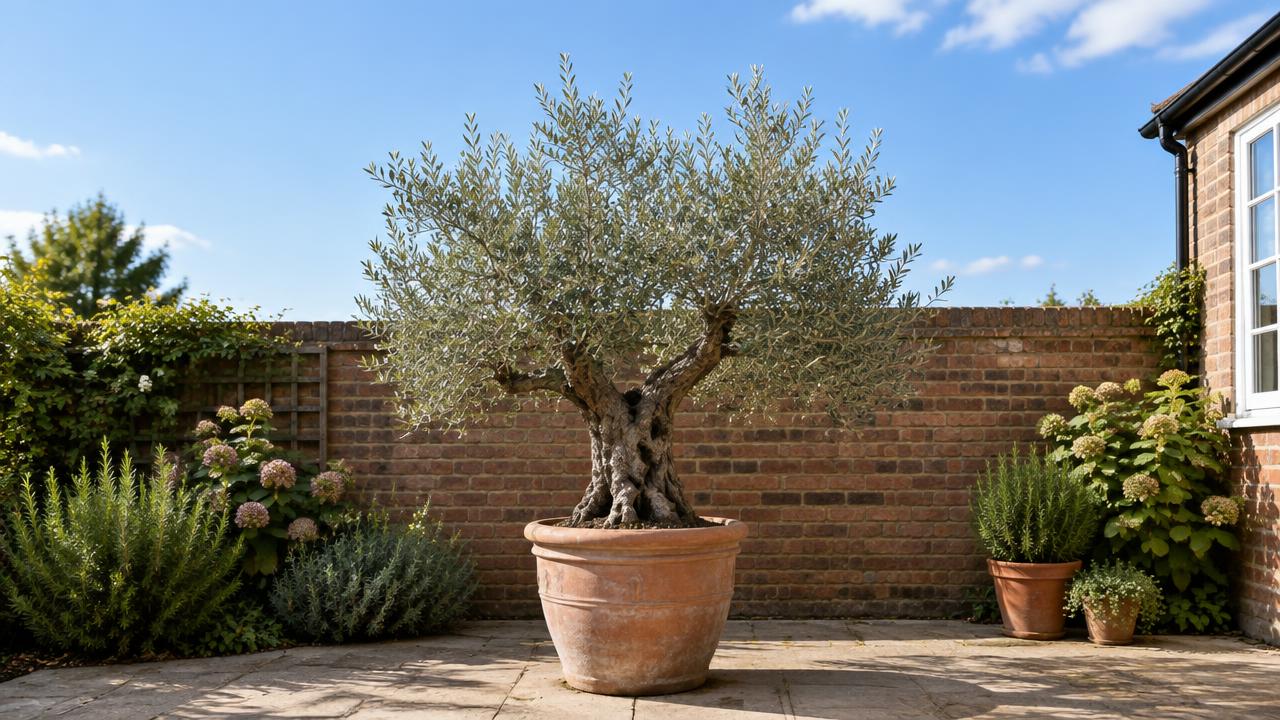
An olive is one of the few Mediterranean trees that will live outdoors in much of Britain in a pot, and the care it needs is simpler than its reputation suggests. Drainage, sun and patience do most of the work, and the same three things decide whether the trunk ever fills out.
Why an olive works in a pot
Olives are native to the Mediterranean region, and the RHS describes them as drought tolerant once established and best suited to sunny, sheltered positions on well-drained soil or to container cultivation. A pot suits them for a practical reason as well as a botanical one. It lets you decide exactly what the roots sit in, which matters a great deal in a climate where winters are long and wet.
The RHS gives Olea europaea a hardiness rating of H4 and says many olives are hardy through most of the UK, tolerating around -5 to -10°C. That is tougher than most people assume, but it comes with two qualifications. Leaves and branches can still be damaged by severe frost, and the RHS recommends containers specifically for colder areas and for heavier, wetter soils, because a pot can be given sharp drainage and moved somewhere frost-free when it needs to be.
Choosing an olive
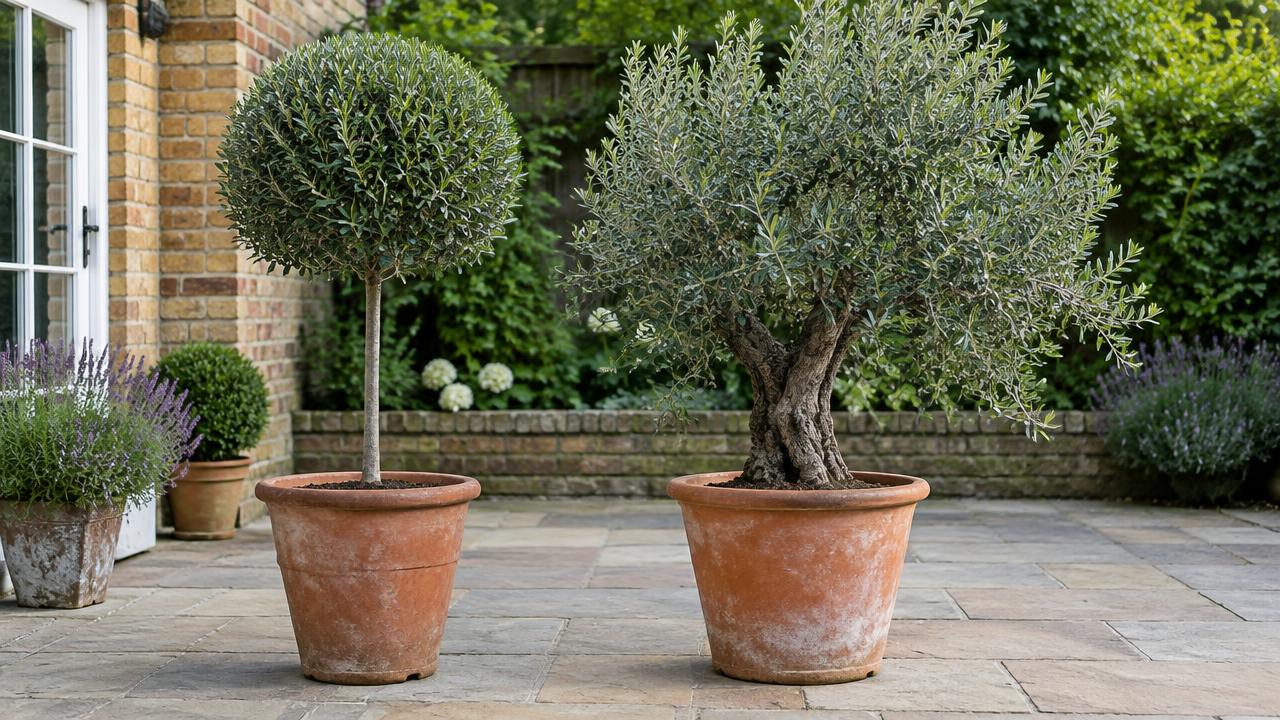
The RHS notes that Olea europaea is sold in Britain in many sizes, from mature old trees with gnarled trunks to half-standards that take up very little space. Because olives rarely produce fruit here, its advice is to choose for shape or foliage rather than for a crop, and that is the sensible starting point for a container tree.
What matters more than the label is the structure you are buying. A young half-standard with a pencil-thin stem and a mature specimen with a thick, fissured trunk are both sold as olive trees, but they are separated by a very long time. The RHS plant profile gives 20 to 50 years as the time an olive takes to reach its ultimate height, which is a fair indication of the pace involved.
Pot size and material
The RHS suggests a thick, frost-proof container at least 30 to 35cm wide and deep, or large enough to take the roots easily, with plenty of drainage holes in the base. Its wider guidance on trees in containers adds two useful points. A small tree should not go straight into a very large pot but be moved up in stages, and a tree's final container should be at least about 45cm across. Sizing the pot to the plant is covered in more detail in our complete repotting guide.
On material, the RHS points out that unglazed terracotta is porous and dries out more quickly, while plastic is lighter and holds moisture for longer. Either will grow an olive. Terracotta's extra weight and faster drying are both useful for this particular plant, provided the pot is sold as frost-proof, while plastic asks for a little more care over winter wet and stability. The wider choices are covered in container growing fundamentals.
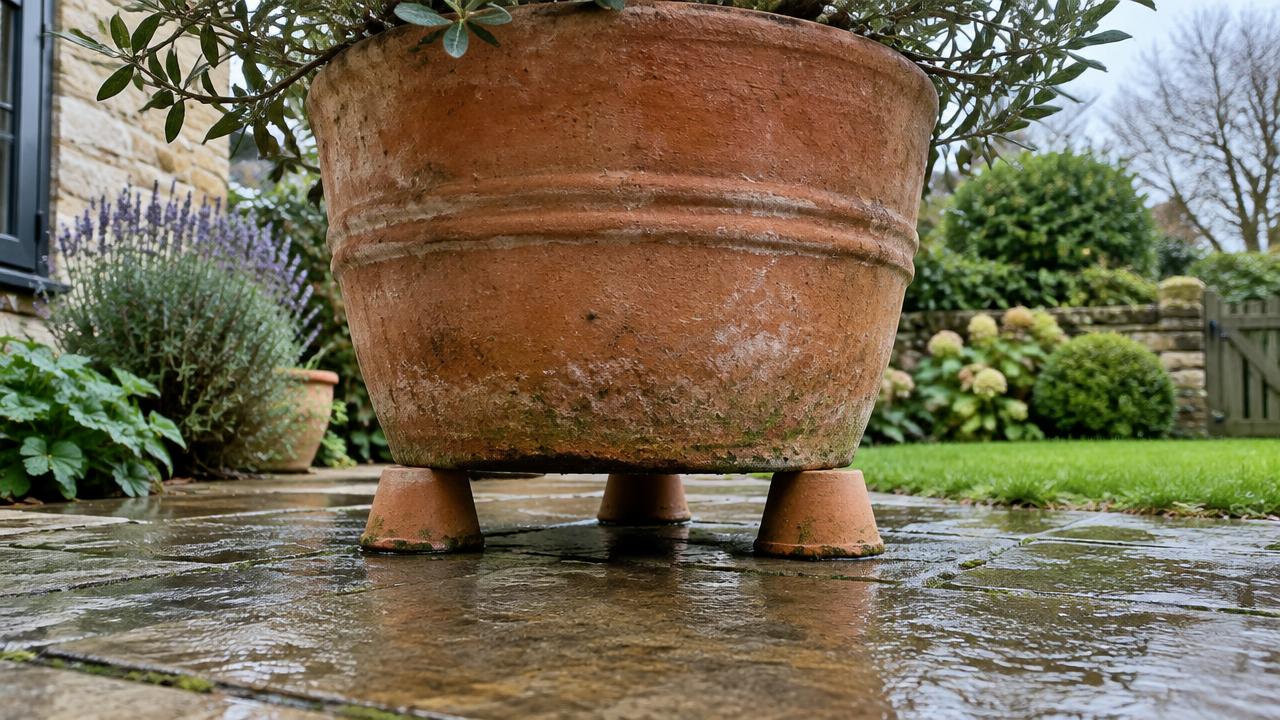
Whatever the pot is made of, raise it off the ground. The RHS recommends pot feet or bricks under container olives so that the compost cannot become saturated, and keeping the drainage holes clear is the single most useful thing you can do before winter.
Compost and drainage
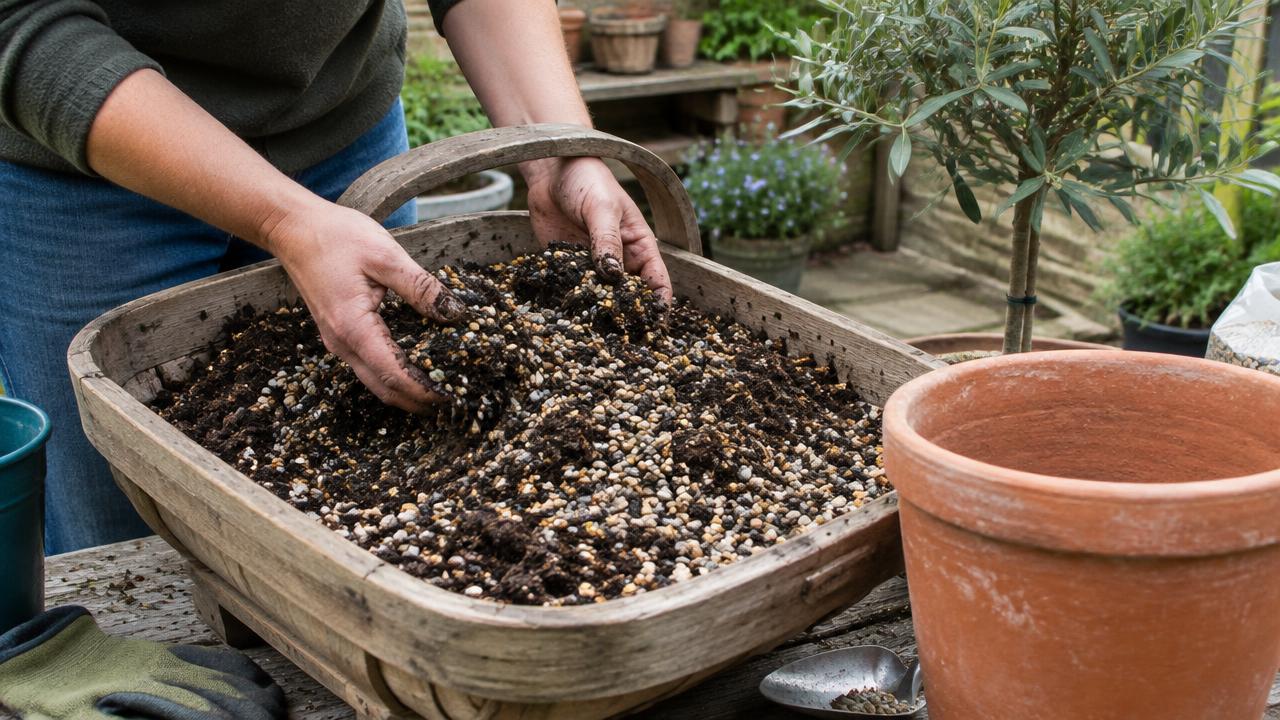
Use a peat-free, soil-based compost such as John Innes No. 3, and mix in about 20 per cent horticultural grit by volume. That is the RHS recommendation for container olives, and both halves of it are doing a job. The loam in a soil-based compost does not rot down in the way that purely organic ingredients do, so the mix keeps its structure for longer, and the RHS says composts of this kind last around three to four years before they need replacing. The grit is there to improve drainage.
You do not need a deep layer of gravel or broken pots in the bottom. The RHS includes the belief that crocks improve drainage in its list of common gardening myths, on the grounds that a layer of crocks interrupts the movement of water through the compost and reduces the volume the roots can use. What it does recommend is covering any drainage hole wider than about 2.5cm with a single crock or stone so that compost cannot fall through, and leaving smaller holes uncovered.
Position and light
Give an olive full sun and as much of it as you can manage. The RHS lists the plant for full sun in a sheltered, south-facing position, and its growing guide asks for a sunny, sheltered site away from cold winds.
Light is the one requirement that cannot be made up for elsewhere. An olive in a shadier spot may hang on for years, but it is working with less energy, and you should expect slower growth and thinner foliage than the same tree would manage in full sun.
Shelter earns its place for two reasons. Cold wind is one of the things the RHS identifies as damaging the canopy in winter, and a top-heavy tree in a pot is easily blown over. Against a sunny wall is the ideal spot on both counts.
Watering
Olives are drought tolerant once established in the ground, but that reputation is misleading in a pot, as with the other plants in our guide to drought-tolerant plants for pots. The RHS says container-grown olives need regular watering from April to late September while they are in active growth, and its fruit-growing guide goes further and advises keeping the compost moist through the growing season.
In practice that means checking the compost rather than following a timetable. Push a finger a few centimetres into the surface, water thoroughly when it has begun to dry, and let the excess run out through the drainage holes. A pot in full sun dries far faster in a hot spell than in a cool, damp one, so the interval between waterings will change from week to week. Prolonged dryness shows up on the tree itself, and the RHS lists it as a cause of leaf fall and brown leaf edges in container olives.
Winter is the opposite problem. The RHS advice is to keep the compost barely moist and to raise the pot so that it cannot become saturated. That does not mean no water at all, particularly for a tree that has been moved under cover and is getting no rain, but it does mean a pot should never stand in a full saucer through the cold months.
Feeding
For an olive grown as an ornamental tree, the RHS recommends a simple routine. Each spring, scrape away about 5cm of compost from the surface and replace it with fresh compost of the same gritty, soil-based mix. That annual top-dressing is the only feeding its guide to ornamental olives prescribes for trees in containers.
If you are growing for fruit, the advice changes. The RHS fruit guide suggests mixing controlled-release fertiliser granules into the compost at planting and giving a balanced liquid feed every month during the growing season. The same approach is reasonable for a young tree you are deliberately trying to grow on, since it is being asked to do more than hold its shape.
Repotting and root management
Olives cope well with a restricted root run, which is part of why they suit containers, but there is no fixed timetable for moving one on. Look at the rootball in spring if growth has slowed, if the compost has broken down and stopped draining freely, or if you suspect the roots are seriously congested. A root or two appearing through a drainage hole is not enough to go on, because it tells you where one root has gone rather than what state the whole rootball is in.
If the tree needs more room, move it up one size rather than jumping to a much larger pot, as our repotting guide sets out. Spring is the sensible time, with a full growing season ahead for the roots to move into fresh compost.
If you want to hold the tree at its present size, keep it in the same container and rely on the annual spring top-dressing to refresh the compost. That is a legitimate choice for a manageable patio tree. It is also a decision to limit growth, and with it the rate at which the trunk can thicken.
Pruning and shaping
Olives need very little pruning, and the RHS says so plainly: they grow slowly, so there is not much to remove. In late spring or early summer, take out dead, diseased or dying branches, cutting back to a sideshoot. At the same time, thin the branches enough to let light into the centre, remove any that spoil the shape, and cut off shoots arising near the base or along the trunk if you are keeping a clear stem.
Container trees may need a little more attention to keep them in proportion. The RHS suggests additional summer pruning to keep size in check, and pinching out the shoot tips once a potted olive reaches about 1.5m to encourage branching.
Two warnings come with that. The RHS advises against pruning any harder than this, because hard pruning produces vigorous upright water shoots that then have to be thinned out. It also advises against pruning later than August, since the new growth that follows will not have time to harden before the frosts.
How olive trunks actually thicken
This is the question most owners of a thin-stemmed olive eventually ask, and the answers they are usually given are pruning advice. Pruning is mostly working in the wrong direction.
A woody stem thickens by adding a new layer of wood each growing season from the cambium, the thin band of living tissue beneath the bark. That growth is paid for by the sugars the leaves make, so the amount of new wood a tree can lay down is tied to how much foliage it carries, how much light that foliage receives, and whether the roots can supply the water and nutrients to support it. None of this is special to olives. It is how trees grow, and it leads to a principle that is simple to state and awkward to live with: a tree thickens when it is allowed to grow, and whatever restricts growth restricts girth as well.
Seen that way, the usual treatment of a patio olive is a recipe for a thin trunk. A half-standard clipped back to the same neat head every summer loses much of the foliage it would have used to make wood. A tree held permanently in a small pot has a root system that can only support so much top growth. A position short of full sun reduces what the leaves can produce in the first place. On top of all that, a British growing season is shorter and cooler than a Mediterranean one, and that is the one constraint you cannot alter.
Our detailed article on how to thicken an olive trunk looks at ordinary free growth and specialist sacrifice-branch training. If trunk development is the priority, the adjustments follow from the same principle. Give a young olive more freedom to grow before imposing its final compact shape, which means accepting a looser, less tidy tree for some years rather than clipping it back to the same outline every summer. Move it up through pot sizes in stages so the roots are not held permanently in a small volume, keep it in the sunniest position you have, and water and feed it consistently through the growing season.
How long does it take?
Longer than you would like, and there is no reliable figure to quote. Trunk growth depends on the cultivar, the size of the plant you start with, the volume of the pot, light, water, feeding, local climate and the vigour of the individual tree. A number of centimetres per year for a container olive in Britain would be a guess.
What can be said is that the RHS describes olives as slow-growing and gives 20 to 50 years for a tree to reach its ultimate height. The thick, twisted specimens people have in mind are old trees, and no technique compresses that into a few seasons in a pot. A realistic aim is a tree that thickens steadily and looks more substantial each year. If the ancient look is what you want now, a mature specimen bought at that size is the honest route to it.
Flowers and fruit in Britain
Olives produce sprays of small, creamy-white, fragrant flowers in summer. They are easy to overlook among the foliage, and on many British trees they are the end of the story.
Fruiting here is possible but unreliable. The RHS says fruit may occasionally develop in hot summers in some parts of the UK, and its fruit guide speaks of a crop sometimes following hot summers in southern gardens. Any olives you do get need special preparation before they are edible, which the RHS describes as soaking green fruit in salted water or dry-curing black fruit in salt. For most British container growers an olive is more dependable as an ornamental tree than as a food crop, and treating it as one avoids disappointment.
Winter protection
Our forecast-led guide to protecting pots from frost explains when to move, wrap or leave a container alone.
Many established olives can stay outside all year in milder, sheltered parts of the UK. The RHS is equally clear that winter protection is required in colder parts of the country, and that in those areas a container olive is best moved to a frost-free place for the winter. A pot makes that possible, but it also leaves the roots more exposed to cold than they would be in the ground, one reason autumn planting in pots needs more care than planting into open soil.
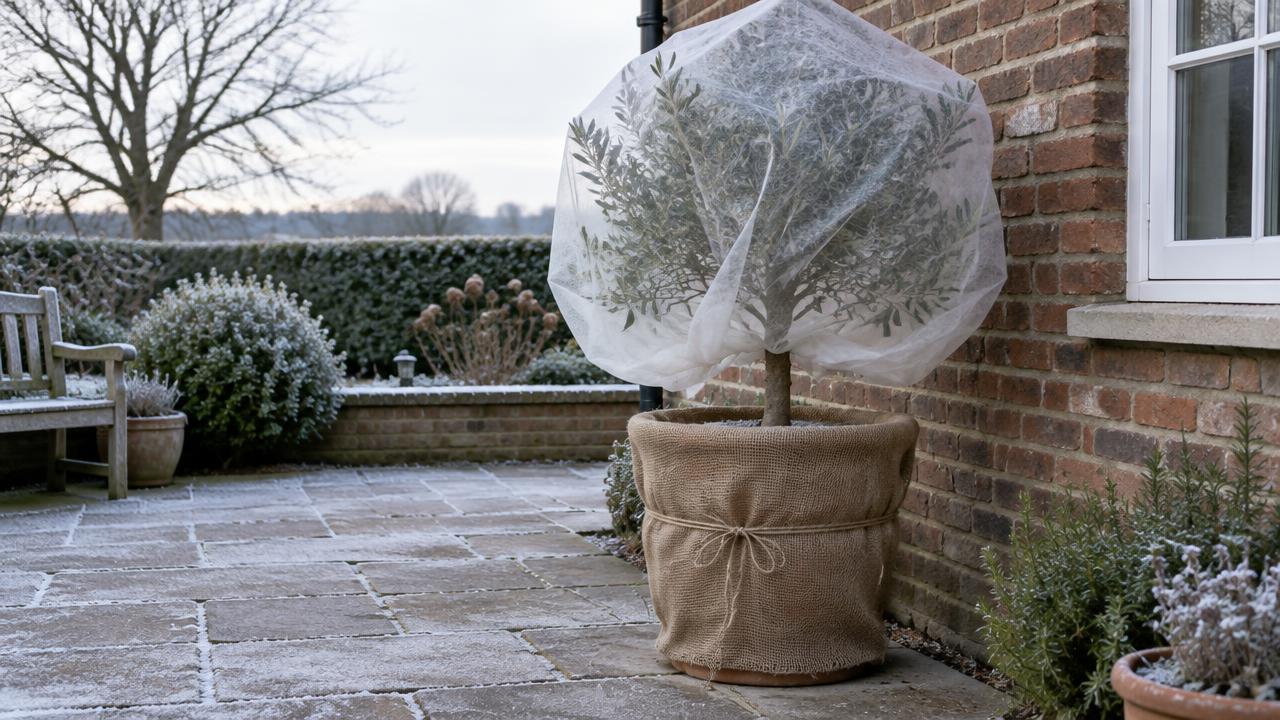
Where the tree is staying out, move it to the most sheltered spot you have, away from cold winds and ideally against a wall. In very cold spells the RHS suggests wrapping the canopy in a couple of layers of fleece or hessian, and wrapping the container as well. Bubble wrap or hessian tied round the pot is its general recommendation for trees in containers. Take the wrapping off in milder weather and put it back when severe frost is forecast, rather than leaving the tree bundled up for months.
Where the tree is coming under cover, the requirement is frost-free rather than warm. An unheated greenhouse, a cold conservatory or a bright porch fits the description, and what an olive generally does not need is a centrally heated living room. Under cover or outside, keep the compost barely moist and the pot raised on feet.
Common problems
Leaf loss is the symptom that worries people most. The RHS identifies two common causes: the natural shedding of older leaves in spring as new growth begins, and dry compost, which makes older leaves lower down or deep inside the plant fall and can brown the leaf edges on the sunny side. Leaf fall at other times of year, or in a pot that is plainly not dry, deserves a closer look at the roots and drainage rather than being written off as normal.
Frost damage shows as dead or browned stems after a hard winter. The RHS advice is to wait until late spring and then prune affected stems back to new shoots, by which time it is clear what has survived.
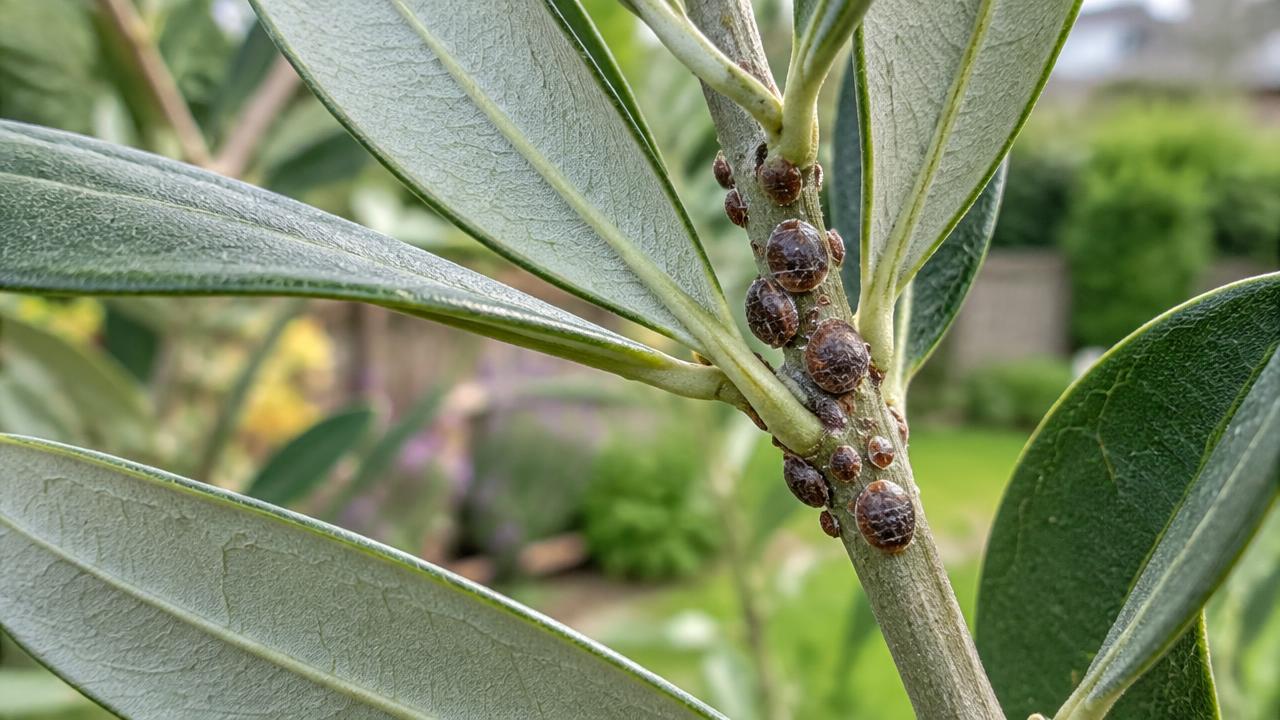
Scale insects are listed by the RHS among the pests of olives. Look for small, raised, brownish bumps on stems and the undersides of leaves, sometimes with a sticky coating on the foliage beneath them. Olive scab, a fungal disease that marks the leaves, is the other problem the RHS names. It also flags olives as a high-risk host for Xylella fastidiosa, a serious bacterial disease of many plants, which is a reason to take some care over where a tree comes from.
Olive calendar
January and February. Keep the compost barely moist and the pot raised on feet with its drainage holes clear. Wrap the canopy and container when severe frost is forecast, and unwrap again in milder spells.
March. Top-dress by replacing the top 5cm of compost with fresh mix. Check the rootball if growth was poor last year, and pot on one size if the roots are congested.
April. Regular watering begins and continues through the summer. Start a monthly balanced liquid feed if you are growing for fruit or building up a young tree.
May and June. Carry out the main prune: dead, diseased or dying wood, crowded branches, and shoots on the trunk if you want a clear stem. Cut frost-damaged stems back to new shoots once you can see what has recovered.
July and August. This is the peak of growth and the time flowers appear. Water regularly and check for scale. Trim to restrict size if you need to, or leave the tree alone if you are building girth, and finish any pruning by the end of August.
September. Keep watering regularly until late in the month, then let the intervals lengthen as growth slows. Stop liquid feeding.
October. Clear the drainage holes, check the pot feet and move the tree to its winter position. In colder areas, bring it into a frost-free place before severe weather arrives.
November and December. Keep the compost barely moist and let rainfall do most of the work for a tree outdoors. Protect the canopy and container during severe frost.
FAQ
Can olive trees survive British winters outdoors?
Often, yes. The RHS rates Olea europaea as H4 and says many olives tolerate around -5 to -10°C, but winter protection is required in colder parts of the UK. A container leaves the roots more exposed, so shelter, wrapping in severe frost and good drainage all matter.
Should I bring my olive indoors for winter?
It depends where you live. In colder areas the RHS recommends moving container olives to a frost-free place, such as an unheated greenhouse or cold conservatory. The aim is frost-free rather than warm, so a heated living room is not what the tree needs.
Do I need crocks or gravel in the bottom of the pot?
Not as a drainage layer. The RHS lists the idea that crocks improve drainage among common gardening myths. It does recommend placing a single crock or stone over any drainage hole wider than about 2.5cm to stop compost falling through.
When should I repot an olive?
When the rootball needs it rather than at a set interval. Check in spring if growth has slowed, the compost has deteriorated or the roots seem badly congested, and move up one pot size if so. One or two roots at a drainage hole are not reason enough.
Why is my olive dropping leaves?
The RHS names natural shedding of older leaves in spring and dry compost as the usual causes. If leaves are falling at another time of year and the compost is not dry, check the drainage and the condition of the roots.
How do I make the trunk thicker?
Let the tree grow. Girth comes from the wood a tree lays down each season, which depends on leaf area, light, root room, water and nutrition. Allow a young olive more free growth before clipping it to a final shape, and expect the process to take years.
Will my olive produce fruit in Britain?
Possibly. The RHS says fruit may occasionally develop in hot summers in some parts of the UK, and that it needs special preparation before it is edible. Most British growers are better off treating an olive as an ornamental tree.
FURTHER READING
- Getting Started
Container Growing Fundamentals
- Getting Started
The Complete Guide to Repotting
- Getting Started
The Complete Guide to Planting Bulbs
RELATED POSTS
Robin is a small-space grower writing for everyone working with a courtyard, balcony, window box, patio or sunny sill. Edible and leafy, both kept alive in the kind of light real small spaces actually get.
✦ Free with the newsletter — the small-space starter sheet
Grow Anywhere — a free weekly email.
The Potted Club newsletter. A short note from Robin — what to sow, one plant problem solved, and the best new guide.
FREE WEEKLY EMAIL · NO SPAM · UNSUBSCRIBE ANYTIME