HOME / GUIDES / GETTING STARTED
The Complete Guide to Repotting
When a plant actually needs repotting versus when it just needs feeding, how to handle different root types without causing transplant shock, which plants hate being disturbed, and which ones want repotting every year.
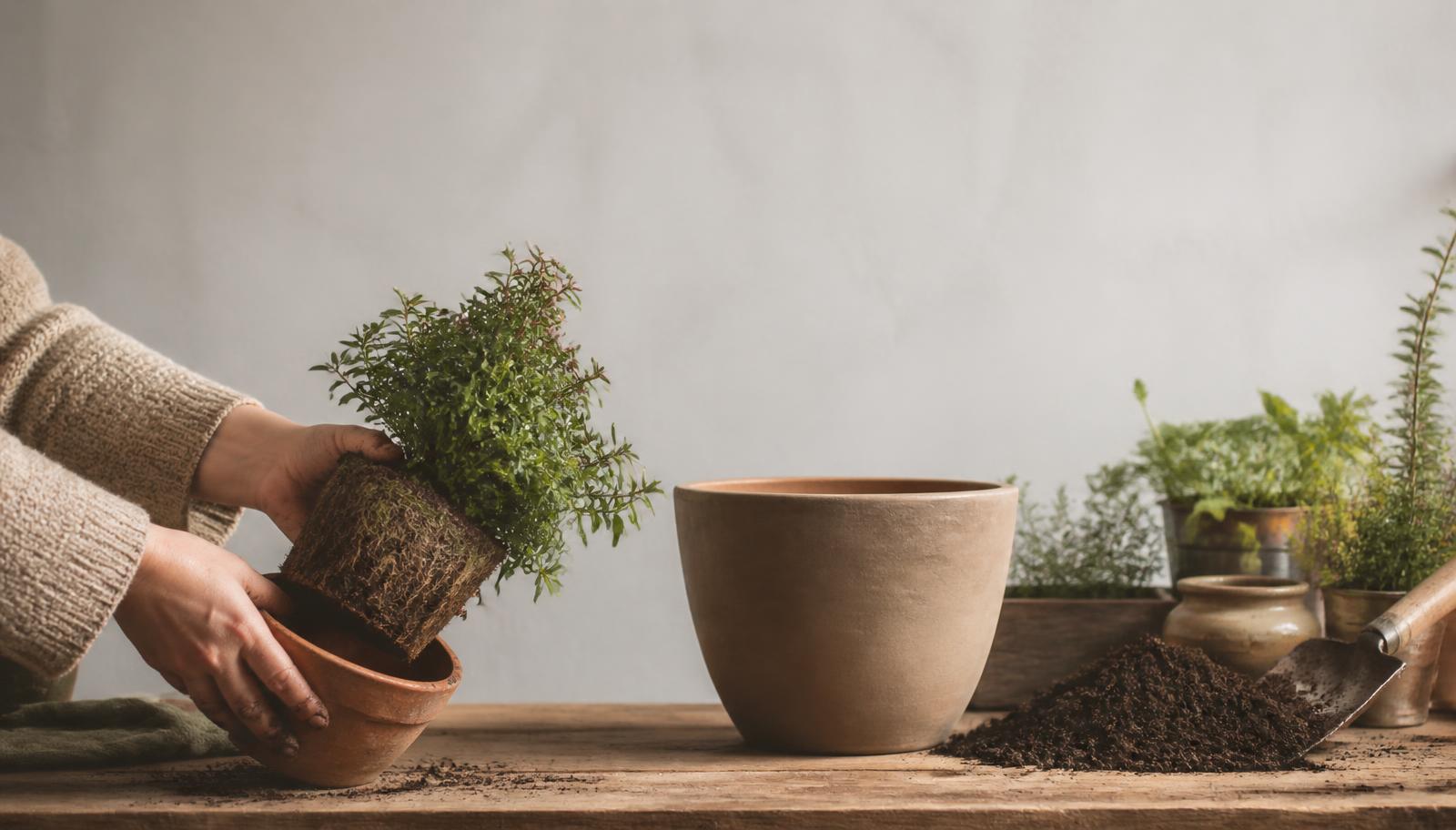
Why plants actually need repotting
"It's outgrown its pot" undersells what's really happening. Several things are usually going on at once, and understanding them changes how you judge whether a plant genuinely needs repotting or something else entirely.
Roots fill the available compost, eventually running out of room to expand and starting to circle the inside of the pot instead of growing outward. As covered in our feeding guide, a pot's nutrients are mostly used up within about six weeks and need topping up regularly, but even with feeding, the compost itself physically breaks down over time, losing the structure that lets water and air move through it properly. Repeated feeding and watering, particularly with tap water, also leaves mineral salts building up in the compost, which can eventually affect root health. All of this together is why a plant that was thriving a year or two ago can start to struggle even with unchanged care.
Signs it's time, and signs it isn't
The common signs are fairly recognisable: roots visible growing out of the drainage holes, roots clearly circling when you look at the surface of the compost, water running straight through without being absorbed, the plant drying out unusually fast even after a thorough watering, slowed growth despite normal feeding, and a plant that's become top-heavy and prone to tipping over.
Worth saying plainly, though: not every struggling plant needs repotting. Yellowing leaves, wilting, or poor growth are just as often caused by a watering problem, incorrect light, or a missed feed, and repotting a plant that's actually dealing with one of those adds a second stress on top of the real issue rather than solving it. Check watering habits and light conditions first. If the plant is otherwise being cared for properly and the signs above are present, particularly visible root-bound growth, that's when repotting is genuinely the answer.
When to repot
Spring is the ideal time for most plants. Growth is picking up, which means a plant recovers from the disturbance fastest and puts the fresh compost and extra room to use quickly, rather than sitting disturbed through a period of dormancy.
Early summer is still a reasonable window, particularly for fast-growing plants that need repotting more than once a year.
Autumn is workable if genuinely necessary, but growth is slowing, so recovery takes longer. Better to wait if the plant can hold on until spring.
Winter should be avoided unless it's an emergency, since most plants are dormant or resting and have the least capacity to recover from root disturbance at exactly the point growth has stopped.
A few situations override the seasonal rule. A plant that's just arrived home in a badly cracked or broken pot needs moving regardless of season. A plant that's severely root-bound and clearly suffering shouldn't wait months for the "right" season if it's genuinely struggling. And a newly purchased plant, as covered in our piece on feeding houseplants, is usually fine left in its original pot and compost for its first six weeks or so, rather than repotted immediately on arrival.
Choosing the next pot
Size up by roughly 2 to 5cm in diameter, not into a dramatically larger pot. This is worth taking seriously: a pot that's much bigger than the current rootball holds far more compost than the plant's roots can actually use, which stays wet for much longer after watering and is one of the most common causes of root rot following a repot. A modest increase in size gives the roots room to grow into without leaving a large volume of permanently damp compost around them.
For guidance on pot materials (terracotta, plastic, fabric and so on) and choosing the right compost type for different plants, our container growing fundamentals guide covers this in depth and applies just as much to a repot as to an original planting.
Step-by-step technique
- Water the plant thoroughly a few hours beforehand. A well-watered rootball holds together better and is considerably less stressful to handle than a bone-dry one.
- Prepare the new pot first. Add a layer of fresh compost to the base before you touch the plant, so it's not sitting bare-rooted while you get things ready.
- Ease the plant out. Tip the pot on its side, tap the sides firmly, or squeeze a flexible plastic pot gently to loosen the rootball. For a stuck rigid pot, run a knife around the inside edge before trying again.
- Assess the roots before doing anything else. This is the step most generic advice skips, and it genuinely changes what you do next; see the section below on handling different root types.
- Remove any dead, mushy, or clearly rotten roots, trimming them back to healthy tissue with clean scissors or secateurs.
- Position the plant in the new pot, so the top of the rootball sits roughly 2cm below the rim, leaving room for watering without compost spilling over.
- Backfill around the sides with fresh compost, firming gently as you go so there are no large air pockets, but without compacting it hard.
- Water thoroughly once, until it runs through the drainage holes, then leave it be.
Handling different root types
This is where most repotting advice stays too generic, and it's worth doing properly since the wrong handling can genuinely set a plant back.
Circling, root-bound roots (common in houseplants and anything left too long in a pot) benefit from being gently teased apart around the outside before repotting, or lightly scored with a clean knife in three or four vertical lines down the rootball if they're tightly matted. This encourages roots to grow outward into the fresh compost rather than continuing to circle in the same pattern, which they'll otherwise do even in a bigger pot.
Fibrous rootballs (most herbaceous perennials, many houseplants) are generally forgiving and can be loosened gently by hand around the edges without much risk, and are the easiest root type to work with.
Woody shrub and tree roots (roses, container fruit trees, mature shrubs) are far less forgiving of disturbance. Loosen only the outermost layer gently, avoid cutting any but the smallest damaged roots, and expect these plants to need a longer, quieter recovery period than a fast-growing houseplant.
Bulbs and rhizomes (many flowering perennials, some houseplants) shouldn't have their storage structures cut or heavily disturbed at all. Handle the surrounding compost gently and avoid damaging the bulb or rhizome itself, which is where the plant's stored energy for next season's growth sits.
Dividing while you repot
Repotting time is also the natural moment to divide many perennials, turning one repotting job into several free plants. If a fibrous-rooted perennial has grown into a large, congested clump, gently pull or cut the rootball into two or more sections, each with its own healthy roots and growing points, and pot each one separately in fresh compost.
This works well for many popular container perennials and ties directly into the free-plants thinking covered in our piece on deadheading versus letting plants seed: between division and seed-saving, a surprising amount of a small-space garden can be grown for nothing beyond the cost of compost and pots.
Transplant shock: what's normal and what isn't
Some drooping, mild leaf drop, or a brief pause in visible growth in the days after repotting is normal and expected, particularly for a plant that had a lot of root disturbance. This is transplant shock, and for most plants it resolves within one to two weeks as the roots settle into the new compost and resume normal function.
What's worth watching for beyond that: leaves dropping continuously rather than settling after a week or so, new growth that emerges weak or discoloured, or a plant that shows no sign of recovery after several weeks. These can point to overwatering in the aftermath (see below), root damage during the repot that was more significant than intended, or a pot that's too large for the rootball, leaving compost wet for too long.
Minimise shock in the first place by disturbing roots as little as the plant's type allows, repotting in the right season, and keeping the plant somewhere with stable light and temperature for the first week or two rather than moving it around.
Watering and feeding after repotting
Water thoroughly once, immediately after repotting, until it runs through the drainage holes. This settles the compost around the roots and removes large air pockets. After that single thorough watering, let the compost approach dryness before watering again, checking with the finger test covered in our watering guide, rather than keeping it constantly damp. Overwatering in the days after repotting, on top of already-stressed roots, is one of the most common ways a repot goes wrong.
Hold off on feeding for four to six weeks. Fresh compost already contains nutrients, and a newly repotted plant, dealing with root disturbance, has limited capacity to use extra feed productively in the first few weeks regardless. Resume your normal feeding routine once that window has passed and the plant is showing genuine new growth.
Plants that hate being repotted
A handful of plants are genuinely better left alone for as long as reasonably possible, and disturbed as little as possible when repotting does become necessary.
Orchids have fine, sensitive roots that resent disturbance and are usually repotted only every two to three years, using a specialist orchid mix rather than ordinary compost.
Citrus trees dislike root disturbance and are typically repotted only every three to five years, with care taken not to disturb the root flare at the base of the trunk.
Mature rosemary and lavender, as covered in our feeding guide's note on Mediterranean plants, are adapted to poor, undisturbed soil and can sulk badly after a heavy repot; when it is needed, disturb the roots as little as possible.
Cacti and succulents have roots adapted to stable, undisturbed conditions and generally want repotting only every two to four years, handled with minimal root disturbance and left to settle in dry compost for a few days before the first watering.
Peace lilies and a few other houseplants also tend to sulk visibly, with drooping and leaf yellowing, after a heavy repot, even though they recover fine given time; if a plant is prone to this, gentle, infrequent repotting is the better approach.
Plants that want repotting often
At the other end, several common container plants are vigorous enough that frequent repotting, or simply starting fresh each year, is standard practice rather than something to avoid.
Tomatoes, chillies and other fast-growing annual edibles are typically started fresh in new compost each season rather than repotted at all in the ongoing sense. Basil and other fast-growing herbs often benefit from potting on once during a single growing season if they're outgrowing a small starter pot. Strawberries benefit from being divided and refreshed every year or two to stay productive. Fast-growing houseplants like pothos, spider plants and monstera often need repotting every year or so while young and rapidly growing, tapering off to every couple of years once more mature.
Repotting large or heavy container specimens
A patio fruit tree, a large shrub, or anything approaching the "two-person lift" category deserves a mention of its own, since the technique above assumes a plant you can comfortably handle solo.
Lay the pot on its side on a tarpaulin or old sheet rather than trying to lift a heavy plant upright out of a pot, which is both harder on your back and harder on the plant. Work the pot free gradually, tapping and easing rather than forcing, and have the new, larger pot and fresh compost ready and positioned before you start, since a large rootball exposed to air and sun for too long dries out and stresses quickly. For anything genuinely too heavy or awkward to manage safely alone, this is a reasonable job to get a second pair of hands for, or to have done professionally, particularly for an expensive or long-established specimen.
Quick reference: how often
| Plant type | Typical repotting frequency |
|---|---|
| Fast-growing houseplants (pothos, spider plant) | Every 1-2 years while young |
| Slower houseplants (snake plant, ZZ plant) | Every 2-3 years |
| Herbs (non-woody, e.g. basil, mint) | Once a season, or start fresh |
| Woody herbs (rosemary, lavender) | Every 2-3 years, minimal disturbance |
| Tomatoes and annual edibles | Fresh compost each season |
| Strawberries | Divide and refresh every 1-2 years |
| Orchids | Every 2-3 years |
| Citrus trees | Every 3-5 years |
| Cacti and succulents | Every 2-4 years |
| Roses and shrubs in containers | Every 2-3 years, or top-dress in between |
Common mistakes
Sizing up too much at once. A pot dramatically larger than the current rootball holds excess wet compost the roots can't use, a leading cause of root rot after repotting.
Using old, exhausted compost. Reusing tired compost from a previous planting defeats much of the point of repotting, since nutrient depletion and poor structure are exactly what a repot is meant to fix.
Repotting during a heatwave. As covered in our piece on trees in a heatwave, repotting is itself a stress event, and adding it to extreme heat gives a plant the least possible capacity to cope with either.
Feeding immediately. Fresh compost already has nutrients, and a stressed, newly repotted plant can't productively use more on top. Wait the recommended four to six weeks.
Breaking too many roots on a plant that hates disturbance. Treating an orchid or a mature citrus the same way as a fast-growing pothos causes real, sometimes lasting, damage.
Overwatering afterwards, out of anxiety. One thorough watering at the time of repotting, then back to checking the compost before watering again, not a constantly damp routine "just in case."
FAQ
How do I know if my plant needs repotting or something else?
Check watering, light and feeding first. If those are all reasonable and you can see roots circling the rootball, growing out of the drainage holes, or water running straight through without being absorbed, repotting is likely the answer. If the plant is otherwise well cared for but still struggling, look at watering and light conditions again before assuming it needs a bigger pot.
How much bigger should the new pot be?
Roughly 2 to 5cm wider than the current pot. A much larger pot holds more compost than the roots can use, which stays wet longer and increases the risk of root rot.
Can I repot in winter?
Better to avoid it unless genuinely necessary, since most plants are dormant and recover from disturbance far more slowly at that point. If a pot is cracked or a plant is severely root-bound and struggling, it's still worth doing regardless of season.
Should I remove all the old compost when repotting?
Not entirely, and not forcefully. Gently loosen the outer layer and remove clearly old, spent compost, but heavy-handed removal of all compost from the rootball, particularly for plants that dislike disturbance, causes more stress than it solves.
Why has my plant wilted after repotting?
Some mild wilting or leaf drop in the first one to two weeks is normal transplant shock and usually resolves as the roots settle. Continuing decline beyond that points toward overwatering, a pot that's too large, or more root damage than intended during the repot.
Should I water before or after repotting?
Both, in different ways. Water thoroughly a few hours before repotting so the rootball holds together well, then water once thoroughly again immediately after repotting to settle the compost, before returning to your normal check-before-watering routine.
Can I cut roots when repotting?
Yes, for dead, mushy or clearly damaged roots, and for gently scoring or loosening tightly circling roots on root-bound plants. Avoid cutting healthy roots unnecessarily, and be especially cautious with plants that dislike disturbance, like orchids and citrus.
Do all plants really need repotting eventually?
Most container plants do, since compost breaks down and roots eventually fill available space regardless of how well a plant is fed and watered. A few very slow-growing or repot-averse plants can go many years between repots, refreshed instead with occasional top-dressing rather than a full repot.
FURTHER READING
- Getting Started
Container Growing Fundamentals
- Getting Started
Feeding Plants: What They Actually Need
- Getting Started
How to Water Plants Properly
RELATED POSTS
- Houseplants
Don't Repot Your Houseplants This Autumn. You Can Do This Instead
- Plant Problems
Why Is My Plant Drooping After Repotting
- Houseplants
Should I Feed My Houseplants?
Robin is a small-space grower writing for everyone working with a courtyard, balcony, window box, patio or sunny sill. Edible and leafy, both kept alive in the kind of light real small spaces actually get.
✦ Free with the newsletter — the small-space starter sheet
Grow Anywhere — a free weekly email.
The Potted Club newsletter. A short note from Robin — what to sow, one plant problem solved, and the best new guide.
FREE WEEKLY EMAIL · NO SPAM · UNSUBSCRIBE ANYTIME