What to Do With Strawberry Plants After Fruiting
The fruit has finished. The plant hasn't. What to cut back, whether to keep the runners, how to turn one balcony strawberry pot into next year's plants for free, and when an old plant is finally worth replacing.
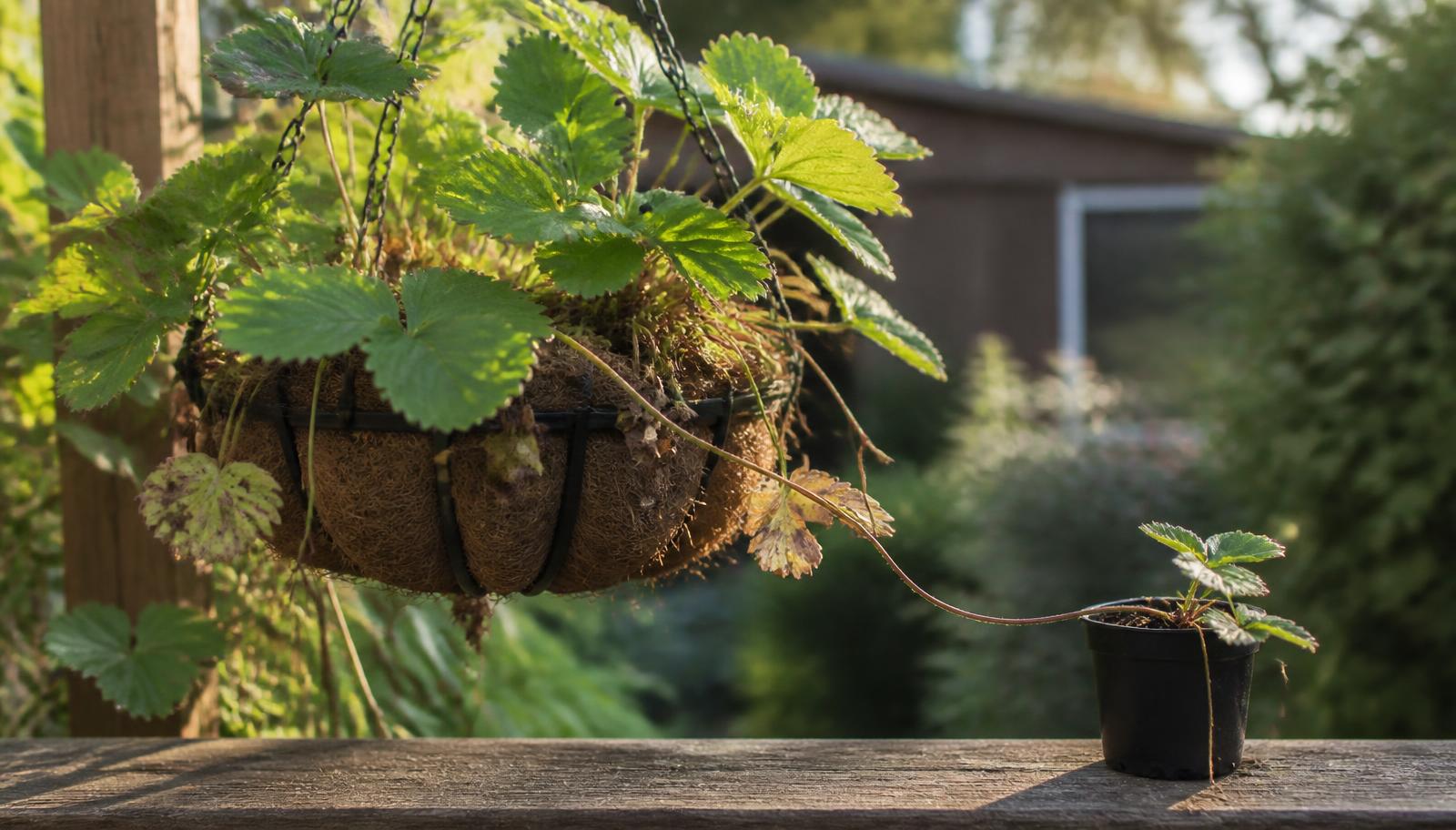
The fruit has finished. The plant hasn't.
If you bought a strawberry plant for a balcony or hanging basket in spring, you're probably looking at something a bit tired and untidy by now: the fruit's gone, the foliage looks a bit ragged, and it's tempting to treat the whole thing as finished for the year. It isn't. What you do with a strawberry plant in the weeks after fruiting genuinely determines how well it performs next year, and whether you end up with free new plants or nothing at all.
First, work out what strawberry you have
This matters before you do anything else, because cutting back a plant that's still capable of fruiting is a real mistake worth avoiding.
Summer-fruiting strawberries, the most common type, crop hard and fast over a two- to three-week window, generally finishing by early August. If your plant fruited in a single concentrated burst and has now clearly stopped, this is almost certainly what you have, and the cutback advice below applies.
Perpetual (or everbearing) strawberries produce smaller flushes of fruit spread over a much longer period, often from early summer right into autumn. If your plant is still flowering or setting the occasional fruit now, it's likely this type, and a hard cutback would remove fruit it's still capable of producing.
Alpine strawberries crop intermittently right through summer in small amounts and are usually left to their own devices rather than cut back on a schedule at all.
If you're not sure which you've got, watch it for another week or two before doing anything drastic. A plant still flowering or fruiting is telling you plainly which category it's in. The RHS strawberry growing advice is a useful cross-check if you've lost the label.
Remove old leaves and spent growth
For a summer-fruiting strawberry that's genuinely finished, cut the foliage back to around 5cm once fruiting is over. This tidies up tired, sometimes disease-prone old leaves and encourages fresh, healthy growth to take over for the rest of the season. It's a proper cutback, not a light trim, and it looks more severe than it feels for the plant.
Don't automatically cut off every runner
This is where it's worth pausing before tidying everything away. Strawberry plants send out runners, long trailing stems with a small plantlet at the tip, as their natural way of propagating themselves. Removing every runner as it appears keeps a pot looking neater, but it also throws away the easiest, cheapest way to get new plants for next year. Late summer, right after fruiting, is genuinely the ideal time to let a few runners develop and root, rather than snipping them all off out of habit.
How to turn a runner into a new strawberry plant
The method is genuinely simple, and it works while the runner is still attached to the parent plant, so there's no risk involved in trying it.
Sink a small pot, around 9cm, filled with fresh multi-purpose compost, next to the parent plant, close to where a runner's plantlet naturally sits. Peg the plantlet down onto the compost surface using a small U-shaped piece of wire, a bent paperclip, or anything similar that holds it in gentle contact with the soil. Keep the compost consistently moist while it roots. After two to six weeks, give the little plant a very gentle tug; if it resists and feels anchored, it's rooted, and you can snip the runner connecting it to the parent. Leave the new plant undisturbed in its pot for a little longer before moving or planting it out.
This is exactly the sort of thing a single balcony strawberry pot makes possible for nothing beyond a bit of compost and a small pot.
Should you feed strawberries after fruiting?
Yes, but it's worth being clear about what the feed is actually for at this point. You're not trying to force another flush of fruit; the goal is healthy vegetative growth now, and strong flower buds forming for next year's crop. A general balanced feed, or one slightly leaning toward potassium, applied a couple of weeks after the post-fruiting cutback, supports exactly that — our guide to feeding plants properly covers strengths and timings.
What about watering?
Don't neglect watering just because the harvest is over. A potted strawberry plant is still actively growing through late summer and into autumn, building the foliage and root system it'll rely on next spring, and it still needs consistent moisture to do that properly. See our watering guide for the general principles, which apply here just as much as during fruiting — and if a plant has already dried out badly while you were away, this is how to bring it back.
Should you repot them?
Worth considering if the plant has been in the same pot for a couple of years, or if growth has clearly slowed despite normal feeding. Late summer, after the post-fruiting cutback, is a reasonable time to do it. Our repotting guide covers the general technique, sizing up modestly rather than dramatically, and giving the plant fresh compost to work with.
Can strawberries stay outside all winter?
Generally, yes, strawberries are hardy enough to overwinter outdoors in the UK, but container-grown plants are more exposed to cold than ones in open ground, since there's no surrounding soil mass to buffer root temperature. Move pots somewhere a little sheltered, against a wall rather than fully exposed, and raise them slightly off the ground to help drainage, since waterlogged winter compost is a bigger risk to a potted strawberry than the cold itself. Container growing fundamentals goes into why pot size and drainage matter so much here.
When should you throw an old strawberry plant away?
Strawberry plants naturally decline after roughly three to four years, cropping less and with reduced vigour even with good care. Persistent disease, a plant that's clearly struggling despite reasonable conditions, or one that's simply stopped performing well are all fair reasons to let it go rather than continue nursing it. Since runners from a healthy plant give you free replacements anyway, there's little reason to keep an old, declining one going out of sentiment alone. If that frees up a pot, what to plant in pots in August has the realistic options for filling it.
How to create next year's strawberry pots for free
Pull the whole approach together and it's genuinely a self-sustaining cycle: let a healthy plant produce a few runners each summer, root two or three of the strongest into their own small pots, and by the time the parent plant is nearing the end of its productive life in three or four years, you've already got its replacements growing on for nothing. One balcony strawberry pot, treated this way, can keep a small strawberry patch going indefinitely without ever buying a new plant.
FAQ
Can strawberries fruit twice in one year?
Perpetual (everbearing) varieties do, producing smaller flushes across the season rather than one concentrated crop. Summer-fruiting varieties crop once, in a short, heavy burst, and won't flower again until the following year.
Should I cut all the leaves off after fruiting?
No, cut back to around 5cm rather than removing foliage entirely. The plant still needs some leaves to photosynthesise and build strength for next year.
Should I remove all the runners?
Not automatically. A few healthy runners rooted into their own pots give you free new plants for next year. Remove excess runners if you don't want more plants, but it's worth keeping two or three.
Can strawberries survive winter in pots?
Yes, generally, though container plants are more exposed to cold than ones in open ground. Move pots somewhere sheltered and ensure good drainage over winter.
When should I repot strawberries?
Late summer, after the post-fruiting cutback, is a reasonable time if a plant has outgrown its pot or growth has slowed. Not every plant needs it every year.
How long does a strawberry plant live?
Roughly three to four years before productivity noticeably declines, even with good care. Propagating from runners each year is the easiest way to keep a steady supply of younger, more productive plants.
READ THE FULL GUIDE
Container Growing Fundamentals →
RELATED POSTS
Robin is a small-space grower writing for everyone working with a courtyard, balcony, window box, patio or sunny sill. Edible and leafy, both kept alive in the kind of light real small spaces actually get.
✦ Free with the newsletter — the small-space starter sheet
Grow Anywhere — a free weekly email.
The Potted Club newsletter. A short note from Robin — what to sow, one plant problem solved, and the best new guide.
FREE WEEKLY EMAIL · NO SPAM · UNSUBSCRIBE ANYTIME