
HOME / GUIDES / GETTING STARTED
The Complete Guide to Bare-Root Planting
How to buy, store and plant bare-root roses, fruit trees, raspberries and hedging in a small garden or large pot, with RHS advice on timing, depth, staking and aftercare.
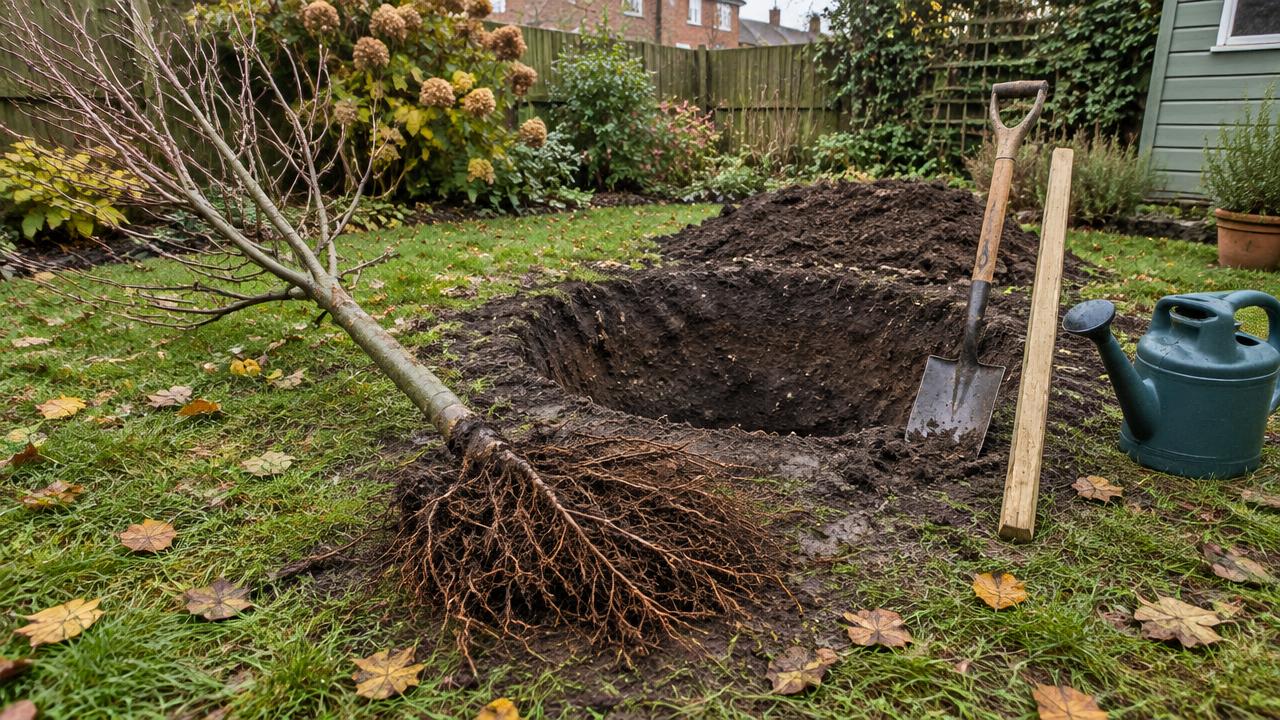
From November, nurseries start sending out plants with no pot and almost no soil, just a bundle of dormant stems and roots wrapped in a bag. Bare-root plants can look unpromising when they arrive, but they are one of the best-value ways to buy roses, fruit trees, raspberries and hedging, and the RHS says they often establish better than plants grown in containers. This guide covers when to buy, what to do when the parcel arrives, how to plant in the ground or in a large pot, and how to look after bare-root plants until they are settled, with a particular eye on what works in a small garden.
What bare-root means
A bare-root plant has been grown in a nursery field, then lifted while it is dormant and sold with little or no soil around its roots. The RHS lists fruit trees, hedging plants and some perennials among the plants often sold this way, and roses and raspberry canes are widely available too.
There are good reasons to buy them. The RHS says bare-root plants are generally cheaper than the same plants in containers, and its November advice adds that they are lighter to transport, come without plastic pots and often establish better. For hedging in particular, the saving adds up quickly, because you may need several plants for every metre. The catch is timing. Bare-root plants can only be bought for a few months of the year, and they need planting promptly once they arrive.
When to buy and plant
The RHS says bare-root stock is only available in winter and early spring, while the plants are dormant, and that trees and shrubs are best planted between October and April. Its November advice notes that bare-root hedging, trees and shrubs become available that month, and says to plant them promptly, before they dry out.
Different plants have their own sweet spots within that window. The RHS describes November as an ideal time to plant roses, and says bare-root roses for containers are ideally potted up in November too. Raspberry canes can be planted at any time while they are dormant, between November and March, although the RHS says late autumn is best.
Whatever you are planting, the one rule that matters most is the state of the soil. The RHS warns against planting into ground that is waterlogged, or frozen so hard you can't get a spade in. After a wet October, that may mean waiting a few days for heavy soil to drain before you plant.
When your plants arrive
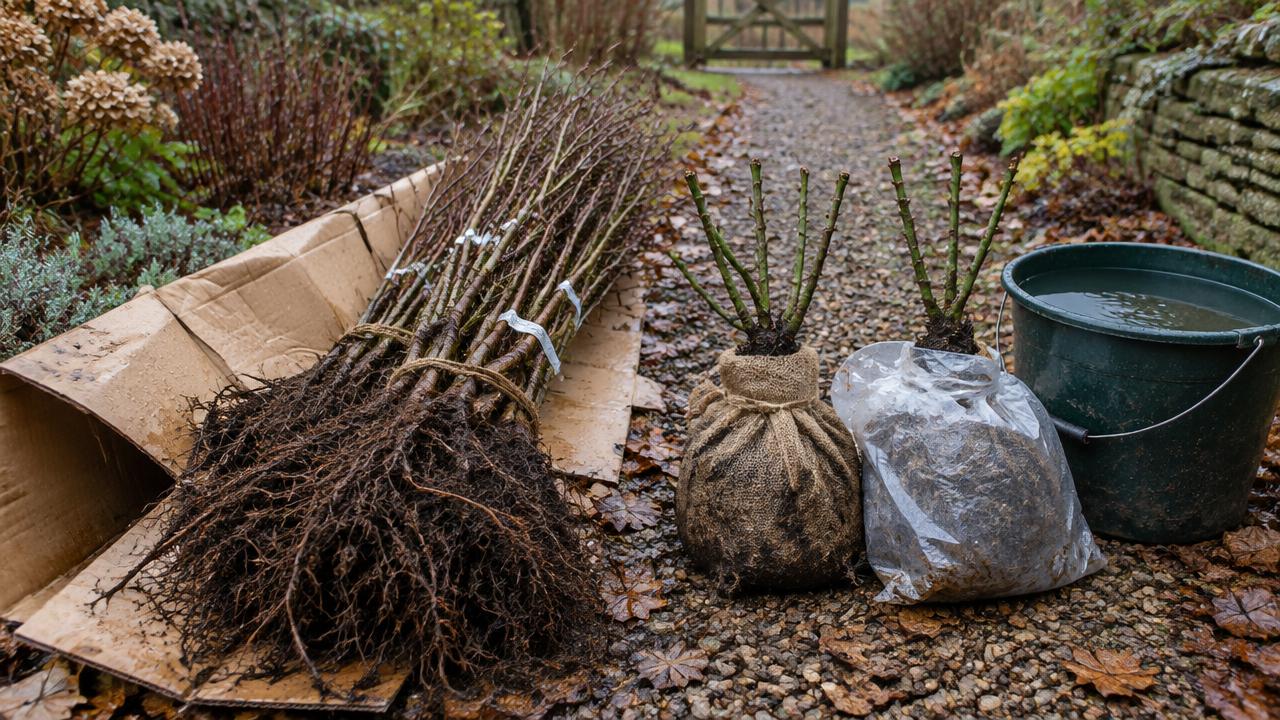
Open the parcel as soon as it comes and check that the roots are still damp. Bare-root plants have no soil to protect them, and the RHS advice is to plant promptly, before the roots dry out. Keep them covered and out of wind and sun while you get ready.
Before planting trees and shrubs, the RHS suggests soaking the roots in a bucket of water for about 30 minutes. You can then plant straight from the bucket.
If you can't plant straight away, because the ground is frozen or sodden or you simply don't have time, heel the plants in. Heeling in means planting them temporarily in a trench or a spare patch of workable soil, with the roots covered, to stop them drying out until you can plant them where they will grow. The RHS says plants can stay heeled in until planting is possible. For roses, the RHS suggests unpacking them and keeping them in a container of slightly moist peat-free compost until you are ready.
How to plant a bare-root tree or shrub
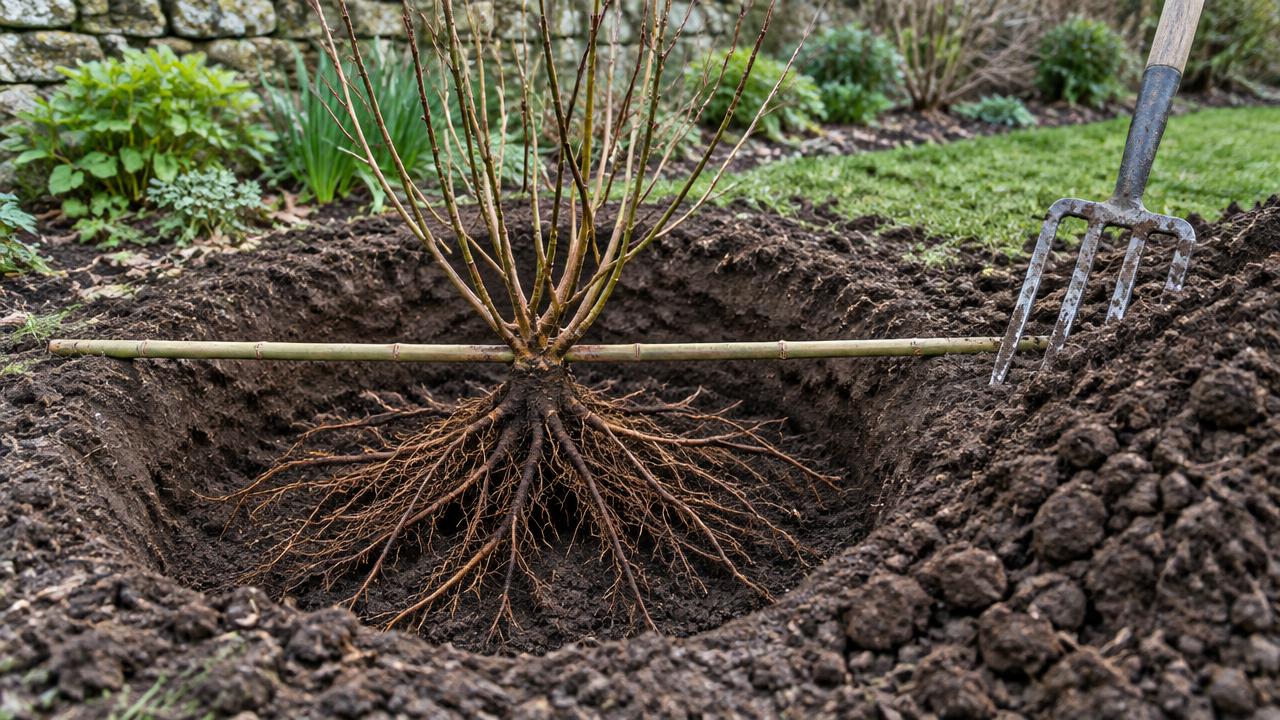
Start with the hole. The RHS advises digging a hole no deeper than the roots, but ideally at least three times the diameter of the root system. A wide hole lets the roots spread out into loosened soil. If the sides of the hole are smooth and compacted, break them up with a fork so roots can grow through them.
Spread the roots out in the hole and check the depth. The RHS says the plant should sit so that the first flare of roots is level with the soil surface once planting is complete. A cane laid across the hole makes it easy to check. If you are staking a tree, put the stake in now, before you backfill, so it goes between the roots rather than through them.
Refill the hole carefully, working soil between and around the roots so there are no air pockets, then firm it gently. The RHS warns against compacting the soil into a hard mass. Water the plant in well afterwards to settle the soil.
You can skip the extras. The RHS says there is little evidence that adding organic matter to the bottom of the planting hole helps, and that applying fertiliser at planting time isn't beneficial. It mentions mycorrhizal fungi as an option on poor soils, but they aren't essential, and if you do use them it advises not feeding at all, because phosphorus can suppress the fungus.
Staking
The RHS says all but very small trees benefit from staking, as do many tall or top-heavy shrubs. Trees under about 140cm usually don't need it, but in a windy garden, on a slope or with a broad-crowned tree, a stake makes a real difference while the roots establish.
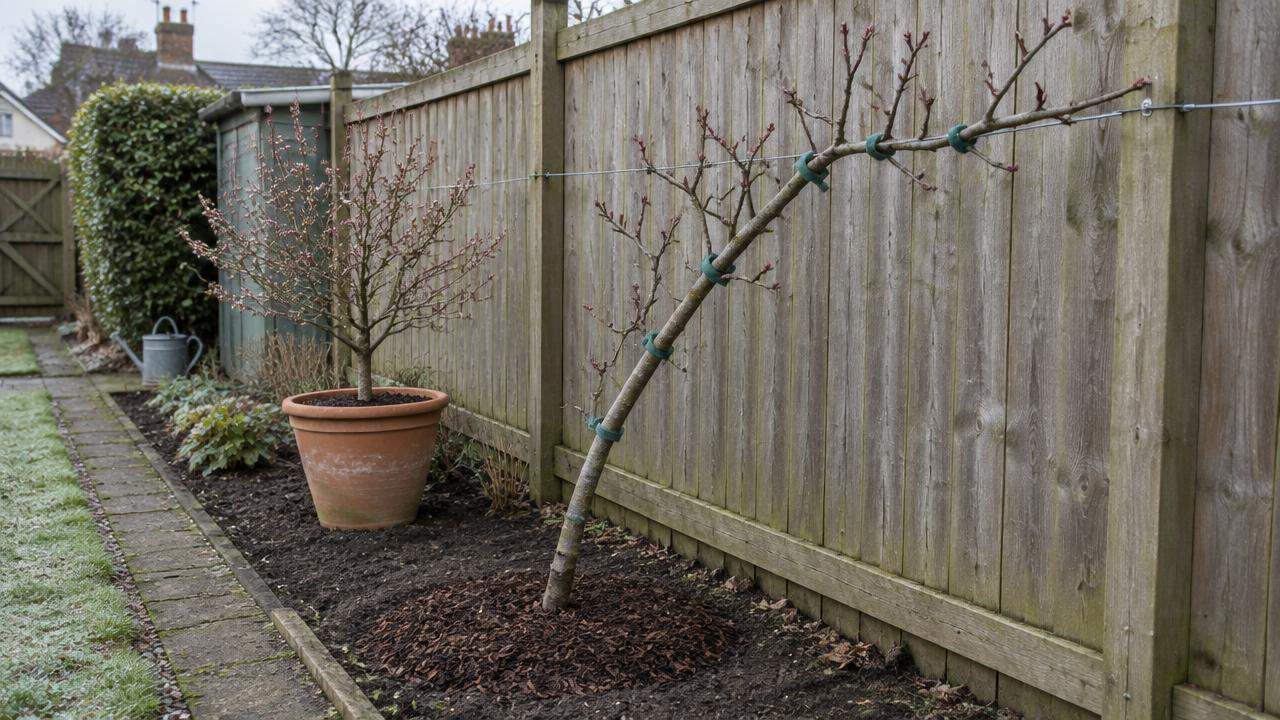
Bare-root trees need staking at the point of planting, so the stake goes in before you backfill and passes between the roots. For most young trees, the RHS recommends a single stake driven in at a 45-degree angle to the main stem, at least 40cm into the soil. As a rule of thumb, if you can lift the tree, one stake is enough. Attach the tree about 40 to 50cm above the ground, or about a third of its height, using a tree tie with a spacer so the trunk doesn't rub against the stake.
Check ties at least once a year, and more often for fast-growing trees, loosening them before they cut into the bark. The RHS says a stake can usually come out once the tree has a good root system and a trunk strong enough to support itself, which typically takes between 18 months and three years. Our article on wind damage covers what to look for after a storm.
Bare-root roses
Roses are one of the most popular bare-root buys, and they suit both a small border and a large pot. The RHS suggests planting them in late autumn at leaf fall, or from late winter to early spring before growth resumes, but never into frozen ground.
In the ground, dig a hole roughly twice the width of the roots and the depth of a spade's blade. The key detail is the graft union, the knobbly point near the base where the rose was budded onto its rootstock. The RHS advises setting it at soil level rather than below, because planting it deeper is reported to increase the risk of rose dieback.
Avoid planting a new rose where an old one grew. The RHS warns that roses are at risk from rose replant disease, sometimes called soil sickness. If you have no choice, it suggests digging out soil about 45cm deep and wide and replacing it with soil from another part of the garden.
Roses also do well in containers. The RHS says patio and miniature roses are the best types for pots, and can be grown in fairly small but deep pots 23 to 35cm deep. Ground-cover and climbing roses need larger containers, at least 30 to 45cm deep. It recommends peat-free John Innes No 3 and suggests ideally potting up bare-root roses in November. Put the pot in its final position before you fill it, because it will be heavy afterwards.
Leave pruning until the first late winter or early spring after planting, as the RHS advises, and water well in dry spells for at least two summers.
Fruit trees for small spaces
A fruit tree is the bare-root buy that most rewards a little research, because the rootstock it is grafted onto decides how big it grows. Two trees of the same apple variety can end up very different sizes depending on what is underneath. Check the label or the nursery listing before you buy.
| Fruit | Rootstock | Size as a bush, per the RHS | Small-space notes |
|---|---|---|---|
| Apple | M27 | 1.2 to 1.8m | Small gardens with fertile soil, but too dwarfing for pots |
| Apple | M9 | 1.8 to 2.4m | An excellent stock for small gardens |
| Apple | M26 | 2.4 to 3m | Suits containers |
| Apple | MM106 | 3 to 4m | Unsuitable for small gardens |
| Pear | Quince C | 2.5 to 3m | Suits cordons and bushes, needs fertile, moisture-retentive soil |
| Cherry | Gisela 5 | 2.4 to 3m | Suits bushes, pyramids and fans |
| Plum | Pixy | 3 to 4m | Suits cordons and dwarf bushes |
Trained forms make even better use of a small space. A cordon is restricted to a single main stem, upright or at 45 degrees, and an espalier is trained flat against a wall or fence with horizontal tiers of branches. Both can be bought ready-trained, and the RHS lists M9 and M26 among the apple rootstocks suited to cordons.
Pollination matters too. Most apples and pears need another tree of the same fruit nearby to cross-pollinate, so the RHS advises choosing at least two trees from the same or an adjacent pollination group, unless the variety is self-fertile. In a small garden, a self-fertile variety such as the 'Stella' cherry, which the RHS lists for containers, saves the space of a second tree. A neighbour's tree of the same fruit may also do the job.
If you are growing fruit in a pot, the RHS suggests a container 45 to 50cm in diameter for most fruit, filled with a loam-based compost such as John Innes No 3, and an apple on M9 or M26 rather than M27. Its apple advice is to plant while the tree is dormant, from autumn to spring, so a bare-root tree can go into its pot when it arrives, as long as the compost is workable and the pot drains freely. If the weather is against you, heel it in or keep the roots covered and damp until you can pot it, rather than leaving it in its bag. Stand the pot in a warm, sunny, sheltered spot, as the RHS suggests. Heavy terracotta helps keep a tree upright in wind, and wrapping the pot in hessian or bubble wrap protects the roots in an exposed spot.
Whether in a pot or in the ground, keep the graft union, the visible join between the fruit variety and its rootstock, above the finished soil or compost level. Fruit-growing advice warns that if it is buried, the variety on top can form its own roots, and the size control the rootstock was chosen for can be lost.
Raspberries
Raspberry canes are widely sold bare-root, and they will grow in a pot if you choose a compact variety. Bare-root canes are sold only while dormant, and the RHS says they can be planted at any time between November and March, as long as the soil isn't frozen, with late autumn best.
Don't plant them too deep. The RHS says the first roots should be no more than 5cm below the surface. In the ground, space plants 40 to 60cm apart. After planting, the RHS advises cutting most canes back to about 25cm. The exception is summer-fruiting raspberries sold as long canes, which are meant to fruit in their first summer, so don't cut those back.
For a pot, the RHS suggests a container at least 40cm wide and 30cm deep, filled with about two-thirds peat-free multipurpose compost and one-third loam-based compost such as John Innes No 3. Plant one cane in the centre at its previous soil level and add canes or poles for support. It recommends a compact variety such as 'Ruby Beauty' for containers.
Planting a bare-root hedge
A hedge is where the savings from bare-root add up fastest, and the RHS says smaller transplants, known as whips, establish faster than larger plants. The classic bare-root hedge is an informal native mix, and the RHS suggests plants such as hawthorn, field maple, wild privet, holly and blackthorn for wildlife, providing shelter and food. If you want something lower and more formal for a small garden, the RHS lists hedges kept at 30 to 90cm, including lavender, Ilex crenata, Euonymus fortunei cultivars and dwarf berberis. These are more often sold in pots than bare-root, so check what the nursery is offering before you order.
Prepare a strip 60 to 90cm wide, dug to the depth of a spade blade, and trim back any damaged roots to healthy growth before planting. In a single row, the RHS says planting distances vary from 30 to 60cm, depending on the plant. For hedges thicker than 90cm, it suggests a staggered double row, with the rows 45cm apart and plants 90cm apart in each row. As with trees, the point where the roots flare out from the stem should sit level with the surrounding soil.
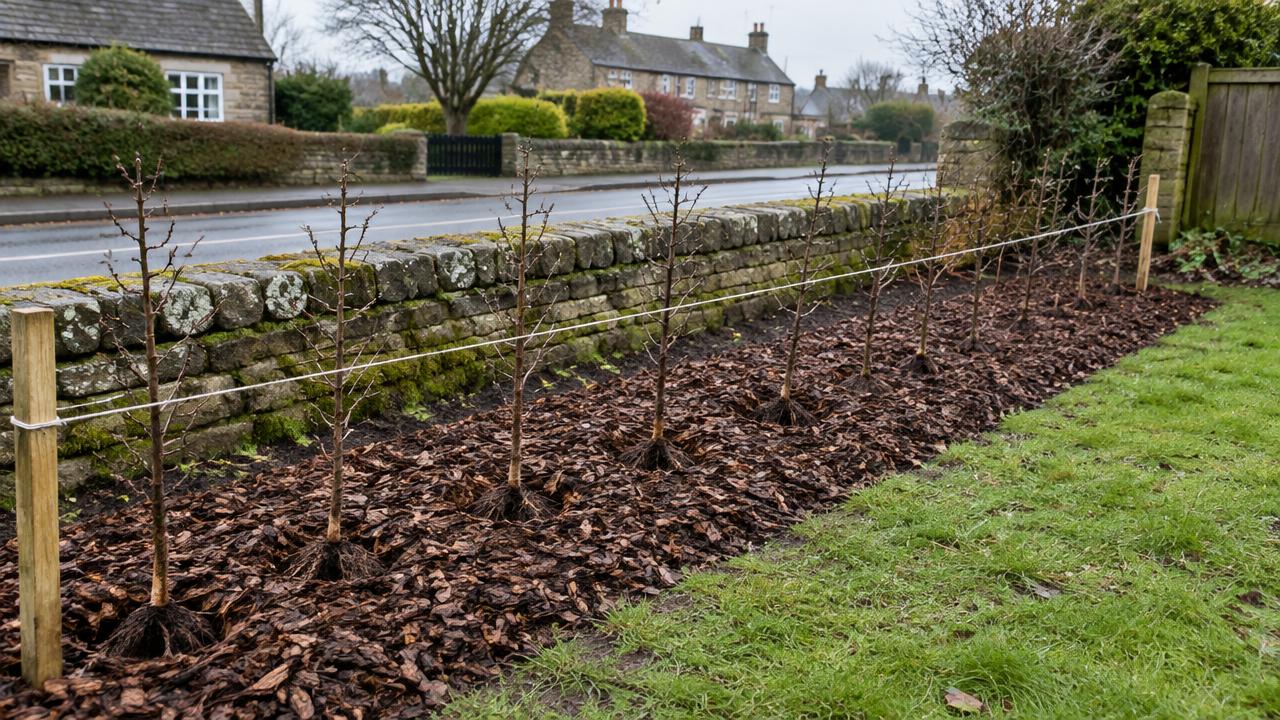
The first pruning can feel harsh. For deciduous hedges, the RHS advises cutting back the leading upright shoots by about a third just after planting and again the following winter, cutting just above a bud. Evergreen hedges are treated differently. The RHS says to leave the leading shoot unpruned and trim only straggly side shoots for the first two years.
After planting, keep the hedge and 45cm either side free of weeds, and mulch the soil to a depth of about 7.5cm. The RHS advises keeping new hedges well watered for their first two years.
Aftercare for the first two years
The first spring and summer are when new plants are most at risk, because the RHS says drought stress is common in new plantings. As a guide for dry weather during the growing season, it suggests about 30 to 50 litres per square metre a week, which is four to six watering cans. That is a reference point rather than a fixed routine, because heavy clay, light sandy soil and pots all behave differently. To check whether a plant needs water, dig down with a trowel beside the roots. The RHS also warns that overwatering can rot roots, so water when the soil is dry rather than by the calendar.
Keep competition away. The RHS recommends a weed- and grass-free circle at least 1.2m across around new trees for their first three years. A mulch at least 5cm deep, applied in late autumn to late winter, helps hold in moisture, but leave a gap of about 10cm around the stem. Check tree ties in spring and autumn and loosen them as the trunk thickens.
Plants in pots need closer attention. The RHS says compost in containers should be kept moist but not wet at all times, and that each spring the top layer can be refreshed with controlled-release fertiliser mixed in. For roses in pots, it suggests top-dressing with a granular rose fertiliser each spring and avoiding feeding after August. Our guide to watering plants covers how to tell when a pot needs water.
Common mistakes
The most common mistake is leaving the parcel unopened in a warm garage or porch for a week. Bare roots dry out quickly, so plant promptly or heel the plants in. A close second is planting too deep. The top of the roots should be level with the soil. On a rose, the graft union sits at soil level, and on a fruit tree it stays above it.
Others are easy to avoid once you know them. Don't dig a deep, narrow hole and fill it with rich compost and fertiliser, which the RHS says doesn't help. Don't plant into frozen or waterlogged ground, however keen you are. Don't buy an apple on a vigorous rootstock such as MM106 for a small garden, and don't put a new rose where an old one has been growing. Finally, don't forget to water in spring. A dormant plant needs little in November, but by May it is growing fast with a root system that is still finding its way.
FAQ
When is the bare-root season?
Bare-root plants are only available while they are dormant, in winter and early spring. The RHS says trees and shrubs are best planted between October and April, and that November is an ideal month for roses.
Do I need to soak bare-root plants before planting?
The RHS advises soaking bare-root trees and shrubs for about 30 minutes before planting. Keep the roots covered and damp until they go in.
What if the ground is frozen when my plants arrive?
Don't plant into frozen or waterlogged soil. Heel the plants into a spare patch of workable soil, or keep bare-root roses in a container of slightly moist peat-free compost, until conditions improve.
Can I plant a bare-root rose in a pot?
Yes. The RHS suggests potting up bare-root roses in November, using peat-free John Innes No 3. Patio and miniature roses suit pots 23 to 35cm deep, while climbers and ground-cover roses need at least 30 to 45cm.
Should I add compost or fertiliser to the planting hole?
The RHS says there is little evidence that adding organic matter to the bottom of the hole helps, and that applying fertiliser at planting time isn't beneficial. Mulch the surface after planting instead.
FURTHER READING
- Getting Started
Container Growing Fundamentals
- Getting Started
The Complete Guide to Repotting
- Getting Started
How to Water Plants Properly
RELATED POSTS
Robin is a small-space grower writing for everyone working with a courtyard, balcony, window box, patio or sunny sill. Edible and leafy, both kept alive in the kind of light real small spaces actually get.
✦ Free with the newsletter — the small-space starter sheet
Grow Anywhere — a free weekly email.
The Potted Club newsletter. A short note from Robin — what to sow, one plant problem solved, and the best new guide.
FREE WEEKLY EMAIL · NO SPAM · UNSUBSCRIBE ANYTIME