The Pest You Should Check Your Pots for This September
September is an important time to check container plants for vine weevil. Here's how to spot the signs and decide whether treatment is needed.
Two very different pests in one insect
Vine weevil (Otiorhynchus sulcatus) isn't exclusively a container pest. But growing plants in pots can turn it from an unsightly nuisance into a much more serious problem.
The reason is below the compost. Adult vine weevils eat leaves, leaving distinctive notches around their edges. Their larvae eat roots. And when virtually all of a plant's roots are confined to one relatively small pot, significant root damage can eventually cause the entire plant to fail.
That makes early September a particularly useful time to know what you're looking for. Young larvae may now be feeding in containers, while conditions can still be suitable for one of the principal biological controls used against them. It was one of the jobs worth doing over the bank holiday weekend, and it's still worth doing now.
Why containers are particularly vulnerable
Vine weevil attacks a remarkably broad range of plants, both outdoors and under cover. But the RHS identifies plants growing in pots and containers as particularly susceptible to serious damage from the larvae.
It isn't difficult to see why. A plant growing in open ground potentially has a much larger root system spread through a greater volume of soil. In a container, the roots and the larvae feeding on them occupy the same finite volume of compost — one of the trade-offs covered in our container growing fundamentals.
This doesn't mean every pot needs inspecting or treating. It does mean container gardeners have particularly good reason to recognise the warning signs.
There are two very different kinds of damage
Adult vine weevils feed mainly during spring and summer, producing irregular, often curved notches around leaf margins. The damage can look dramatic, particularly on evergreen plants, but the RHS says adult feeding rarely affects a plant's vigour. If an otherwise healthy plant has a few notched leaves, the damage itself doesn't necessarily require intervention.
It is useful information, though. Adult feeding suggests a weevil has been visiting the plant and gives you a reason to pay closer attention. Adults are mainly active after dark, so checking susceptible plants with a torch on a mild evening can sometimes reveal them. During the day they may shelter beneath pots and in other dark, protected places.
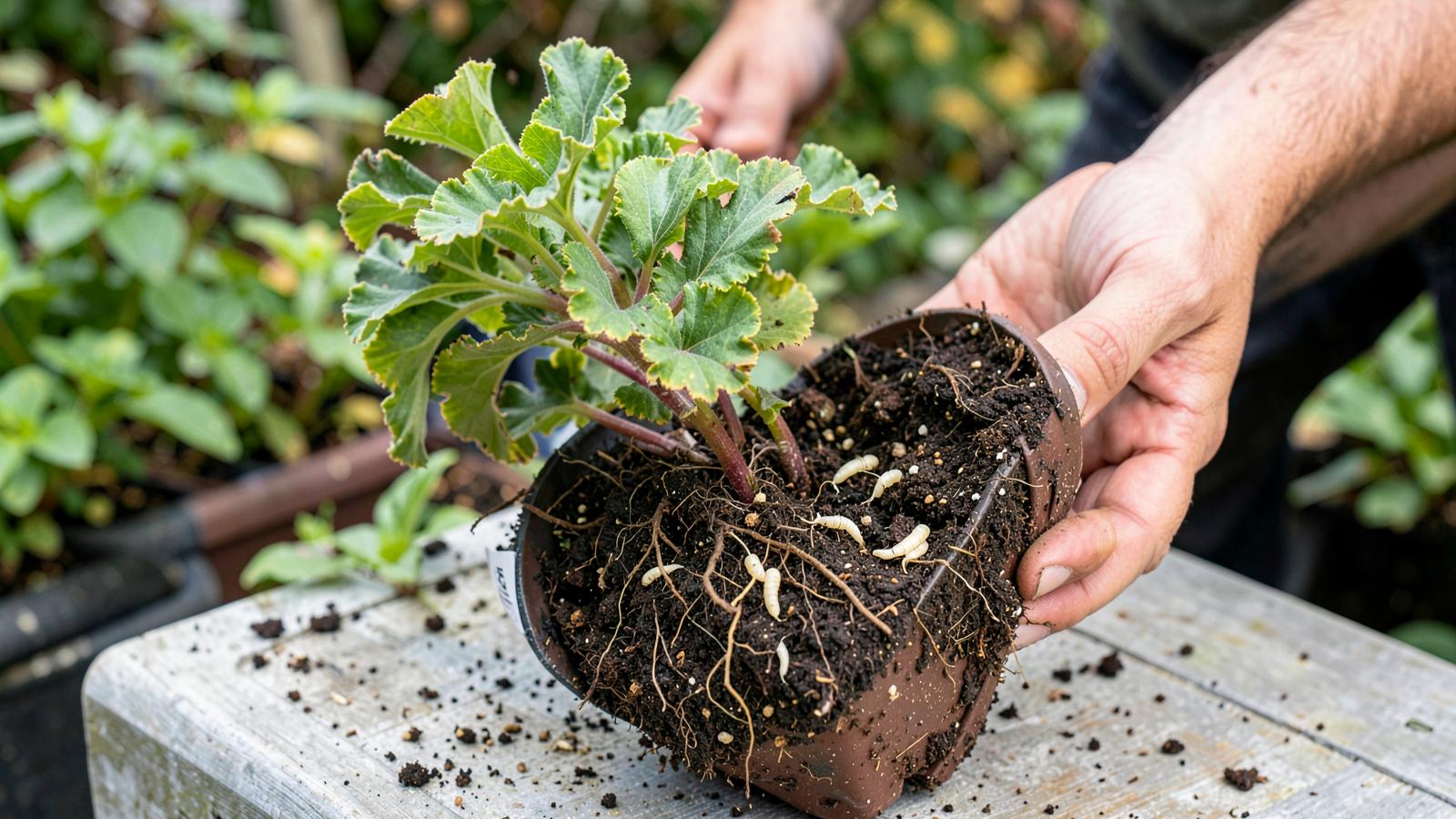
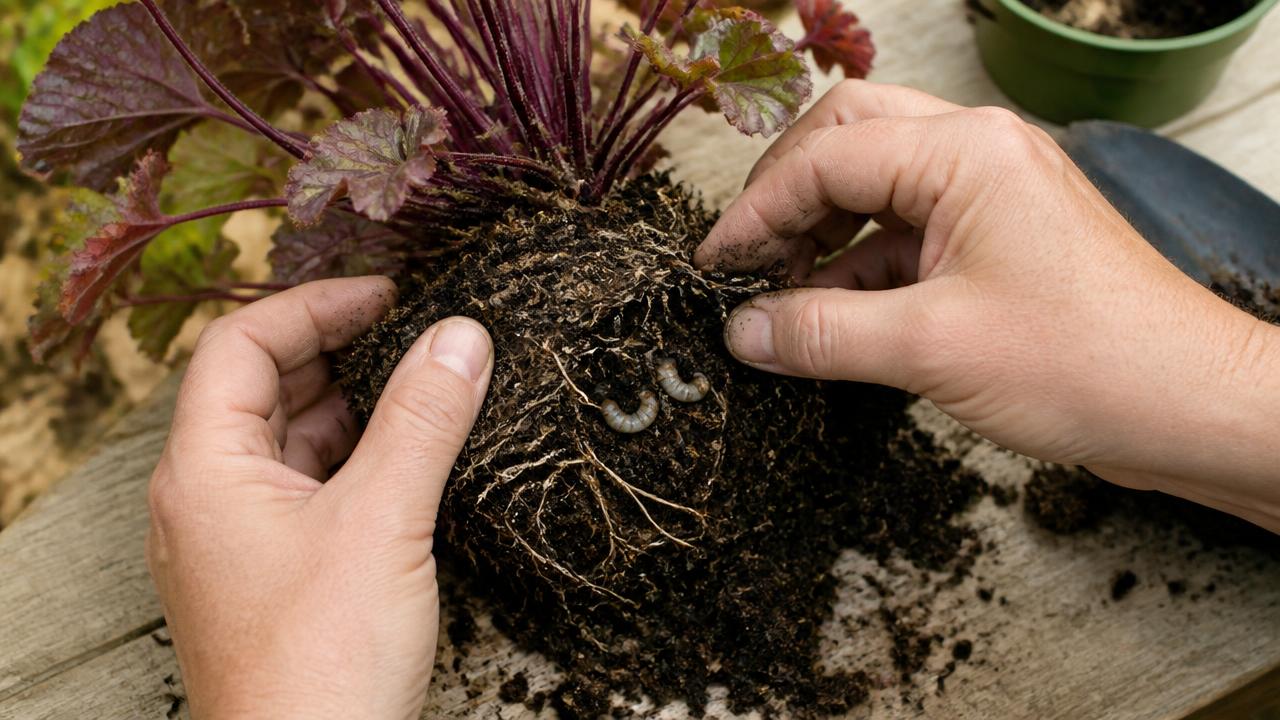
The larvae are much more consequential. They're creamy-white, legless and generally curled into a C shape, with a pale brown head, and fully grown larvae can reach around 10mm. They live in the growing medium and eat roots. Severe infestations can cause a plant to grow poorly, wilt, become loose in its compost and eventually die.
Importantly, none of those symptoms diagnoses vine weevil by itself. Drought, waterlogging and other root problems can produce similar effects — worth reading alongside is your plant dead, or just protecting itself from drought. If a plant is unexpectedly struggling, particularly alongside characteristic leaf notching, the next useful step is to inspect the roots rather than simply assuming it needs more water.
The plants worth checking first
Vine weevil has a very broad host range, so there isn't a neat list of plants that are either safe or susceptible. There are, however, some familiar container plants worth paying particular attention to.
Heucheras, primulas and polyanthus, cyclamen, sedums and other succulents, strawberries, fuchsias and begonias are among the plants associated with vine-weevil damage. Larvae can also damage underground plant structures: the RHS notes that they may bore into cyclamen corms and begonia tubers.
If you've noticed suspicious notching on one of these plants during summer, or a plant is now declining unexpectedly, inspect it more closely. Gently remove a suspicious plant from its container if practical and look through the outer compost and rootball, looking for the characteristic C-shaped larvae and evidence of root damage. Finding them turns a suspicion into a much stronger diagnosis. Our pests and diseases reference covers what else to rule out.
Why September matters
The timing is what makes vine weevil particularly relevant now.
Eggs laid during the warmer months develop into larvae that feed on roots through autumn and can continue into winter, depending on conditions. The RHS identifies August to early September as the optimum period for applying nematodes against vine-weevil larvae. At this stage many grubs are still young, while the growing medium is generally warm enough for suitable nematodes to remain active.
That doesn't make September the only possible treatment period. Some nematode species work at lower temperatures than others, and treatment opportunities depend on both the pest's life cycle and conditions in the pot. But if you've confirmed a problem, this is a useful window rather than something to leave until a plant collapses later in the year.
Do nematodes actually work?
There is good experimental evidence that they can.
Entomopathogenic nematodes are microscopic organisms that infect and kill vine-weevil larvae. They're sold commercially as biological controls and watered into the growing medium.
A 2026 meta-analysis published in Pest Management Science brought together 162 comparisons from 23 studies of nematodes used against vine weevil. Across those studies, nematode treatment was associated with roughly 63 per cent fewer surviving larvae than untreated controls.
That's meaningful evidence, but it isn't a promise that treating a pot will remove 63 per cent of its vine weevils. Results varied substantially between studies, and conditions matter.
Different commercially available nematode species also have different useful temperature ranges. Current RHS guidance says Steinernema species can be effective at soil or compost temperatures of approximately 5-20°C, while Heterorhabditis generally require around 12-20°C. That becomes increasingly important as autumn progresses.
If you're treating a confirmed infestation, follow the temperature range and application instructions for the particular product rather than treating all vine-weevil nematodes as interchangeable. The compost should generally be moist and well drained, and it shouldn't be allowed to dry out immediately after treatment.
If you find grubs
Don't panic and don't automatically discard the plant.
Where practical, physically remove the larvae you can find. The RHS recommends repotting affected plants and removing grubs from the roots and compost.
Then assess the plant. If plenty of healthy root remains, repotting into fresh growing medium may give it the opportunity to recover, as covered in our repotting guide. A valuable or easily rescued plant may justify considerably more effort than a seasonal plant already nearing the end of its useful life.
If most of the root system has been destroyed, repeatedly watering the plant won't solve the underlying problem; its ability to absorb that water has been compromised. Equally, don't assume every struggling plant with damaged roots is salvageable. Sometimes replacing it is the sensible option.
Four mistakes to avoid
Assuming notched leaves mean the plant needs treatment. Adult feeding is generally cosmetic. It's a useful clue, not evidence that damaging numbers of larvae are present below.
Assuming an inexplicably wilting pot needs more water. Check the compost and roots first. Both vine-weevil damage and waterlogging can produce a plant that looks thirsty.
Waiting until a badly affected plant collapses. If you've seen adult damage or have had vine weevil previously, checking susceptible plants while larvae are still relatively young gives you more options.
Treating every container indiscriminately. The RHS recommends using pathogenic nematodes carefully where there is a specific problem to treat. Biological control is still an intervention, not something every pot routinely requires.
What to do this weekend
Start with the pots that give you a reason to look.
Check heucheras, primulas, cyclamen, succulents, strawberries, fuchsias and begonias that have shown suspicious leaf notching or unexplained poor growth. Look underneath containers for hiding adults and, if you're suspicious, check again after dark — the same damp evening conditions that bring out slugs and snails.
Inspect the rootball of plants that are declining unexpectedly. If you find characteristic white, brown-headed, C-shaped grubs, remove those you can see and decide whether repotting and biological control are justified.
If you're using nematodes, check the temperature requirements of the particular species before applying them.
And if all you find is a few notched leaves on an otherwise vigorous plant, leaving it alone may be entirely reasonable.
The most obvious sign of vine weevil is often the least serious part of the problem. In September, it's what might be happening underneath the compost that's worth checking.
FAQ
What does vine-weevil damage look like?
Adults produce irregular notches around leaf edges. Larvae feed on roots and can cause plants to grow poorly, wilt, become loose in their compost or die when infestations are severe.
What do vine-weevil grubs look like?
They're creamy-white, legless larvae, generally curled into a C shape, with a pale brown head. Fully grown larvae can reach around 10mm.
Which plants should I check?
Vine weevil attacks many plants, but heucheras, primulas, cyclamen, succulents, strawberries, fuchsias and begonias are among the familiar container plants worth watching.
When should I use vine-weevil nematodes?
The RHS identifies August to early September as an optimum treatment period, but suitable timing also depends on temperature and the nematode species being used. Follow the instructions for the particular product.
Can a plant recover from vine-weevil damage?
It depends on how much healthy root remains. Removing larvae and repotting may save a plant with a viable root system; severe root loss can make recovery unlikely.
Should I treat every pot if I find vine weevil?
No. Concentrate on affected or genuinely at-risk plants and use biological controls according to current guidance rather than treating an entire container collection routinely.
RELATED POSTS
- Seasonal
What to Do With Your Pots This Bank Holiday Weekend
- Plant Problems
Why the Slugs Are Back
- Houseplants
Don't Put Your Houseplants on an Autumn Watering Schedule
Robin is a small-space grower writing for everyone working with a courtyard, balcony, window box, patio or sunny sill. Edible and leafy, both kept alive in the kind of light real small spaces actually get.
✦ Free with the newsletter — the small-space starter sheet
Grow Anywhere — a free weekly email.
The Potted Club newsletter. A short note from Robin — what to sow, one plant problem solved, and the best new guide.
FREE WEEKLY EMAIL · NO SPAM · UNSUBSCRIBE ANYTIME