HOME / GUIDES / PLANT PROBLEMS
Pests and Diseases: A Small-Space Reference
How to actually work out what's wrong with a struggling plant, the pests and diseases most likely to turn up in a small garden or on a windowsill, and the least-toxic-first approach to dealing with each one properly.
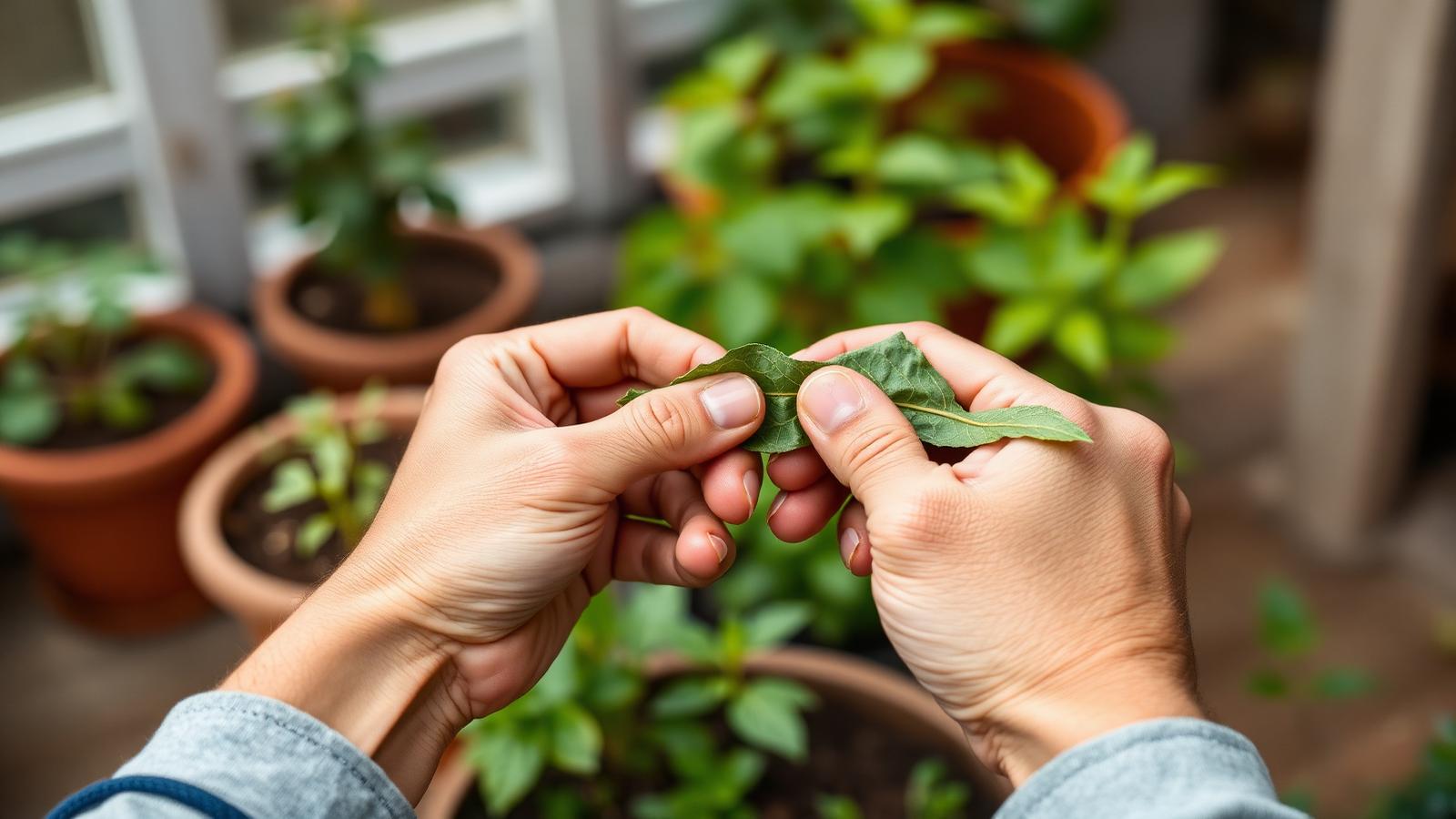
Updated 28 August 2026 with revised diagnostic advice and the latest RHS guidance.
Diagnose before you treat
The single most common mistake in dealing with a plant problem is treating the wrong thing. A leaf with brown patches could be scorch, a fungal disease, a nutrient deficiency or genuine pest damage, and each one wants a completely different response. Guessing from a single photo, or reaching for whatever spray happens to be under the sink, wastes time and can occasionally make things worse.
A few minutes of proper observation gets you much further than an immediate reaction.
Pattern. Is the damage even across the whole plant, or concentrated in one area? Widespread yellowing can point towards a feeding, watering or environmental issue, while patchy, localised damage may make a pest or localised disease more likely. Neither is definitive on its own.
Location. Look at which parts of the plant are affected first. Some nutrient deficiencies show most clearly in older foliage, while aphids commonly congregate around soft new growth and flower buds. Spider mites are often easiest to find on the undersides of leaves. Also check stems, the compost surface and, where necessary, the roots.
Timing and weather. A sudden problem after a hot spell suggests scorch or heat stress. Problems appearing after prolonged wet, still weather can point towards diseases favoured by high moisture and poor airflow, including grey mould and some downy mildews. Hot, dry conditions, meanwhile, can favour spider mites.
Speed of onset. Pest populations can build gradually or, in favourable conditions, surprisingly quickly. Diseases can spread as an infection develops. Physiological problems can also appear suddenly after heat, drought, overwatering or another environmental change. Speed is useful evidence, but not a diagnosis by itself.
Check the culprit directly. Turn leaves over and look at stems, growing points and the base of the plant. Many pests are visible if you actually look, rather than only inspecting the damage itself.
Common pests
Aphids are probably the most universally recognised garden pest: small, soft-bodied insects, usually green, black or grey, clustering on new growth and flower buds. They suck sap and often leave a sticky residue, honeydew, which can lead to sooty mould growing on top of it. A strong jet of water, or a gentle wipe with a damp cloth, can dislodge light infestations.
Encouraging ladybirds, lacewings, hoverflies and other natural predators is also useful in an outdoor container garden. A small number of aphids on an otherwise healthy plant doesn't necessarily require treatment.
Spider mites thrive in the hot, dry conditions covered in our piece on houseplants in a heatwave. Nearly invisible to the naked eye, they show up as fine webbing and a dull, stippled or slightly bronzed look to leaves, usually starting on the undersides. Regularly inspecting susceptible plants, rinsing affected foliage and avoiding excessively hot, dry conditions can all help. If an indoor plant is badly affected, moving it away from the rest of your collection while you deal with the problem can reduce the chance of spread.
Whitefly are small, white, moth-like insects that flutter up in a small cloud when a plant is disturbed. They're common on tomatoes and many houseplants. Yellow sticky traps can help catch and monitor flying adults. For an established infestation, use a product specifically intended for the plant and pest you're treating rather than ordinary washing-up liquid, which isn't formulated for use on plants and can damage foliage.
Slugs and snails become particularly noticeable in damp conditions and can cause conspicuous damage to seedlings, soft new growth and leafy plants. Ragged holes and silvery slime trails are the usual clues.
Not every slug needs controlling. Many species feed substantially on decaying material, fungi and other organic matter rather than healthy plants, and slugs and snails are part of the wider garden ecosystem. Concentrate on protecting plants that are actually suffering meaningful damage.
Hand-picking after dark or during damp weather is one straightforward option in a small garden, while traps can help where damage is concentrated. Don't put too much faith in traditional barriers: RHS garden trials found that copper tape, crushed eggshells, sharp grit, bark mulch and wool pellets did not significantly reduce slug damage.
Biological control using appropriate nematodes is another option where slug damage is serious enough to justify treatment and conditions are suitable.
Vine weevil is a particular problem for container plants. The adult beetle notches leaf edges, which is unsightly but rarely fatal; the real damage comes from the grubs, which live in the compost and eat roots, sometimes causing a plant to collapse with seemingly little warning. If a container plant wilts despite apparently appropriate watering, tip it out and check the root ball for small, creamy-white, C-shaped grubs with brown heads.
Nematodes applied to the compost are a standard biological control. Timing and temperature matter because the nematodes need suitable conditions to work. Late summer into early autumn can be a particularly useful period to tackle young vine weevil larvae while the compost remains warm enough for biological control — the RHS vine weevil guidance covers timing in more detail.
Fungus gnats are the small flies that hover around houseplant compost. They're generally more of a nuisance than a serious threat to an established plant, although their larvae can be more problematic around seedlings and very young plants. They favour consistently damp growing media, so allowing the upper layer to dry somewhat between waterings, where appropriate for the plant, can make conditions less favourable. Sticky traps catch and monitor the adults.
Leaf miners create distinctive pale, winding tunnels within the leaf itself, the visible trail of a tiny larva feeding between the upper and lower leaf surfaces. They're common on beetroot, spinach, chard and some ornamentals. Removing badly affected leaves where practical can help reduce a small infestation, although the damage is often largely cosmetic on an otherwise healthy plant.
Scale insects look more like small, immobile brown or grey bumps than typical insects, often clustered along stems and the midribs of leaves, and are easily mistaken for a plant disease or an odd growth at first glance. They feed on sap in much the same way as aphids and can produce sticky honeydew. With a small infestation, physical removal by gently wiping or scraping individual scales away is a sensible first response. Check the plant repeatedly afterwards, since a single clean-up may not catch every stage of the infestation.
Common diseases
Powdery mildew shows as a white or grey powdery coating across leaves, stems and sometimes flower buds. Powdery mildews are a group of fungi rather than a single disease, and they don't require persistently wet leaves to infect a plant. Poor airflow, crowded growth and dry roots can all contribute to favourable conditions. Improving spacing, keeping plants appropriately watered at the roots and removing badly affected material can help. Roses, courgettes and many ornamentals are particularly prone.
Black spot is a rose-specific fungal disease showing as black or purple-black spots on leaves, usually with yellowing around them, eventually causing leaf drop. As covered in our roses piece, removing badly affected leaves and clearing fallen infected foliage from around the plant can reduce material available to contribute to reinfection. Improving airflow around the plant also helps.
Grey mould, or botrytis, appears as a fuzzy grey-brown coating, typically on damaged, dying or soft plant tissue, particularly in cool, damp, poorly ventilated conditions. Removing affected material promptly and improving airflow are the key responses.
Downy mildew is often confused with powdery mildew but is a genuinely different group of diseases, commonly showing as yellow or pale patches on the upper leaf surface with greyish, whitish or purplish growth underneath. Cool, damp and humid conditions favour many downy mildews. Salad crops, brassicas and some ornamentals are particularly susceptible.
Improving airflow, avoiding unnecessarily keeping foliage wet for long periods and removing badly affected leaves are useful responses. Spacing plants properly also helps, particularly in small gardens where it's tempting to squeeze one more pot into every available gap.
Damping off is a seedling-specific problem: young seedlings suddenly collapse at the base and die, often very quickly. Several different organisms can cause damping off, with excessively wet, poorly ventilated growing conditions increasing the risk. Prevention matters far more than treatment here, since there's rarely a way back once a seedling has badly collapsed. Use fresh, clean seed compost, avoid overwatering young seedlings and ensure appropriate airflow around trays.
Not everything is a pest or disease
A genuinely large proportion of "what's wrong with my plant" questions turn out to be physiological problems: something about growing conditions, not a living organism attacking the plant. Treating these as if they were pests or disease wastes effort and can delay the actual fix.
Blossom end rot, a dark, sunken patch at the base of tomatoes and sometimes other susceptible fruiting crops, is associated with insufficient calcium reaching the developing fruit, often because inconsistent moisture availability interferes with calcium uptake and movement through the plant. No pesticide fixes it; for container-grown tomatoes, consistent watering is the important intervention, along the lines set out in how to water your plants properly.
Leaf scorch, showing as crispy brown or bleached patches, can result from excessive heat, intense light, drying winds or a combination of environmental stresses, covered in more depth in our piece on houseplants in a heatwave. Correcting the growing conditions, rather than treating for disease, is the response.
Bolting, a plant suddenly shooting up a flower stem and abandoning leaf production, is a response to factors including temperature and day length, covered in our dedicated piece on why plants bolt. It isn't a disease and can't be reversed once well under way.
Nutrient deficiencies, covered in our feeding guide, can produce yellowing, pale leaves or poor flowering that looks superficially like disease. But don't diagnose a deficiency from leaf colour alone: overwatering, root damage, unsuitable compost conditions and other problems can interfere with nutrient uptake and produce similar symptoms.
If a problem isn't visibly spreading and closely follows a change in growing conditions — a hot windowsill, inconsistent watering, extreme weather or a missed feeding routine — consider a physiological cause before assuming a pest or disease.
Diagnostic table
A quick-reference starting point. This won't cover every possible cause, but it narrows things down fast.
| Symptom | Most likely cause | What to do |
|---|---|---|
| Sticky residue and clustered small insects on new growth | Aphids | Wipe or hose off a light infestation; encourage natural predators |
| Fine webbing, dull stippled leaves, worse in heat | Spider mites | Rinse foliage, check growing conditions and isolate badly affected indoor plants |
| White powdery coating on leaves | Powdery mildew | Improve airflow and keep plants appropriately watered |
| Yellow patches on top of leaves, fuzzy growth underneath | Downy mildew | Improve airflow, avoid prolonged wet foliage and space plants appropriately |
| Black spots on rose leaves, yellowing around them | Black spot | Remove badly affected and fallen foliage; improve airflow |
| Small immobile brown or grey bumps along stems, sticky residue | Scale insects | Physically remove a light infestation and keep checking |
| Pale winding tunnels within a leaf | Leaf miner | Remove badly affected leaves where worthwhile |
| Ragged holes in leaves, slime trails | Slugs and snails | Protect vulnerable plants; hand-pick or use targeted control where necessary |
| Sudden wilting or collapse despite apparently appropriate watering, on a container plant | Possible vine weevil grubs in the roots | Inspect the root ball; use appropriate biological control if necessary |
| Small flies hovering around compost | Fungus gnats | Review watering and allow the surface to dry where appropriate; use sticky traps |
| Seedlings collapsing suddenly at the base | Damping off | Remove affected seedlings, improve airflow and avoid overwatering remaining ones |
| Dark sunken patch at the base of a tomato | Blossom end rot, not a pest or disease | Water more consistently; don't spray |
| Crispy or bleached patches after intense heat or sun | Leaf scorch, not a pest or disease | Reduce the environmental stress rather than spraying |
Prevention: what actually reduces problems long-term
Airflow. Overcrowded plants, particularly indoors or in a still courtyard, can create humid, stagnant conditions that favour several plant diseases. Space plants appropriately and avoid allowing foliage to remain permanently pressed together.
Watering appropriately. Poor watering can cause problems directly and make others worse indirectly. Avoid keeping plants permanently saturated unless they genuinely require those conditions. Where prolonged wet foliage increases disease risk, watering the growing medium rather than routinely soaking the leaves can help. Morning watering is often useful outdoors because foliage accidentally splashed has time to dry during the day — the same principle covered in container growing fundamentals.
Quarantine new plants. A new houseplant or nursery-bought plant can introduce pests such as spider mites or whitefly to an existing collection. Check new arrivals carefully, particularly leaf undersides, stems and growing points. Where practical, keeping new indoor plants separate initially gives you time to spot a developing infestation.
Choose resistant varieties where they exist. Many modern varieties are bred or selected for resistance to particular diseases. Checking a variety's disease resistance before buying is a useful, low-effort form of prevention.
Keep plants generally healthy. Correct light, watering, growing medium and nutrition give a plant the best chance of coping with additional stress. Good basic care won't prevent every pest or disease, but it gives the plant a better starting point.
Treat the least invasive way first
The sensible approach to any pest or disease problem is to start with the least disruptive intervention appropriate to the problem and escalate only if necessary, rather than reaching immediately for the strongest available product.
For many pests: physical removal — wiping, hosing or hand-picking — can be the first step. Biological controls, such as appropriate nematodes for vine weevil or slugs, can be useful for specific problems. If further treatment is genuinely necessary, use a product legally authorised for the intended plant and pest and follow its instructions carefully.
For many diseases: removing badly affected material and improving the conditions favouring the problem — airflow, spacing or watering technique — is a sensible starting point. Whether further treatment is worthwhile depends on the disease, the plant and the severity of the problem.
This isn't about avoiding chemical treatments on principle. It's about using no more intervention than the problem actually requires, particularly where broader treatments can affect pollinators and beneficial insects and other beneficial organisms.
For many common small-space problems, cultural, physical or biological controls are enough.
Common mistakes
Treating before diagnosing. Spraying for a pest that turns out to be a physiological problem wastes the treatment and delays the actual fix.
Assuming every mildew behaves the same way. Powdery mildew and downy mildew are different diseases with different biology and can favour different conditions. Identify what you're dealing with before changing the plant's environment.
Leaving infected material around susceptible plants. Where a disease can persist on fallen or affected material, clearing it from immediately around the plant can reduce a source of future infection. That doesn't mean every diseased leaf automatically belongs in general waste: appropriate disposal depends on the disease and your composting system.
Ignoring a new plant's quarantine period. A single infested new arrival can spread pests such as spider mites or whitefly through an indoor collection. Inspect first and keep new plants separate initially where practical.
Reaching for the strongest spray first. Escalating straight to a chemical treatment when physical removal, biological control or improved conditions could solve the problem can create unnecessary cost and collateral impact on beneficial organisms.
FAQ
How do I know if my plant has a pest, a disease, or just a growing problem?
Look at the whole plant. Check whether there are visible pests or fungal growth, which parts are affected, how quickly the problem appeared and whether it followed a change such as extreme heat, inconsistent watering or prolonged wet weather. These are clues rather than absolute rules, so avoid diagnosing from one symptom alone.
Are spider mites really worse in a heatwave?
Yes. Spider mites favour hot, dry conditions and can become a particular problem on houseplants and plants in protected growing environments during prolonged warm weather. Inspect leaf undersides, rinse affected foliage and avoid excessively hot, dry conditions where possible.
Why does my rose keep getting black spot every year?
Black spot can persist on infected plant material, allowing the disease to return in subsequent seasons. Remove badly affected leaves and clear fallen infected foliage from around the rose. Good airflow also helps, and if black spot is severe every year, choosing a more resistant rose variety can make a substantial difference.
Is it safe to use washing-up liquid as an insecticidal spray?
It's better not to improvise with it. Ordinary washing-up liquid isn't formulated as a plant-protection product and can damage foliage. Start with physical removal where practical and, if treatment is genuinely necessary, use an appropriate product according to its label.
My container plant just collapsed with no warning. What happened?
Check the root ball rather than automatically giving it more water. Severe drying or waterlogging can cause collapse, but vine weevil grubs can also destroy a container plant's roots while remaining almost completely hidden above the compost. Look for creamy-white, C-shaped grubs with brown heads.
Why do my tomatoes get a dark patch on the bottom even though I don't see any pests?
That's likely blossom end rot, a physiological problem associated with insufficient calcium reaching the developing fruit, often because inconsistent moisture availability interferes with uptake. For container tomatoes, maintaining more consistent moisture is the important response rather than applying a pesticide.
Should I always treat pests with chemicals to be sure they're gone?
No. First decide whether treatment is necessary at all. Where it is, start with an appropriate targeted approach — physical removal, improved growing conditions or biological control — and escalate only if the problem continues to cause meaningful damage. Many small-space pest problems can be managed without broader chemical treatment.
FURTHER READING
- Getting Started
Container Growing Fundamentals
- Getting Started
Feeding Plants: What They Actually Need
- Getting Started
The Complete Guide to Planting Bulbs
RELATED POSTS
Robin is a small-space grower writing for everyone working with a courtyard, balcony, window box, patio or sunny sill. Edible and leafy, both kept alive in the kind of light real small spaces actually get.
✦ Free with the newsletter — the small-space starter sheet
Grow Anywhere — a free weekly email.
The Potted Club newsletter. A short note from Robin — what to sow, one plant problem solved, and the best new guide.
FREE WEEKLY EMAIL · NO SPAM · UNSUBSCRIBE ANYTIME