What to Do With Your Pots This Bank Holiday Weekend
A practical August Bank Holiday checklist for container gardens: what to deadhead, harvest, propagate, check and protect before September arrives.
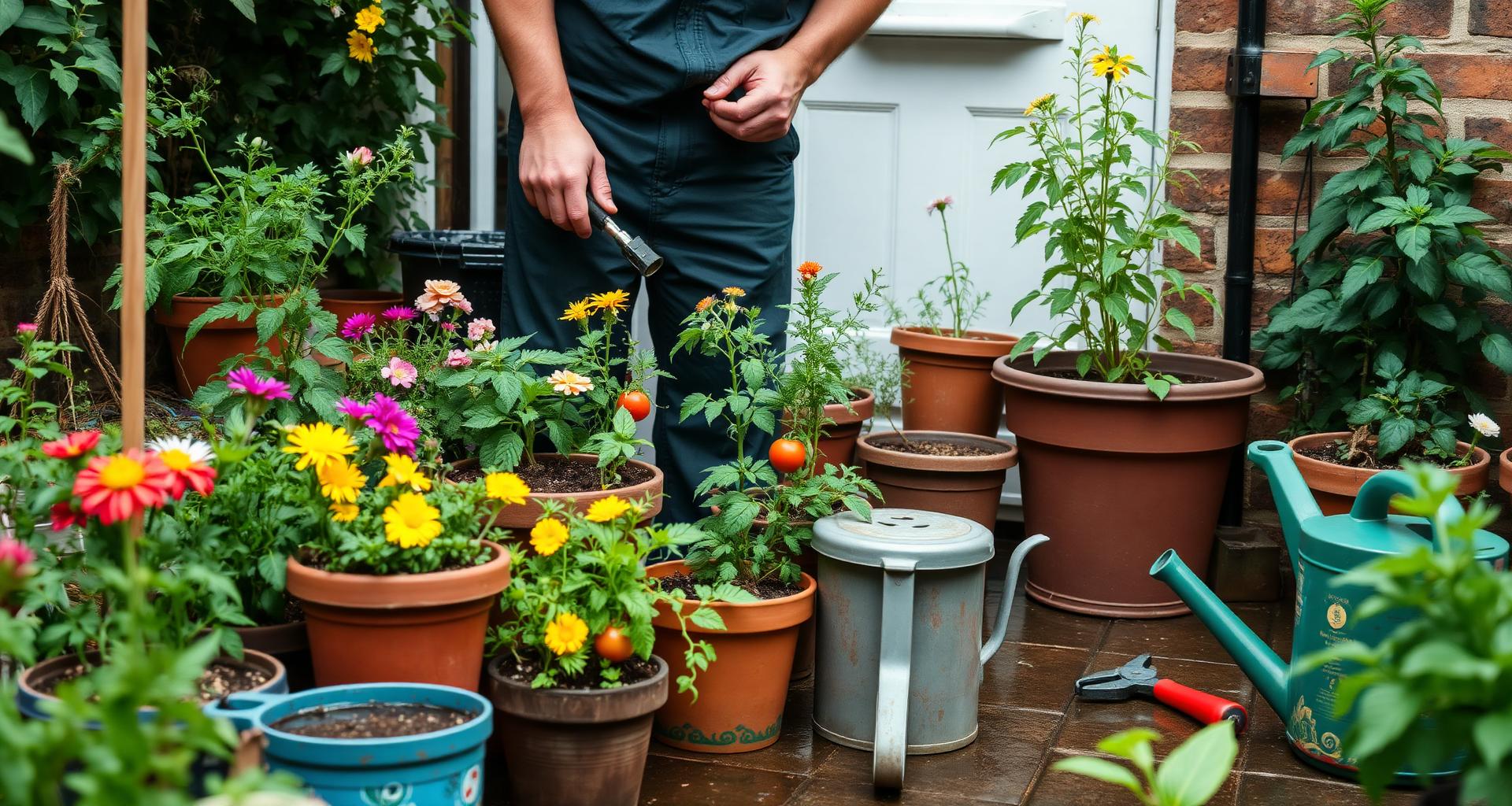
A weekend with actual time to spend
Most of the year, container gardening happens in stolen ten-minute windows: watering before work, deadheading while you're outside with a coffee, noticing something has eaten the lettuce when you're already late for something else.
A long weekend is different. You don't need to spend three days gardening, but it's a useful opportunity to do the jobs that benefit from a proper look rather than another hurried pass with the watering can. And at the end of an unusually dry summer, with wetter conditions returning, there are a few things particularly worth checking.
Here's where we'd spend the time.
1. See what the rain has actually done
Start with the pots themselves. Recent rain doesn't automatically mean every container is adequately watered. Dense foliage can shed water away from the compost, while pots under eaves, balconies or against walls can remain surprisingly dry.
Push a finger a few centimetres into the compost rather than judging it from the surface. If it's still dry underneath, water properly. If it's already moist, leave it alone.
Then check the other extreme. Saucers may have filled with water, and drainage holes that weren't much of a problem during weeks of dry weather suddenly matter again once heavier rain arrives. Make sure water can escape freely and that containers aren't sitting permanently saturated. As covered in our piece on making the most of this rain, one wet spell doesn't instantly reverse what a dry summer has done to a container.
While you're there, look for fresh slug damage too. Damp conditions make slugs and snails much more active. Check soft-leaved plants and seedlings for fresh ragged holes and slime trails, then look underneath pot rims and saucers where slugs may shelter during the day. Our piece on why the slugs are back covers what to do if you find them, and why copper tape, eggshells and grit aren't the answer.
2. Deadhead, but not everything
Anything still flowering deserves a proper look. The RHS recommends continuing to deadhead dahlias, roses, penstemons and bedding plants in August to prolong displays into early autumn. Hanging baskets also benefit from continued deadheading, watering and feeding.
Remove flowers that are genuinely finished, taking the spent bloom and its stalk back to the next suitable leaf or bud where appropriate.
But don't turn this into a scorched-earth exercise. Some plants are better left alone once the flowers fade. Rudbeckias and sunflowers can provide seed for birds. Nigella and honesty develop attractive seedheads. And if there's something you'd like to grow from seed next year, you'll obviously need to let at least some flowers complete the process — we've covered when to deadhead and when to let go in more detail.
The useful question isn't simply "has this flower finished?" It's "what do I want this plant to do next?" If the answer is produce more flowers, deadhead it. If the answer is produce seed, winter structure or food for wildlife, leave it.
3. Take some late-summer cuttings
If propagation has been sitting on your gardening to-do list, this is genuinely good timing. Late August remains within the semi-ripe cutting window for many shrubs; the RHS specifically lists plants including lavender, box and Ceanothus among those that can still be propagated this way now. It also recommends taking cuttings from tender perennials such as pelargoniums and osteospermums during August.
Semi-ripe material is growth produced this year that has begun to firm up at the base while remaining relatively soft towards the tip. Choose healthy, non-flowering shoots where possible, and take more than one cutting rather than putting all your hopes into a single stem.
For tender plants, this has another advantage: a few small rooted cuttings take considerably less room to overwinter than a collection of large mature pots.
Our propagation guide covers the process properly, including where to cut, what compost to use and how to look after cuttings while they establish. This isn't necessarily your last chance of the year, but it is a good one.
4. Harvest what's ready
If you're growing food in containers, don't leave ripe produce hanging around simply because you're waiting for the mythical perfect harvest day. Pick ripe tomatoes. Harvest courgettes before they become marrows. Keep picking beans while they're productive. Cut herbs you're actually going to use. Regular picking can also keep productive plants going.
Tomatoes deserve a little extra attention after a dry period followed by wetter weather. Big fluctuations in water availability can contribute to fruit splitting and other problems, so continue checking the compost rather than assuming rainfall has taken over the job completely. Our guide to looking after tomatoes through the rest of summer goes into more detail. If something is ripe now, though, the simplest solution is usually the best one: pick it and eat it.
5. Clear what is genuinely finished
Some pots will have reached the end. Bolted lettuce, finished early crops and annual displays that are genuinely beyond recovery don't need to occupy valuable container space for another month out of sentiment. Clear them.
But distinguish between finished and merely late-summer tired. A flowering container with plenty of buds may respond to deadheading, feeding and another few weeks of decent weather. A vegetable plant still producing a worthwhile crop doesn't need removing because September is approaching.
If you do empty a pot and want to use it again immediately, assess the compost before planting straight back into it. Old container compost isn't automatically useless, but a hungry crop may have depleted nutrients and the structure may have deteriorated after months of watering, so depending on its condition it may need refreshing with new material or replacing entirely. There's still time for some fast-growing salad crops, particularly in southern Britain, including rocket, radish and suitable lettuces. If you don't intend to replant the container yet, there's no reason to refresh the compost simply so it can sit empty.
6. Give the pots themselves a health check
Now look at the container rather than the plant. Are roots growing heavily through the drainage holes? Does water disappear instantly down a gap between a shrunken rootball and the side of the pot? Is the plant obviously top-heavy for its container? Are drainage holes blocked? Has a terracotta pot cracked?
A long weekend is useful for spotting these things, but spotting a problem doesn't mean everything needs repotting immediately. For permanent container plants, routine repotting is generally better tackled at the appropriate time for the plant rather than automatically at the end of August. If something is healthy but congested, make a note. If it's actively suffering because the container has become unsuitable, that's different — our complete guide to repotting covers what to look for and when to act. The aim this weekend is an MOT, not compulsory surgery.
7. Look for vine weevil
This is probably the most time-sensitive job on the list.
Vine weevil is particularly important for container gardeners because its larvae live in the compost and eat plant roots; serious infestations can cause plants to wilt and eventually die. The adults leave characteristic irregular notches around leaf margins, which is usually more cosmetic than catastrophic, but tells you vine weevils have been around. The larvae are the bigger concern.
Mid to late August is a particularly useful time to act. The RHS recommends applying biological controls for vine weevil in August or early September, while young grubs are present and potting compost is generally warm enough for nematodes to work effectively; treating at this stage can control larvae before they become large enough to cause serious root damage. That doesn't mean treating every container preventively; the RHS specifically advises using nematodes carefully and where there is a particular problem to treat. But if you've noticed suspicious notching, or know vine weevil has been a problem in your pots before, this is worth checking now rather than in November when a plant starts collapsing. Our pests and diseases reference covers the signs to look for.
8. Keep feeding what is still performing
Don't stop feeding simply because August is nearly over. Fast-growing bedding plants, edibles and other hungry container plants benefit from regular feeding through the end of August, with bedding and other short-lived annuals continuing to benefit into early autumn. Current RHS guidance also specifically recommends feeding containers to encourage flowering into early autumn.
So if your dahlias are flowering, tomatoes are cropping, or a summer container display is still going strongly, keep supporting it. Follow the instructions for the fertiliser you're using and feed onto moist compost — our feeding guide explains what the different products actually do.
What you don't need is indiscriminate heavy feeding of every permanent plant on the patio in an attempt to force another burst of growth before autumn. Feed the plants that are still actively doing something. Leave the others alone.
What can wait
The bank holiday doesn't need to become a deadline for turning summer into autumn.
You don't need to clear healthy flowering pots. You don't need to repot every permanent container. You don't need to dismantle a productive tomato plant because September appears on the calendar next week. And you certainly don't need to spend the weekend buying replacements for plants that still look perfectly good.
There are autumn jobs coming. There are spring bulbs to think about. There will be containers to refresh and plants to move as the season changes. But this weekend is mostly about getting another few weeks from what you already have.
Check. Tidy. Harvest. Propagate. Deal with anything genuinely wrong. Then leave the rest of it growing.
FAQ
Is late August too late to take cuttings?
No. Semi-ripe cuttings can still be taken from many shrubs, including lavender, and August is also a useful time to take cuttings from tender perennials such as pelargoniums and osteospermums.
Should I still feed container plants at the end of August?
Yes, where they're still actively flowering or cropping. Fast-growing bedding, edibles and hungry container plants can benefit from feeding through the end of August, with some annual displays continuing into early autumn. Avoid assuming every permanent plant needs feeding simply because you're doing the others.
Should I repot root-bound plants this weekend?
Not automatically. Use the weekend to identify congested or struggling plants. If a plant is healthy, routine repotting can usually wait for a more appropriate time. Intervene now if the container is causing an immediate problem rather than because it's a bank holiday weekend.
Is late August a good time to treat vine weevil?
Yes, if you have a genuine vine weevil problem. The RHS identifies August and early September as particularly useful for nematode treatment, since young larvae are present and temperatures are generally suitable for the biological control to work.
Should I clear summer containers before September?
No. If they're healthy and still flowering or producing food, let them continue. Clear plants when they're genuinely finished, not because the calendar changes month.
RELATED POSTS
- Seasonal
When It Finally Rains, Make It Count
- Plant Problems
Why the Slugs Are Back
- Getting Started
Should You Deadhead, or Let It Go to Seed
Robin is a small-space grower writing for everyone working with a courtyard, balcony, window box, patio or sunny sill. Edible and leafy, both kept alive in the kind of light real small spaces actually get.
✦ Free with the newsletter — the small-space starter sheet
Grow Anywhere — a free weekly email.
The Potted Club newsletter. A short note from Robin — what to sow, one plant problem solved, and the best new guide.
FREE WEEKLY EMAIL · NO SPAM · UNSUBSCRIBE ANYTIME